 Add to Chrome
 Add to Firefox
 Add to Edge
Personality as Relational Infrastructure: User Perceptions of Personality-Trait-Infused LLM Messaging
Feb 06, 2026
Digital behaviour change systems increasingly rely on repeated, system-initiated messages to support users in everyday contexts. LLMs enable these messages to be personalised consistently across interactions, yet it remains unclear whether such personalisation improves individual messages or instead shapes users' perceptions through patterns of exposure. We explore this question in the context of LLM-generated JITAIs, which are short, context-aware messages delivered at moments deemed appropriate to support behaviour change, using physical activity as an application domain. In a controlled retrospective study, 90 participants evaluated messages generated using four LLM strategies: baseline prompting, few-shot prompting, fine-tuned models, and retrieval augmented generation, each implemented with and without Big Five Personality Traits to produce personality-aligned communication across multiple scenarios. Using ordinal multilevel models with within-between decomposition, we distinguish trial-level effects, whether personality information improves evaluations of individual messages, from person-level exposure effects, whether participants receiving higher proportions of personality-informed messages exhibit systematically different overall perceptions. Results showed no trial-level associations, but participants who received higher proportions of BFPT-informed messages rated the messages as more personalised, appropriate, and reported less negative affect. We use Communication Accommodation Theory for post-hoc analysis. These results suggest that personality-based personalisation in behaviour change systems may operate primarily through aggregate exposure rather than per-message optimisation, with implications for how adaptive systems are designed and evaluated in sustained human-AI interaction. In-situ longitudinal studies are needed to validate these findings in real-world contexts.

The Last JITAI? The Unreasonable Effectiveness of Large Language Models in Issuing Just-in-Time Adaptive Interventions: Fostering Physical Activity in a Prospective Cardiac Rehabilitation Setting
Feb 13, 2024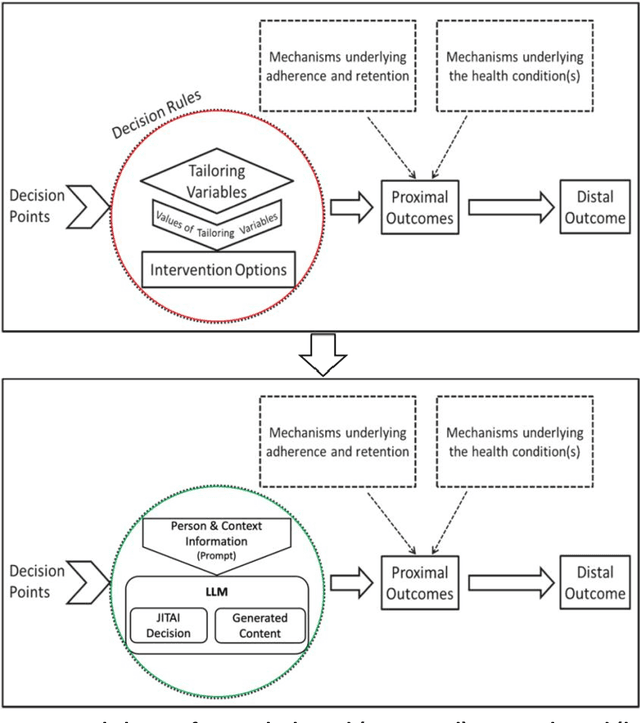
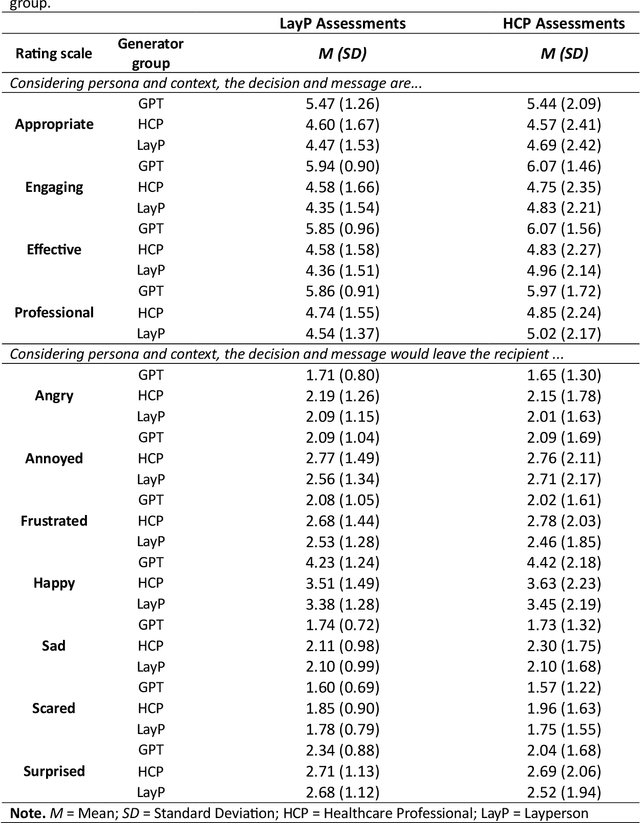
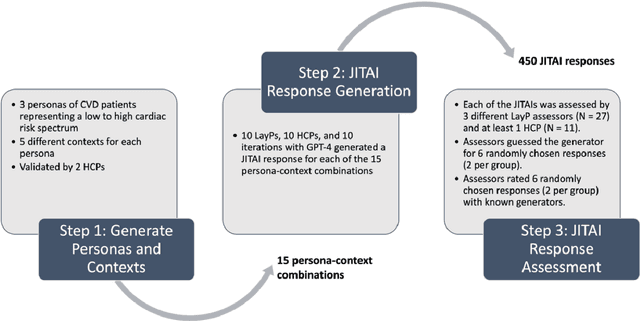
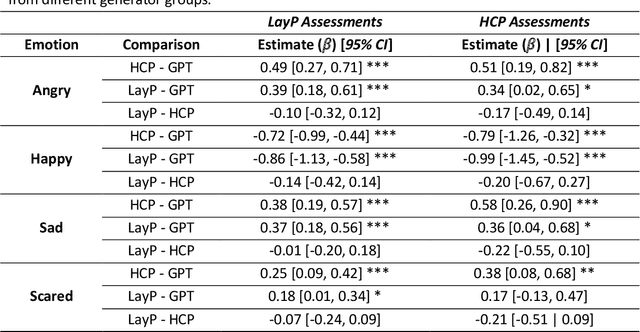
We explored the viability of Large Language Models (LLMs) for triggering and personalizing content for Just-in-Time Adaptive Interventions (JITAIs) in digital health. JITAIs are being explored as a key mechanism for sustainable behavior change, adapting interventions to an individual's current context and needs. However, traditional rule-based and machine learning models for JITAI implementation face scalability and reliability limitations, such as lack of personalization, difficulty in managing multi-parametric systems, and issues with data sparsity. To investigate JITAI implementation via LLMs, we tested the contemporary overall performance-leading model 'GPT-4' with examples grounded in the use case of fostering heart-healthy physical activity in outpatient cardiac rehabilitation. Three personas and five sets of context information per persona were used as a basis of triggering and personalizing JITAIs. Subsequently, we generated a total of 450 proposed JITAI decisions and message content, divided equally into JITAIs generated by 10 iterations with GPT-4, a baseline provided by 10 laypersons (LayPs), and a gold standard set by 10 healthcare professionals (HCPs). Ratings from 27 LayPs indicated that JITAIs generated by GPT-4 were superior to those by HCPs and LayPs over all assessed scales: i.e., appropriateness, engagement, effectiveness, and professionality. This study indicates that LLMs have significant potential for implementing JITAIs as a building block of personalized or "precision" health, offering scalability, effective personalization based on opportunistically sampled information, and good acceptability.