 Add to Chrome
 Add to Firefox
 Add to Edge
Beyond Fact Retrieval: Episodic Memory for RAG with Generative Semantic Workspaces
Nov 10, 2025
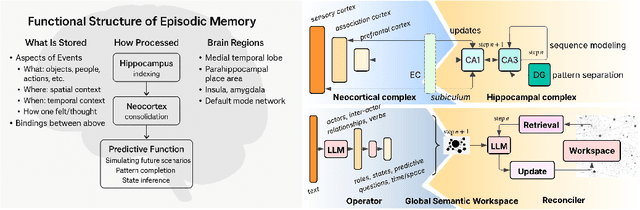
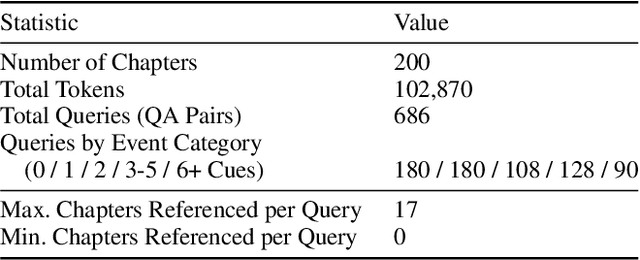
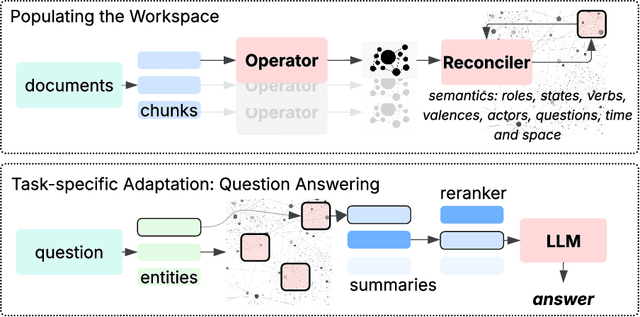
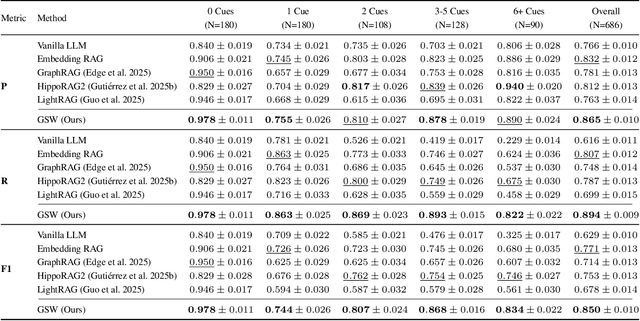
Large Language Models (LLMs) face fundamental challenges in long-context reasoning: many documents exceed their finite context windows, while performance on texts that do fit degrades with sequence length, necessitating their augmentation with external memory frameworks. Current solutions, which have evolved from retrieval using semantic embeddings to more sophisticated structured knowledge graphs representations for improved sense-making and associativity, are tailored for fact-based retrieval and fail to build the space-time-anchored narrative representations required for tracking entities through episodic events. To bridge this gap, we propose the \textbf{Generative Semantic Workspace} (GSW), a neuro-inspired generative memory framework that builds structured, interpretable representations of evolving situations, enabling LLMs to reason over evolving roles, actions, and spatiotemporal contexts. Our framework comprises an \textit{Operator}, which maps incoming observations to intermediate semantic structures, and a \textit{Reconciler}, which integrates these into a persistent workspace that enforces temporal, spatial, and logical coherence. On the Episodic Memory Benchmark (EpBench) \cite{huet_episodic_2025} comprising corpora ranging from 100k to 1M tokens in length, GSW outperforms existing RAG based baselines by up to \textbf{20\%}. Furthermore, GSW is highly efficient, reducing query-time context tokens by \textbf{51\%} compared to the next most token-efficient baseline, reducing inference time costs considerably. More broadly, GSW offers a concrete blueprint for endowing LLMs with human-like episodic memory, paving the way for more capable agents that can reason over long horizons.

Creating an AI Observer: Generative Semantic Workspaces
Jun 07, 2024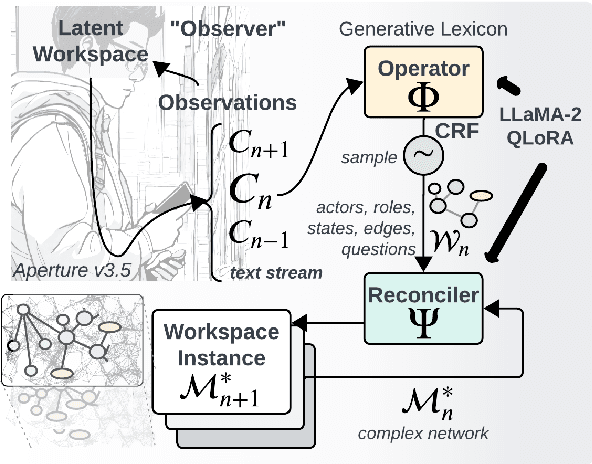

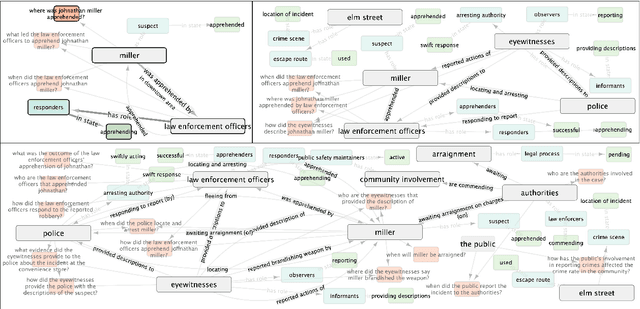

An experienced human Observer reading a document -- such as a crime report -- creates a succinct plot-like $\textit{``Working Memory''}$ comprising different actors, their prototypical roles and states at any point, their evolution over time based on their interactions, and even a map of missing Semantic parts anticipating them in the future. $\textit{An equivalent AI Observer currently does not exist}$. We introduce the $\textbf{[G]}$enerative $\textbf{[S]}$emantic $\textbf{[W]}$orkspace (GSW) -- comprising an $\textit{``Operator''}$ and a $\textit{``Reconciler''}$ -- that leverages advancements in LLMs to create a generative-style Semantic framework, as opposed to a traditionally predefined set of lexicon labels. Given a text segment $C_n$ that describes an ongoing situation, the $\textit{Operator}$ instantiates actor-centric Semantic maps (termed ``Workspace instance'' $\mathcal{W}_n$). The $\textit{Reconciler}$ resolves differences between $\mathcal{W}_n$ and a ``Working memory'' $\mathcal{M}_n^*$ to generate the updated $\mathcal{M}_{n+1}^*$. GSW outperforms well-known baselines on several tasks ($\sim 94\%$ vs. FST, GLEN, BertSRL - multi-sentence Semantics extraction, $\sim 15\%$ vs. NLI-BERT, $\sim 35\%$ vs. QA). By mirroring the real Observer, GSW provides the first step towards Spatial Computing assistants capable of understanding individual intentions and predicting future behavior.