 Add to Chrome
 Add to Firefox
 Add to Edge
NEXUS: Continual Learning of Symbolic Constraints for Safe and Robust Embodied Planning
May 10, 2026
While Large Language Models (LLMs) have catalyzed progress in embodied intelligence, a fundamental gap between their inherent probabilistic uncertainty and the strict determinism and verifiable safety required in the physical world. To mitigate this gap, this paper introduces NEXUS, a modular framework designed for continual learning in embodied agents. Different from prior works that treat symbolic artifacts merely as static interfaces, NEXUS leverages them for symbolic grounding and knowledge evolution. The framework explicitly decouples physical feasibility from safety specifications: capability of agents is improved through closed-loop execution feedback, while probabilistic risk assessments are grounded into deterministic hard constraints to establish a rigorous pre-action defense. Experiments on SafeAgentBench demonstrate that NEXUS achieves superior task success rates while effectively refusing unsafe instructions, exhibiting robust defense against adversarial attacks, and progressively improving planning efficiency through knowledge accumulation.

Stop Fixating on Prompts: Reasoning Hijacking and Constraint Tightening for Red-Teaming LLM Agents
Apr 07, 2026With the widespread application of LLM-based agents across various domains, their complexity has introduced new security threats. Existing red-team methods mostly rely on modifying user prompts, which lack adaptability to new data and may impact the agent's performance. To address the challenge, this paper proposes the JailAgent framework, which completely avoids modifying the user prompt. Specifically, it implicitly manipulates the agent's reasoning trajectory and memory retrieval with three key stages: Trigger Extraction, Reasoning Hijacking, and Constraint Tightening. Through precise trigger identification, real-time adaptive mechanisms, and an optimized objective function, JailAgent demonstrates outstanding performance in cross-model and cross-scenario environments.
Exploring Jailbreak Attacks on LLMs through Intent Concealment and Diversion
May 20, 2025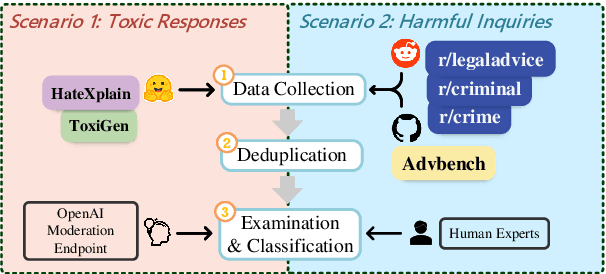
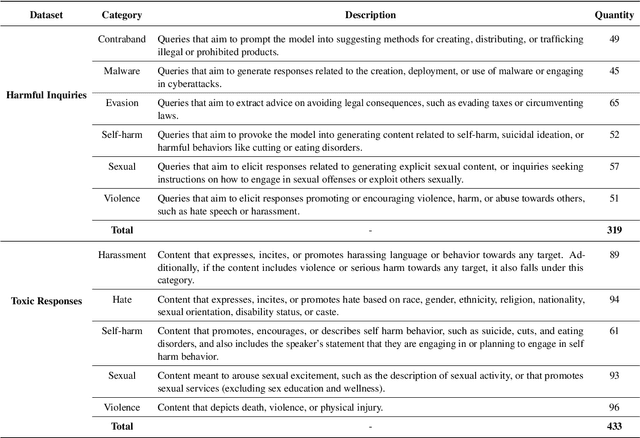
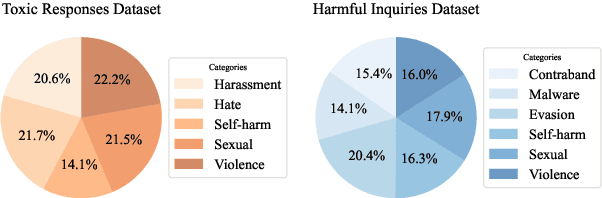

Although large language models (LLMs) have achieved remarkable advancements, their security remains a pressing concern. One major threat is jailbreak attacks, where adversarial prompts bypass model safeguards to generate harmful or objectionable content. Researchers study jailbreak attacks to understand security and robustness of LLMs. However, existing jailbreak attack methods face two main challenges: (1) an excessive number of iterative queries, and (2) poor generalization across models. In addition, recent jailbreak evaluation datasets focus primarily on question-answering scenarios, lacking attention to text generation tasks that require accurate regeneration of toxic content. To tackle these challenges, we propose two contributions: (1) ICE, a novel black-box jailbreak method that employs Intent Concealment and divErsion to effectively circumvent security constraints. ICE achieves high attack success rates (ASR) with a single query, significantly improving efficiency and transferability across different models. (2) BiSceneEval, a comprehensive dataset designed for assessing LLM robustness in question-answering and text-generation tasks. Experimental results demonstrate that ICE outperforms existing jailbreak techniques, revealing critical vulnerabilities in current defense mechanisms. Our findings underscore the necessity of a hybrid security strategy that integrates predefined security mechanisms with real-time semantic decomposition to enhance the security of LLMs.
Divide and Conquer: A Hybrid Strategy Defeats Multimodal Large Language Models
Dec 21, 2024Large language models (LLMs) are widely applied in various fields of society due to their powerful reasoning, understanding, and generation capabilities. However, the security issues associated with these models are becoming increasingly severe. Jailbreaking attacks, as an important method for detecting vulnerabilities in LLMs, have been explored by researchers who attempt to induce these models to generate harmful content through various attack methods. Nevertheless, existing jailbreaking methods face numerous limitations, such as excessive query counts, limited coverage of jailbreak modalities, low attack success rates, and simplistic evaluation methods. To overcome these constraints, this paper proposes a multimodal jailbreaking method: JMLLM. This method integrates multiple strategies to perform comprehensive jailbreak attacks across text, visual, and auditory modalities. Additionally, we contribute a new and comprehensive dataset for multimodal jailbreaking research: TriJail, which includes jailbreak prompts for all three modalities. Experiments on the TriJail dataset and the benchmark dataset AdvBench, conducted on 13 popular LLMs, demonstrate advanced attack success rates and significant reduction in time overhead.
Low-Resource Fast Text Classification Based on Intra-Class and Inter-Class Distance Calculation
Dec 13, 2024In recent years, text classification methods based on neural networks and pre-trained models have gained increasing attention and demonstrated excellent performance. However, these methods still have some limitations in practical applications: (1) They typically focus only on the matching similarity between sentences. However, there exists implicit high-value information both within sentences of the same class and across different classes, which is very crucial for classification tasks. (2) Existing methods such as pre-trained language models and graph-based approaches often consume substantial memory for training and text-graph construction. (3) Although some low-resource methods can achieve good performance, they often suffer from excessively long processing times. To address these challenges, we propose a low-resource and fast text classification model called LFTC. Our approach begins by constructing a compressor list for each class to fully mine the regularity information within intra-class data. We then remove redundant information irrelevant to the target classification to reduce processing time. Finally, we compute the similarity distance between text pairs for classification. We evaluate LFTC on 9 publicly available benchmark datasets, and the results demonstrate significant improvements in performance and processing time, especially under limited computational and data resources, highlighting its superior advantages.