 Add to Chrome
 Add to Firefox
 Add to Edge
Constraint Decay: The Fragility of LLM Agents in Backend Code Generation
May 07, 2026
Large Language Model (LLM) agents demonstrate strong performance in autonomous code generation under loose specifications. However, production-grade software requires strict adherence to structural constraints, such as architectural patterns, databases, and object-relational mappings. Existing benchmarks often overlook these non-functional requirements, rewarding functionally correct but structurally arbitrary solutions. We present a systematic study evaluating how well agents handle structural constraints in multi-file backend generation. By fixing a unified API contract across 80 greenfield generation tasks and 20 feature-implementation tasks spanning eight web frameworks, we isolate the effect of structural complexity using a dual evaluation with end-to-end behavioral tests and static verifiers. Our findings reveal a phenomenon of constraint decay: as structural requirements accumulate, agent performance exhibits a substantial decline. Capable configurations lose 30 points on average in assertion pass rates from baseline to fully specified tasks, while some weaker configurations approach zero. Framework sensitivity analysis exposes significant performance disparities: agents succeed in minimal, explicit frameworks (e.g., Flask) but perform substantially worse on average in convention-heavy environments (e.g., FastAPI, Django). Finally, error analysis identifies data-layer defects (e.g., incorrect query composition and ORM runtime violations) as the leading root causes. This work highlights that jointly satisfying functional and structural requirements remains a key open challenge for coding agents.

RelationalFactQA: A Benchmark for Evaluating Tabular Fact Retrieval from Large Language Models
May 27, 2025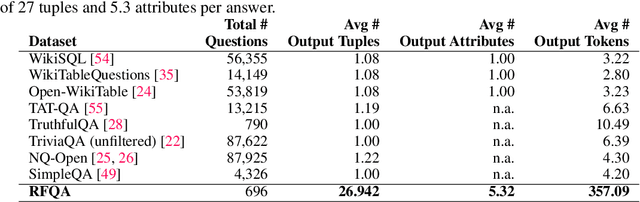
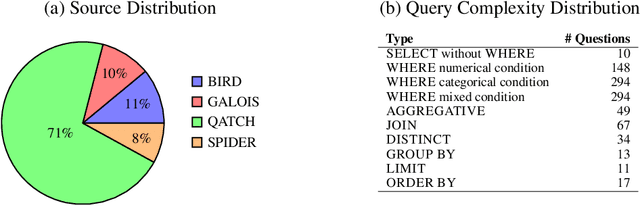
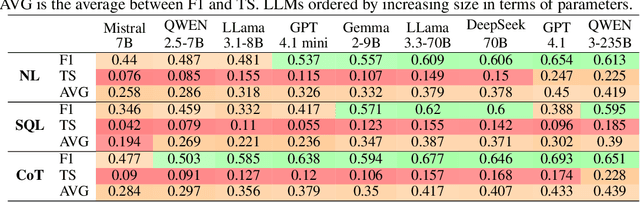
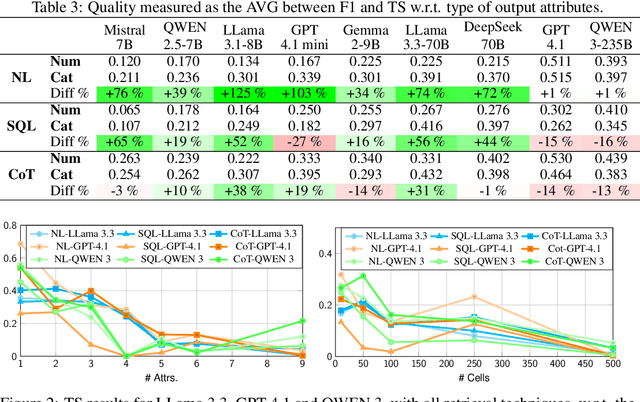
Factuality in Large Language Models (LLMs) is a persistent challenge. Current benchmarks often assess short factual answers, overlooking the critical ability to generate structured, multi-record tabular outputs from parametric knowledge. We demonstrate that this relational fact retrieval is substantially more difficult than isolated point-wise queries, even when individual facts are known to the model, exposing distinct failure modes sensitive to output dimensionality (e.g., number of attributes or records). To systematically evaluate this under-explored capability, we introduce RelationalFactQA, a new benchmark featuring diverse natural language questions (paired with SQL) and gold-standard tabular answers, specifically designed to assess knowledge retrieval in a structured format. RelationalFactQA enables analysis across varying query complexities, output sizes, and data characteristics. Our experiments reveal that even state-of-the-art LLMs struggle significantly, not exceeding 25% factual accuracy in generating relational outputs, with performance notably degrading as output dimensionality increases. These findings underscore critical limitations in current LLMs' ability to synthesize structured factual knowledge and establish RelationalFactQA as a crucial resource for measuring future progress in LLM factuality.