 Add to Chrome
 Add to Firefox
 Add to Edge
The bistable brain: a neuronal model with symbiotic interactions
Aug 01, 2012


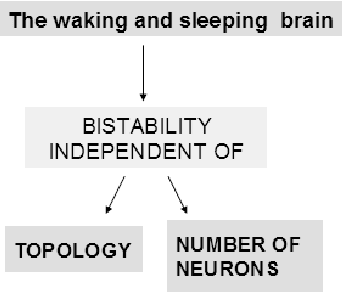

In general, the behavior of large and complex aggregates of elementary components can not be understood nor extrapolated from the properties of a few components. The brain is a good example of this type of networked systems where some patterns of behavior are observed independently of the topology and of the number of coupled units. Following this insight, we have studied the dynamics of different aggregates of logistic maps according to a particular {\it symbiotic} coupling scheme that imitates the neuronal excitation coupling. All these aggregates show some common dynamical properties, concretely a bistable behavior that is reported here with a certain detail. Thus, the qualitative relationship with neural systems is suggested through a naive model of many of such networked logistic maps whose behavior mimics the waking-sleeping bistability displayed by brain systems. Due to its relevance, some regions of multistability are determined and sketched for all these logistic models.

Bistability: a common feature in some "aggregates" of logistic maps
Feb 01, 2007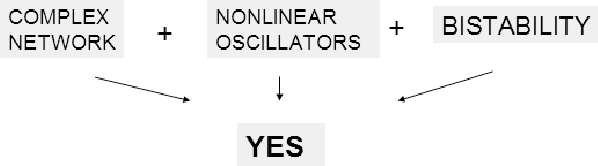


As it was argued by Anderson [Science 177, 393 (1972)], the "reductionist" hypothesis does not by any means imply a "constructionist" one. Hence, in general, the behavior of large and complex aggregates of elementary components can not be understood nor extrapolated from the properties of a few components. Following this insight, we have simulated different "aggregates" of logistic maps according to a particular coupling scheme. All these aggregates show a similar pattern of dynamical properties, concretely a bistable behavior, that is also found in a network of many units of the same type, independently of the number of components and of the interconnection topology. A qualitative relationship with brain-like systems is suggested.