 Add to Chrome
 Add to Firefox
 Add to Edge
Protein Circuit Tracing via Cross-layer Transcoders
Feb 12, 2026
Protein language models (pLMs) have emerged as powerful predictors of protein structure and function. However, the computational circuits underlying their predictions remain poorly understood. Recent mechanistic interpretability methods decompose pLM representations into interpretable features, but they treat each layer independently and thus fail to capture cross-layer computation, limiting their ability to approximate the full model. We introduce ProtoMech, a framework for discovering computational circuits in pLMs using cross-layer transcoders that learn sparse latent representations jointly across layers to capture the model's full computational circuitry. Applied to the pLM ESM2, ProtoMech recovers 82-89% of the original performance on protein family classification and function prediction tasks. ProtoMech then identifies compressed circuits that use <1% of the latent space while retaining up to 79% of model accuracy, revealing correspondence with structural and functional motifs, including binding, signaling, and stability. Steering along these circuits enables high-fitness protein design, surpassing baseline methods in more than 70% of cases. These results establish ProtoMech as a principled framework for protein circuit tracing.

cryoSENSE: Compressive Sensing Enables High-throughput Microscopy with Sparse and Generative Priors on the Protein Cryo-EM Image Manifold
Nov 18, 2025
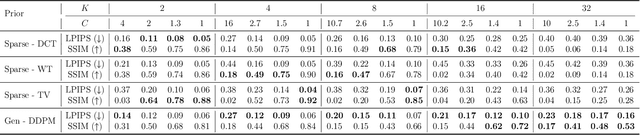
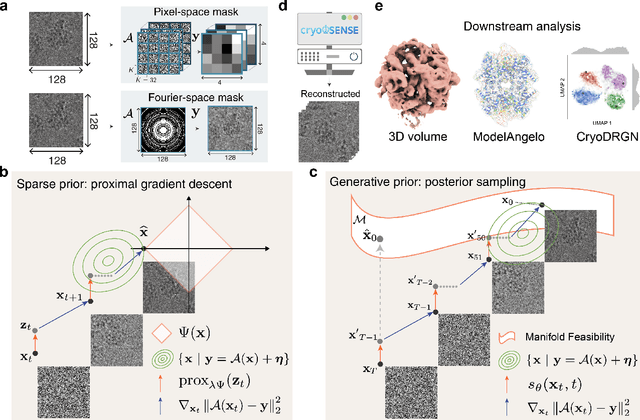
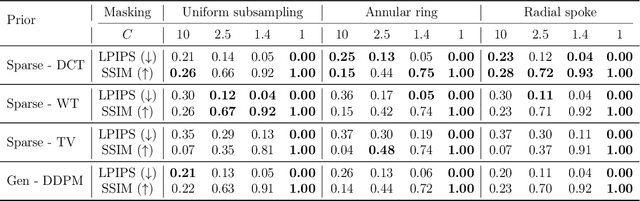
Cryo-electron microscopy (cryo-EM) enables the atomic-resolution visualization of biomolecules; however, modern direct detectors generate data volumes that far exceed the available storage and transfer bandwidth, thereby constraining practical throughput. We introduce cryoSENSE, the computational realization of a hardware-software co-designed framework for compressive cryo-EM sensing and acquisition. We show that cryo-EM images of proteins lie on low-dimensional manifolds that can be independently represented using sparse priors in predefined bases and generative priors captured by a denoising diffusion model. cryoSENSE leverages these low-dimensional manifolds to enable faithful image reconstruction from spatial and Fourier-domain undersampled measurements while preserving downstream structural resolution. In experiments, cryoSENSE increases acquisition throughput by up to 2.5$\times$ while retaining the original 3D resolution, offering controllable trade-offs between the number of masked measurements and the level of downsampling. Sparse priors favor faithful reconstruction from Fourier-domain measurements and moderate compression, whereas generative diffusion priors achieve accurate recovery from pixel-domain measurements and more severe undersampling. Project website: https://cryosense.github.io.
AstroAgents: A Multi-Agent AI for Hypothesis Generation from Mass Spectrometry Data
Mar 29, 2025With upcoming sample return missions across the solar system and the increasing availability of mass spectrometry data, there is an urgent need for methods that analyze such data within the context of existing astrobiology literature and generate plausible hypotheses regarding the emergence of life on Earth. Hypothesis generation from mass spectrometry data is challenging due to factors such as environmental contaminants, the complexity of spectral peaks, and difficulties in cross-matching these peaks with prior studies. To address these challenges, we introduce AstroAgents, a large language model-based, multi-agent AI system for hypothesis generation from mass spectrometry data. AstroAgents is structured around eight collaborative agents: a data analyst, a planner, three domain scientists, an accumulator, a literature reviewer, and a critic. The system processes mass spectrometry data alongside user-provided research papers. The data analyst interprets the data, and the planner delegates specific segments to the scientist agents for in-depth exploration. The accumulator then collects and deduplicates the generated hypotheses, and the literature reviewer identifies relevant literature using Semantic Scholar. The critic evaluates the hypotheses, offering rigorous suggestions for improvement. To assess AstroAgents, an astrobiology expert evaluated the novelty and plausibility of more than a hundred hypotheses generated from data obtained from eight meteorites and ten soil samples. Of these hypotheses, 36% were identified as plausible, and among those, 66% were novel. Project website: https://astroagents.github.io/