 Add to Chrome
 Add to Firefox
 Add to Edge
A Universal Dense Football Event Representation Based on TabTransformer
Jun 08, 2026
Football event data constitute a rich spatiotemporal source for quantitative analysis of player actions in team sports. These datasets contain heterogeneous features, combining continuous location coordinates with categorical variables such as action type, action outcome, and body part. Such data have been applied in sports analytics for match outcome forecasting, player evaluation, and tactical pattern recognition. However, existing approaches predominantly encode categorical features using one-hot or ordinal embedding representations, overlooking the intrinsic semantics of action descriptors. The Transformer is a deep neural network architecture based on self-attention that captures dependencies between input features at arbitrary positions. We propose and implement a Transformer-based model to learn latent dependencies among categorical event features and produce dense representations of football events. By encoding categorical features as learned embedding vectors, sport-specific action semantics are captured during pretraining, enabling the representations to support downstream tasks such as action value estimation and play style recognition. Empirical evaluation shows that the embedding representations yield superior probability calibration over task-specific baselines on the downstream prediction tasks, as measured by Brier score.

Extraction of Positional Player Data from Broadcast Soccer Videos
Oct 21, 2021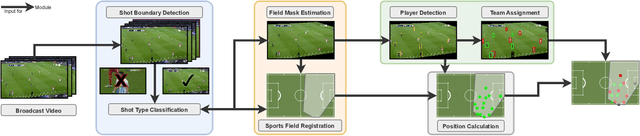
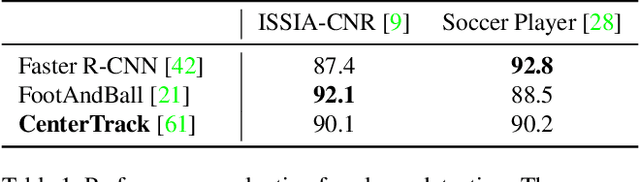
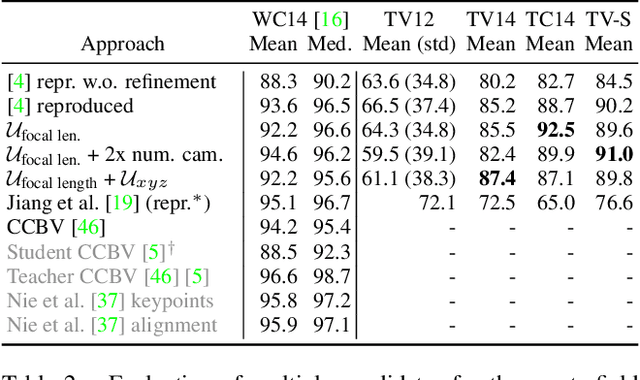
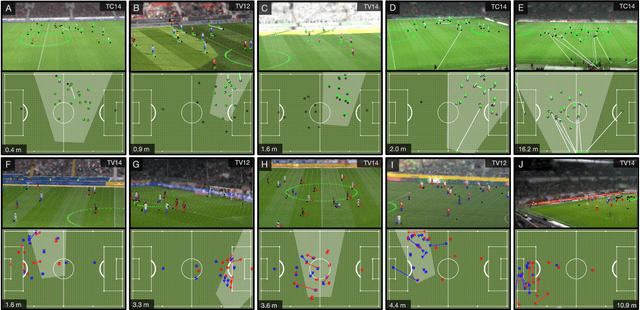
Computer-aided support and analysis are becoming increasingly important in the modern world of sports. The scouting of potential prospective players, performance as well as match analysis, and the monitoring of training programs rely more and more on data-driven technologies to ensure success. Therefore, many approaches require large amounts of data, which are, however, not easy to obtain in general. In this paper, we propose a pipeline for the fully-automated extraction of positional data from broadcast video recordings of soccer matches. In contrast to previous work, the system integrates all necessary sub-tasks like sports field registration, player detection, or team assignment that are crucial for player position estimation. The quality of the modules and the entire system is interdependent. A comprehensive experimental evaluation is presented for the individual modules as well as the entire pipeline to identify the influence of errors to subsequent modules and the overall result. In this context, we propose novel evaluation metrics to compare the output with ground-truth positional data.
A Unified Taxonomy and Multimodal Dataset for Events in Invasion Games
Aug 26, 2021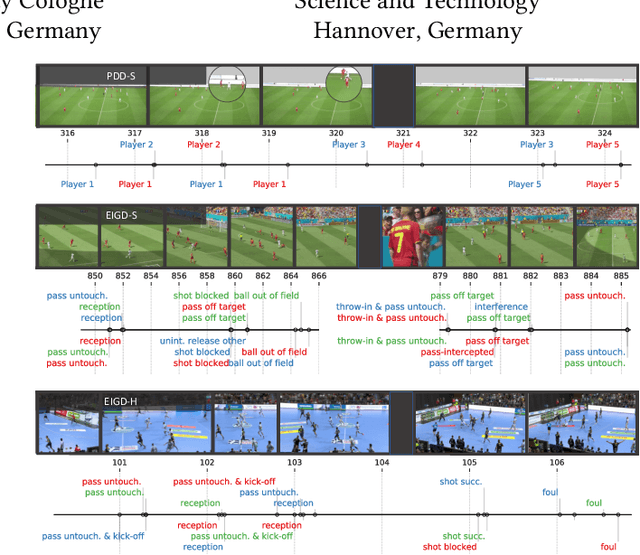
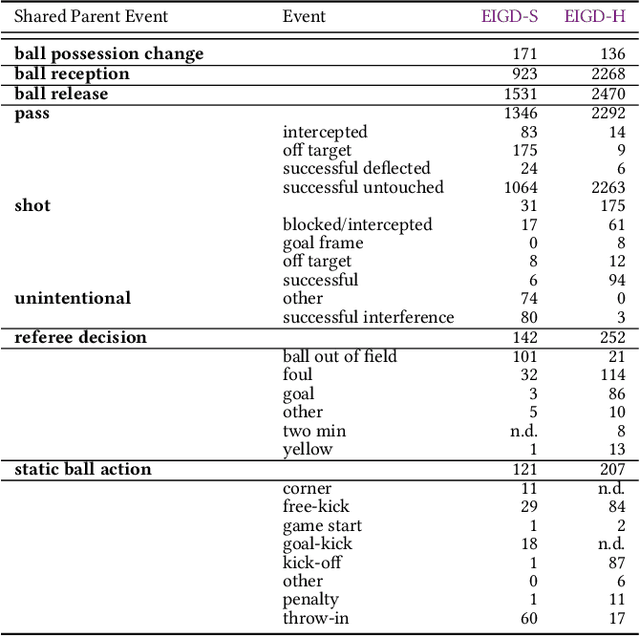
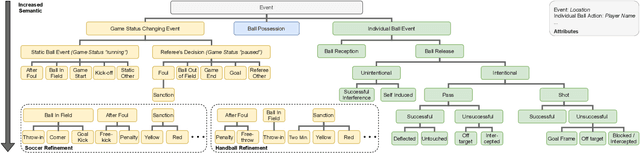
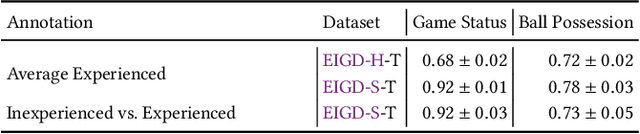
The automatic detection of events in complex sports games like soccer and handball using positional or video data is of large interest in research and industry. One requirement is a fundamental understanding of underlying concepts, i.e., events that occur on the pitch. Previous work often deals only with so-called low-level events based on well-defined rules such as free kicks, free throws, or goals. High-level events, such as passes, are less frequently approached due to a lack of consistent definitions. This introduces a level of ambiguity that necessities careful validation when regarding event annotations. Yet, this validation step is usually neglected as the majority of studies adopt annotations from commercial providers on private datasets of unknown quality and focuses on soccer only. To address these issues, we present (1) a universal taxonomy that covers a wide range of low and high-level events for invasion games and is exemplarily refined to soccer and handball, and (2) release two multi-modal datasets comprising video and positional data with gold-standard annotations to foster research in fine-grained and ball-centered event spotting. Experiments on human performance demonstrate the robustness of the proposed taxonomy, and that disagreements and ambiguities in the annotation increase with the complexity of the event. An I3D model for video classification is adopted for event spotting and reveals the potential for benchmarking. Datasets are available at: https://github.com/mm4spa/eigd