 Add to Chrome
 Add to Firefox
 Add to Edge
Active Localization of Unstable Systems with Coarse Information
Feb 05, 2026
We study localization and control for unstable systems under coarse, single-bit sensing. Motivated by understanding the fundamental limitations imposed by such minimal feedback, we identify sufficient conditions under which the initial state can be recovered despite instability and extremely sparse measurements. Building on these conditions, we develop an active localization algorithm that integrates a set-based estimator with a control strategy derived from Voronoi partitions, which provably estimates the initial state while ensuring the agent remains in informative regions. Under the derived conditions, the proposed approach guarantees exponential contraction of the initial-state uncertainty, and the result is further supported by numerical experiments. These findings can offer theoretical insight into localization in robotics, where sensing is often limited to coarse abstractions such as keyframes, segmentations, or line-based features.

Robust signal decompositions on the circle
Jul 09, 2025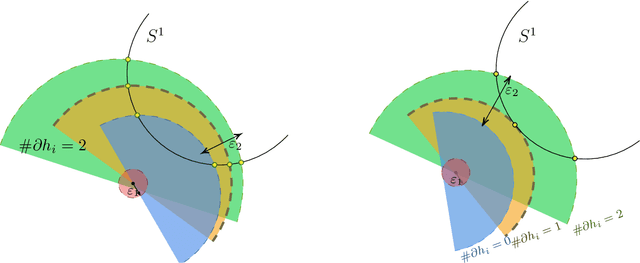
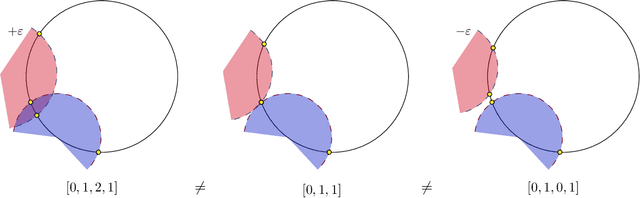
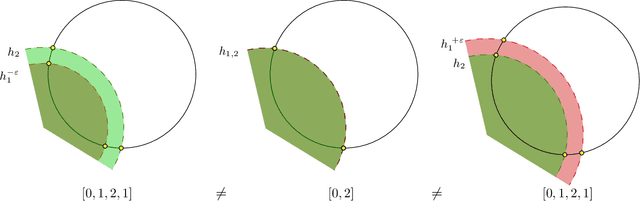
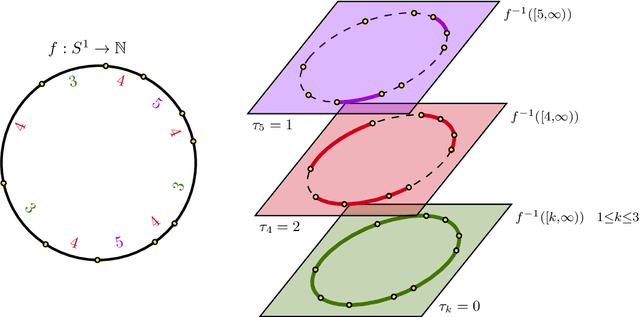
We consider the problem of decomposing a piecewise constant function on the circle into a sum of indicator functions of closed circular disks in the plane, whose number and location are not a priori known. This represents a situation where an agent moving on the circle is able to sense its proximity to some landmarks, and the goal is to estimate the number of these landmarks and their possible locations -- which can in turn enable control tasks such as motion planning and obstacle avoidance. Moreover, the exact values of the function at its discontinuities (which correspond to disk boundaries for the individual indicator functions) are not assumed to be known to the agent. We introduce suitable notions of robustness and degrees of freedom to single out those decompositions that are more desirable, or more likely, given this non-precise data collected by the agent. We provide a characterization of robust decompositions and give a procedure for generating all such decompositions. When the given function admits a robust decomposition, we compute the number of possible robust decompositions and derive bounds for the number of decompositions maximizing the degrees of freedom.