 Add to Chrome
 Add to Firefox
 Add to Edge
GSC-QEMit: A Telemetry-Driven Hierarchical Forecast-and-Bandit Framework for Adaptive Quantum Error Mitigation
Apr 27, 2026
Quantum error mitigation (QEM) is essential for extracting reliable results from near-term quantum devices, yet practical deployments must balance mitigation strength against runtime overhead under time-varying noise. We introduce \emph{GSC-QEMit}, a telemetry-driven, \textbf{context--forecast--bandit} framework for \emph{adaptive} mitigation that switches between lightweight suppression and heavier intervention as drift evolves. GSC-QEMit composes three coupled modules: (G) a Growing Hierarchical Self-Organizing Map (GHSOM) that clusters streaming telemetry into operating contexts; (S) an uncertainty-aware subsampled Gaussian-process forecaster that predicts short-horizon fidelity degradation; and (C) a cost-aware contextual multi-armed bandit (CMAB) that selects mitigation actions via Thompson sampling with explicit intervention cost. We evaluate GSC-QEMit on benchmark circuit families (GHZ, Quantum Fourier Transform, and Grover search) under nonstationary noise regimes simulated in Qiskit Aer, using an instrumented testbed where action labels correspond to graded mitigation intensity. Across Clifford, non-Clifford, and structured workloads, GSC-QEMit improves average logical fidelity by \textbf{+9.0\%} relative to unmitigated execution while reducing unnecessary heavy interventions by reserving them for inferred noise spikes. The resulting policies exhibit a favorable fidelity--cost trade-off and transfer across the evaluated workloads without circuit-specific tuning.

Investigating Quantum Circuit Designs Using Neuro-Evolution
Feb 03, 2026Designing effective quantum circuits remains a central challenge in quantum computing, as circuit structure strongly influences expressivity, trainability, and hardware feasibility. Current approaches, whether using manually designed circuit templates, fixed heuristics, or automated rules, face limitations in scalability, flexibility, and adaptability, often producing circuits that are poorly matched to the specific problem or quantum hardware. In this work, we propose the Evolutionary eXploration of Augmenting Quantum Circuits (EXAQC), an evolutionary approach to the automated design and training of parameterized quantum circuits (PQCs) which leverages and extends on strategies from neuroevolution and genetic programming. The proposed method jointly searches over gate types, qubit connectivity, parameterization, and circuit depth while respecting hardware and noise constraints. The method supports both Qiskit and Pennylane libraries, allowing the user to configure every aspect. This work highlights evolutionary search as a critical tool for advancing quantum machine learning and variational quantum algorithms, providing a principled pathway toward scalable, problem-aware, and hardware-efficient quantum circuit design. Preliminary results demonstrate that circuits evolved on classification tasks are able to achieve over 90% accuracy on most of the benchmark datasets with a limited computational budget, and are able to emulate target circuit quantum states with high fidelity scores.
Neuroevolutionary Transfer Learning of Deep Recurrent Neural Networks through Network-Aware Adaptation
Jun 04, 2020
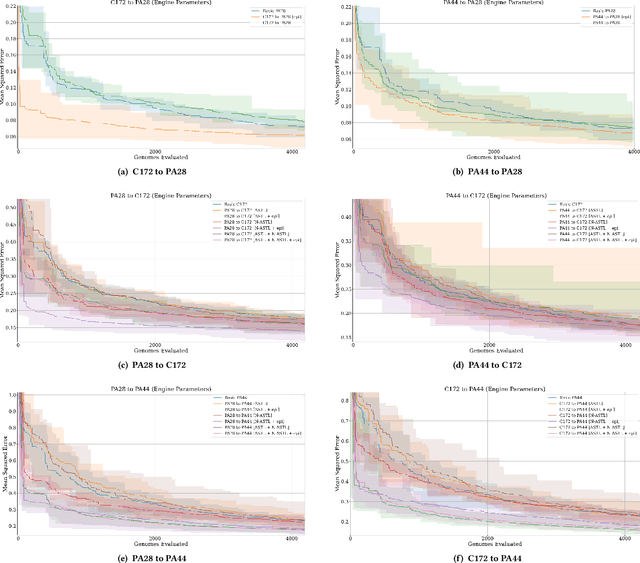
Transfer learning entails taking an artificial neural network (ANN) that is trained on a source dataset and adapting it to a new target dataset. While this has been shown to be quite powerful, its use has generally been restricted by architectural constraints. Previously, in order to reuse and adapt an ANN's internal weights and structure, the underlying topology of the ANN being transferred across tasks must remain mostly the same while a new output layer is attached, discarding the old output layer's weights. This work introduces network-aware adaptive structure transfer learning (N-ASTL), an advancement over prior efforts to remove this restriction. N-ASTL utilizes statistical information related to the source network's topology and weight distribution in order to inform how new input and output neurons are to be integrated into the existing structure. Results show improvements over prior state-of-the-art, including the ability to transfer in challenging real-world datasets not previously possible and improved generalization over RNNs trained without transfer.