 Add to Chrome
 Add to Firefox
 Add to Edge
Path planning for unmanned naval surface vehicles
Jul 02, 2026
There nowadays is a myriad of approaches to real-time avoidance of fixed obstacles for unmanned surface vehicles (USVs) and, to a lesser extent, also the task of avoiding moving obstacles such as boats, ships, swimmers, and other USVs, but both topics still present challenges. This paper offers novel approaches to both of these problems. It uses a combination of a global path planner, which finds a path from a start point to a goal point that avoids fixed obstacles (given that their locations are known in advance), and a local path planner, which can circumnavigate a moving obstacle (as well as any previously unknown fixed obstacles). The global planner is novel in that it employs a combination of three path planners, one known in the literature as Grassfire, one that is a new modification of Grassfire, and one that is a new, and arguably more intuitive, version of the well-known Probabilistic Roadmap. The local planner is novel in that it employs a higher-level decision logic based on its observations regarding the direction of movement of the obstacle relative to the USVs global path. This logic enables the USV to determine the best strategy for avoiding the obstacle by systematically routing the vehicle behind the obstacle rather than running parallel to it until the opportunity to pass appears. Simulations are provided that validate these claims. For comparison with other systems, the simulations include an implementation of the well-known D* algorithm, and the discussion covers additional dynamic path planning systems, which, like D*, do not necessarily route the vehicle behind the moving obstacle.

Nonmonotonic Reasoning as a Temporal Activity
Apr 28, 2014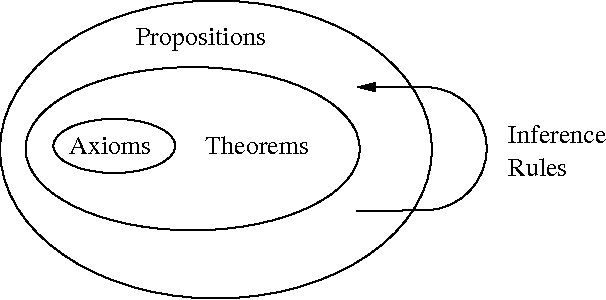

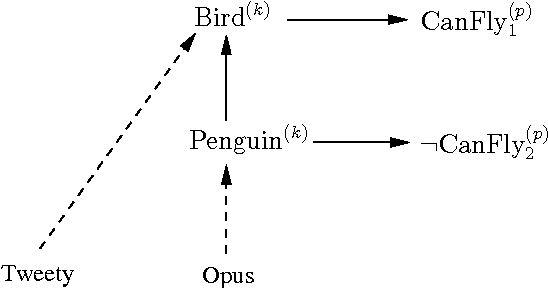
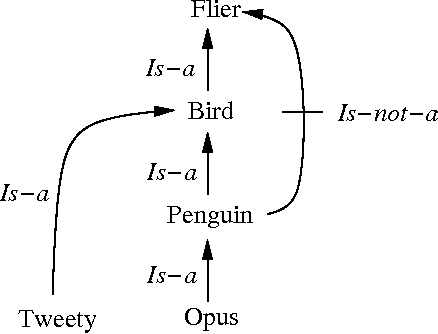
A {\it dynamic reasoning system} (DRS) is an adaptation of a conventional formal logical system that explicitly portrays reasoning as a temporal activity, with each extralogical input to the system and each inference rule application being viewed as occurring at a distinct time step. Every DRS incorporates some well-defined logic together with a controller that serves to guide the reasoning process in response to user inputs. Logics are generic, whereas controllers are application-specific. Every controller does, nonetheless, provide an algorithm for nonmonotonic belief revision. The general notion of a DRS comprises a framework within which one can formulate the logic and algorithms for a given application and prove that the algorithms are correct, i.e., that they serve to (i) derive all salient information and (ii) preserve the consistency of the belief set. This paper illustrates the idea with ordinary first-order predicate calculus, suitably modified for the present purpose, and an example. The example revisits some classic nonmonotonic reasoning puzzles (Opus the Penguin, Nixon Diamond) and shows how these can be resolved in the context of a DRS, using an expanded version of first-order logic that incorporates typed predicate symbols. All concepts are rigorously defined and effectively computable, thereby providing the foundation for a future software implementation.
Dynamic Reasoning Systems
Aug 25, 2013


A {\it dynamic reasoning system} (DRS) is an adaptation of a conventional formal logical system that explicitly portrays reasoning as a temporal activity, with each extralogical input to the system and each inference rule application being viewed as occurring at a distinct time step. Every DRS incorporates some well-defined logic together with a controller that serves to guide the reasoning process in response to user inputs. Logics are generic, whereas controllers are application-specific. Every controller does, nonetheless, provide an algorithm for nonmonotonic belief revision. The general notion of a DRS comprises a framework within which one can formulate the logic and algorithms for a given application and prove that the algorithms are correct, i.e., that they serve to (i) derive all salient information and (ii) preserve the consistency of the belief set. This paper illustrates the idea with ordinary first-order predicate calculus, suitably modified for the present purpose, and two examples. The latter example revisits some classic nonmonotonic reasoning puzzles (Opus the Penguin, Nixon Diamond) and shows how these can be resolved in the context of a DRS, using an expanded version of first-order logic that incorporates typed predicate symbols. All concepts are rigorously defined and effectively computable, thereby providing the foundation for a future software implementation.