 Add to Chrome
 Add to Firefox
 Add to Edge
Joint Channel and Symbol Estimation for RIS-Assisted Fluid Antenna Systems
May 29, 2026
This paper addresses joint channel and symbol estimation in reconfigurable intelligent surface (RIS)-aided multiuser uplink systems with fluid antennas (FAs) at the base station. We propose the Nested Tucker for Fluid Antenna Systems (NTFAS) protocol, in which FA port selection and user-dependent coding vary across blocks while the transmitted symbol matrix is shared across observations. This structure yields coupled Tucker models with common channel and data factors. A two-stage semi-blind bilinear alternating least squares (BALS) receiver is then developed to estimate the cascaded channel and symbols, and to separate the user-to-RIS and RIS-to-BS channels through the embedded PARAFAC structure. Simulations show that NTFAS improves cascaded-channel NMSE and spectral efficiency (SE) with respect to a competing semi-blind benchmark, while maintaining comparable BER performance.

Channel Estimation for Movable Intelligent Surface
May 29, 2026This paper proposes a tensor-based channel estimation framework for an uplink MIMO system assisted by a movable intelligent surface. The considered architecture combines a fixed transmissive metasurface with a smaller movable layer, whose discrete positions create an additional structured training dimension. By jointly exploiting fixed-layer phase patterns and movable-layer positions, the received pilots are modeled as a fourth-order PARAFAC tensor. A trilinear alternating least-squares receiver is then derived to estimate the individual channels and the position-dependent response. Importantly, the proposed method does not require prior knowledge of the movable-layer phase response at the receiver, since this unknown factor is estimated from the tensor structure of the received signal. Simulation results show that increasing the training length improves the NMSE of the estimated factors and the reconstructed cascaded channel.
Circuit-Based Modeling Approach for Channel Estimation in RIS-Assisted Communications
Jun 08, 2025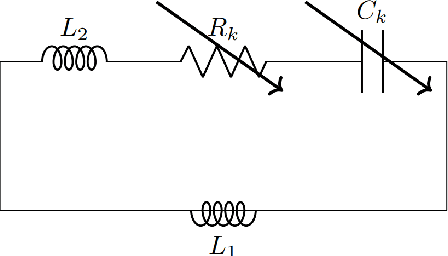
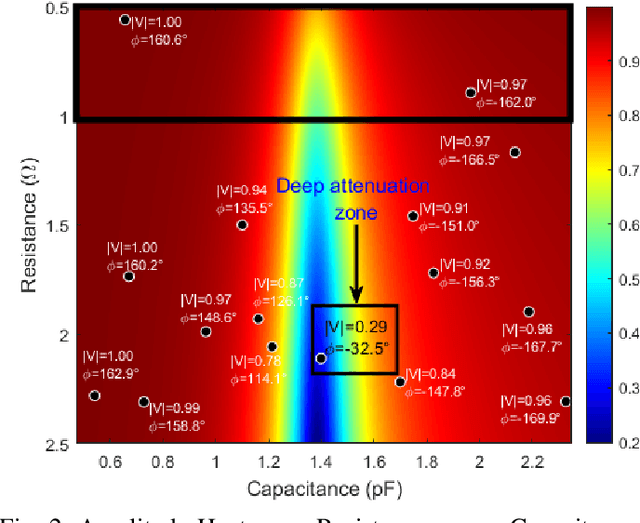
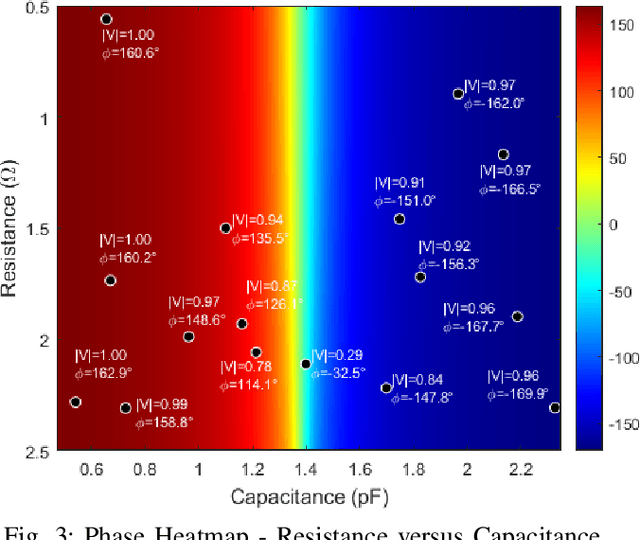
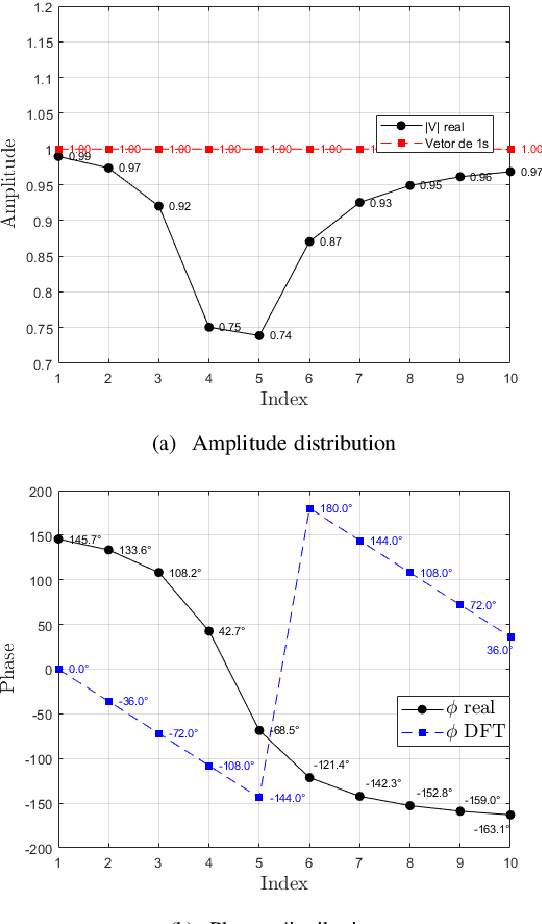
Reconfigurable intelligent surface (RIS) has been explored as a supportive technology for wireless communication since around 2019. While the literature highlights the potential of RIS in different modern applications, two key issues have gained significant attention from the research community: channel estimation and phase shift optimization. The performance gains of RIS-assisted systems rely heavily on optimal phase shifts, which, in turn, depend on accurate channel estimation. Several studies have addressed these challenges under different assumptions. Some works consider a range of continuous phase shifts, while others propose a limited number of discrete phase values for the RIS elements. Many studies present an idealized perspective, whereas others aim to approximate more practical aspects by considering circuit system responses and employing phase shifts derived from a Discrete Fourier Transform (DFT) or other lookup tables. However, to our knowledge, no study has examined the influence of circuit system parameters on channel estimation and subsequent phase shift optimization. This paper models each RIS element as an equivalent resonant circuit composed of resistance, capacitance, and inductance. We propose that resistance and capacitance parameters can be dynamically and independently configured, leading to the formulation of an impedance matrix. Furthermore, we construct a circuit-based RIS phase shift matrix that accounts for the response of the resonant circuit, which changes with variations in the physical parameters of resistance and capacitance. We investigate the impact of this circuit-based RIS phase shift within a tensor-based channel estimation approach. Our results indicate a performance loss compared to ideal scenarios, such as those using the DFT design. However, we found that increasing the training time can mitigate this performance degradation.