 Add to Chrome
 Add to Firefox
 Add to Edge
Strategy-first synthesis planning for complex natural products
Aug 07, 2026
The total synthesis of a complex molecule is among the most demanding intellectual and experimental feats in chemistry: a chemist must plan many steps ahead for how to assemble simple building blocks into an intricate target, devise backup strategies, and anticipate procedural challenges. It is also a profoundly creative activity. For half a century, efforts to automate the retrosynthetic design of natural products and other complex molecules have drawn on catalogued reactions, and the resulting tools now report near-complete success on benchmarks built from that same source. But these tools were shaped to fit benchmarked chemistry, and they falter on many natural products, the frontier of the field, whose densely functionalized, polycyclic architectures demand precisely the inventive chemistry the record contains least. Whether a machine could reasonably design such syntheses like an expert chemist does has remained unclear. Here, we show that SynthEx, an agentic framework built on large language models, plans routes to complex natural products that lie beyond the reach of conventional design algorithms. SynthEx proposes competing strategies, assembles a sequence of routine and key steps into a cohesive route, and critiques and improves its own design; the chemistry it favours is more convergent than existing tools produce, and spans a region of reaction space that catalogue-based tools cannot match. Most notably, in blinded assessments, expert chemists judged its key steps comparable to those of published human syntheses and engaged with them as genuine synthesis plans, a response algorithmic route prediction has not previously accomplished. We release routes to more than a thousand natural products as SynthAtlas, an open, interactive database, and anticipate it will become a shared resource for a collection of complex target molecules that lack existing literature routes.

Agentic generation of verifiable rules for deterministic, self-expanding reaction classification
Jul 01, 2026Computer-assisted synthesis planning breaks target molecules into accessible precursors using large libraries of reaction rules that assign each transformation a deterministic, interpretable label. But chemistry is long-tailed, making manual encoding intractable, and existing tools rely on fixed rulesets that cannot adapt to new chemistries. Here we present a fully automated pipeline in which a multi-agent framework of large language models (LLMs) classifies reactions and writes the rules themselves across 665,901 US patent reactions, generating each rule under a verification loop that tests it against the corpus. It expands a standard taxonomy from 68 to 14,073 classes without human curation. With a lightweight fingerprint classifier, it classifies 97.7\% of unseen reactions, matching a leading proprietary classifier while resolving chemistry more finely and extending on demand to chemistry outside its training distribution. The result is a living reactivity database and a general route to turning generative models into reliable, self-expanding symbolic systems.
Synthelite: Chemist-aligned and feasibility-aware synthesis planning with LLMs
Dec 18, 2025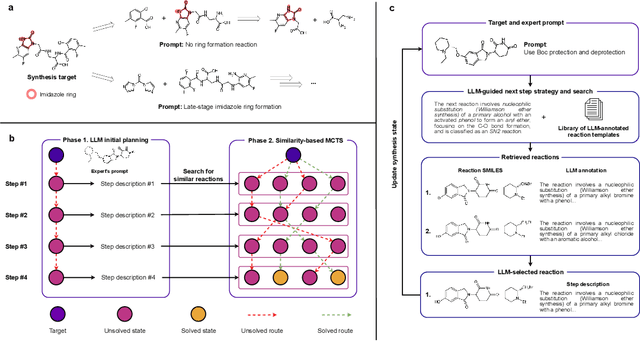
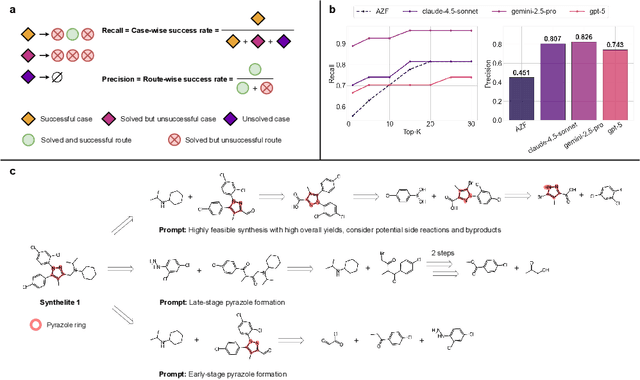
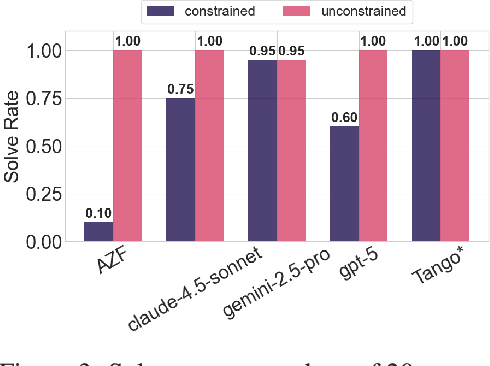
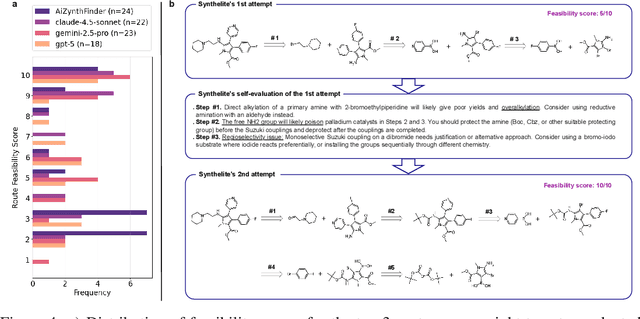
Computer-aided synthesis planning (CASP) has long been envisioned as a complementary tool for synthetic chemists. However, existing frameworks often lack mechanisms to allow interaction with human experts, limiting their ability to integrate chemists' insights. In this work, we introduce Synthelite, a synthesis planning framework that uses large language models (LLMs) to directly propose retrosynthetic transformations. Synthelite can generate end-to-end synthesis routes by harnessing the intrinsic chemical knowledge and reasoning capabilities of LLMs, while allowing expert intervention through natural language prompts. Our experiments demonstrate that Synthelite can flexibly adapt its planning trajectory to diverse user-specified constraints, achieving up to 95\% success rates in both strategy-constrained and starting-material-constrained synthesis tasks. Additionally, Synthelite exhibits the ability to account for chemical feasibility during route design. We envision Synthelite to be both a useful tool and a step toward a paradigm where LLMs are the central orchestrators of synthesis planning.
Tango*: Constrained synthesis planning using chemically informed value functions
Dec 04, 2024Computer-aided synthesis planning (CASP) has made significant strides in generating retrosynthetic pathways for simple molecules in a non-constrained fashion. Recent work introduces a specialised bidirectional search algorithm with forward and retro expansion to address the starting material-constrained synthesis problem, allowing CASP systems to provide synthesis pathways from specified starting materials, such as waste products or renewable feed-stocks. In this work, we introduce a simple guided search which allows solving the starting material-constrained synthesis planning problem using an existing, uni-directional search algorithm, Retro*. We show that by optimising a single hyperparameter, Tango* outperforms existing methods in terms of efficiency and solve rate. We find the Tango* cost function catalyses strong improvements for the bidirectional DESP methods. Our method also achieves lower wall clock times while proposing synthetic routes of similar length, a common metric for route quality. Finally, we highlight potential reasons for the strong performance of Tango over neural guided search methods
AM-RRT*: Informed Sampling-based Planning with Assisting Metric
Oct 28, 2020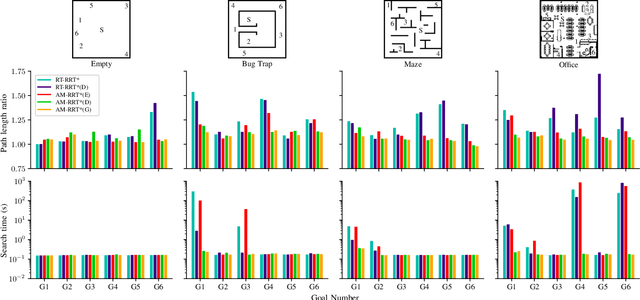
In this paper, we present a new algorithm that extends RRT* and RT-RRT* for online path planning in complex, dynamic environments. Sampling-based approaches often perform poorly in environments with narrow passages, a feature common to many indoor applications of mobile robots as well as computer games. Our method extends RRT-based sampling methods to enable the use of an assisting distance metric to improve performance in environments with obstacles. This assisting metric, which can be any metric that has better properties than the Euclidean metric when line of sight is blocked, is used in combination with the standard Euclidean metric in such a way that the algorithm can reap benefits from the assisting metric while maintaining the desirable properties of previous RRT variants - namely probabilistic completeness in tree coverage and asymptotic optimality in path length. We also introduce a new method of targeted rewiring, aimed at shortening search times and path lengths in tasks where the goal shifts repeatedly. We demonstrate that our method offers considerable improvements over existing multi-query planners such as RT-RRT* when using diffusion distance as an assisting metric; finding near-optimal paths with a decrease in search time of several orders of magnitude. Experimental results show planning times reduced by 99.5% and path lengths by 9.8% over existing real-time RRT planners in a variety of environments.