 Add to Chrome
 Add to Firefox
 Add to Edge
SEAOTTER: Sensor Embedded Autoencoding with One-Time Transcode for Efficient Reconstruction
Jun 02, 2026
In robotics systems, vast amounts of visual data are easily captured at high resolution using low-cost, low-power hardware. Yet, limited bandwidth and on-device compute resources prevent full utilization when transmitted via conventional codecs like JPEG/MPEG. Newer codecs, like AV1/AVIF, improve the rate-distortion trade-off, but demand far more resources for encoding, impractical without custom ASICs. Recent asymmetric autoencoders deliver high quality under extreme power and bandwidth constraints, but add prohibitive decoding cost and use bespoke formats that ignore decades of infrastructure built around standards like JPEG. To address these limitations, we introduce a compression framework for cloud robotics based on a Sensor Embedded Autoencoder paired with a One-Time Transcode for Efficient Reconstruction (SEAOTTER). Because the sensor, cloud, and consumer stages face very different power and bandwidth budgets, SEAOTTER combines the compactness of a learned latent with the broad usability of a standard JPEG file. Since naive transcoding degrades performance, we propose a learnable JPEG color and quantization transform that enables increased accuracy for global, dense, and vision-language-based perception. Using SEAOTTER, we train both general-purpose and task-aware transcoding pipelines for a pre-trained, frozen encoder. At a compression ratio of 200:1 and compared to AVIF, we observe 7 times faster encoding, 3.5 times faster decoding, and +8% ImageNet top-1 accuracy, while retaining compatibility with JPEG infrastructure. Our code is available at https://github.com/UT-SysML/seaotter .

FRAPPE: Full Input, Residual Output Autoencoding with Projection Pursuit Encoder
May 27, 2026Media compression standards have reached a plateau in terms of the rate-distortion-complexity trade-off, limiting the ability to offload expensive AI perception to the cloud in applications like robotics, wearables, and remote sensing. DNN-based codecs improve compression efficiency, but at a cost: they cannot easily adapt to large changes in available bitrate, and real-time encoding requires expensive, power-hungry GPUs that prohibit use on low-cost or resource-constrained platforms. To address these limitations, we propose a novel autoencoding framework (FRAPPE) that uses the Full input to predict the Residual output via a Projection Pursuit Encoder. FRAPPE's encoding objective naturally sorts latent channels by importance, allowing zero-overhead variable-rate coding. Unlike RNN-based learned codecs, whose encoder consumes the previous reconstruction's residual, or RVQ-style codecs, whose codebooks must be applied sequentially, FRAPPE's analysis path is an embarrassingly parallel DAG of independent input projections. Using FRAPPE, we build a variable-rate RGB image codec (FRAPPE-Image), and evaluate its rate-distortion-complexity trade-off against standard image codecs. At high compression ratios (approx. 0.1 bpp) FRAPPE-Image provides higher perceptual quality than AVIF with 47 times faster encoding, making it capable of real-time 1080p, 30fps CPU-only encoding. Our code and pre-trained models are available: https://github.com/UT-SysML/FRAPPE .
LiVeAction: a Lightweight, Versatile, and Asymmetric Neural Codec Design for Real-time Operation
May 07, 2026Modern sensors generate rich, high-fidelity data, yet applications operating on wearable or remote sensing devices remain constrained by bandwidth and power budgets. Standardized codecs such as JPEG and MPEG achieve efficient trade-offs between bitrate and perceptual quality but are designed for human perception, limiting their applicability to machine-perception tasks and non-traditional modalities such as spatial audio arrays, hyperspectral images, and 3D medical images. General-purpose compression schemes based on scalar quantization or resolution reduction are broadly applicable but fail to exploit inherent signal redundancies, resulting in suboptimal rate-distortion performance. Recent generative neural codecs, or tokenizers, model complex signal dependencies but are often over-parameterized, data-hungry, and modality-specific, making them impractical for resource-constrained environments. We introduce a Lightweight, Versatile, and Asymmetric neural codec architecture (LiVeAction), that addresses these limitations through two key ideas. (1) To reduce the complexity of the encoder to meet the resource constraints of the execution environments, we impose an FFT-like structure and reduce the overall size and depth of the neural-network-based analysis transform. (2) To allow arbitrary signal modalities and simplify training, we replace adversarial and perceptual losses with a variance-based rate penalty. Our design produces codecs that deliver superior rate-distortion performance compared to state-of-the-art generative tokenizers, while remaining practical for deployment on low-power sensors. We release our code, experiments, and python library at https://github.com/UT-SysML/liveaction .
Learned Compression for Compressed Learning
Dec 12, 2024Modern sensors produce increasingly rich streams of high-resolution data. Due to resource constraints, machine learning systems discard the vast majority of this information via resolution reduction. Compressed-domain learning allows models to operate on compact latent representations, allowing higher effective resolution for the same budget. However, existing compression systems are not ideal for compressed learning. Linear transform coding and end-to-end learned compression systems reduce bitrate, but do not uniformly reduce dimensionality; thus, they do not meaningfully increase efficiency. Generative autoencoders reduce dimensionality, but their adversarial or perceptual objectives lead to significant information loss. To address these limitations, we introduce WaLLoC (Wavelet Learned Lossy Compression), a neural codec architecture that combines linear transform coding with nonlinear dimensionality-reducing autoencoders. WaLLoC sandwiches a shallow, asymmetric autoencoder and entropy bottleneck between an invertible wavelet packet transform. Across several key metrics, WaLLoC outperforms the autoencoders used in state-of-the-art latent diffusion models. WaLLoC does not require perceptual or adversarial losses to represent high-frequency detail, providing compatibility with modalities beyond RGB images and stereo audio. WaLLoC's encoder consists almost entirely of linear operations, making it exceptionally efficient and suitable for mobile computing, remote sensing, and learning directly from compressed data. We demonstrate WaLLoC's capability for compressed-domain learning across several tasks, including image classification, colorization, document understanding, and music source separation. Our code, experiments, and pre-trained audio and image codecs are available at https://ut-sysml.org/walloc
Machine Perceptual Quality: Evaluating the Impact of Severe Lossy Compression on Audio and Image Models
Jan 15, 2024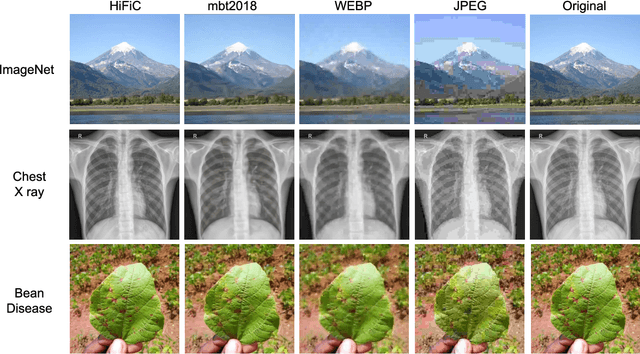
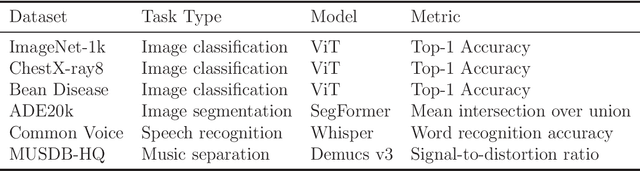
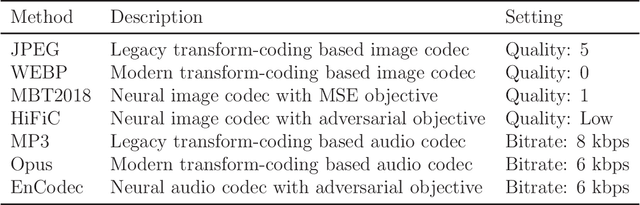
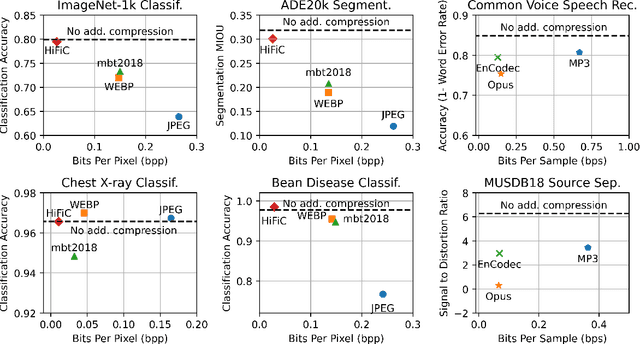
In the field of neural data compression, the prevailing focus has been on optimizing algorithms for either classical distortion metrics, such as PSNR or SSIM, or human perceptual quality. With increasing amounts of data consumed by machines rather than humans, a new paradigm of machine-oriented compression$\unicode{x2013}$which prioritizes the retention of features salient for machine perception over traditional human-centric criteria$\unicode{x2013}$has emerged, creating several new challenges to the development, evaluation, and deployment of systems utilizing lossy compression. In particular, it is unclear how different approaches to lossy compression will affect the performance of downstream machine perception tasks. To address this under-explored area, we evaluate various perception models$\unicode{x2013}$including image classification, image segmentation, speech recognition, and music source separation$\unicode{x2013}$under severe lossy compression. We utilize several popular codecs spanning conventional, neural, and generative compression architectures. Our results indicate three key findings: (1) using generative compression, it is feasible to leverage highly compressed data while incurring a negligible impact on machine perceptual quality; (2) machine perceptual quality correlates strongly with deep similarity metrics, indicating a crucial role of these metrics in the development of machine-oriented codecs; and (3) using lossy compressed datasets, (e.g. ImageNet) for pre-training can lead to counter-intuitive scenarios where lossy compression increases machine perceptual quality rather than degrading it. To encourage engagement on this growing area of research, our code and experiments are available at: https://github.com/danjacobellis/MPQ.