 Add to Chrome
 Add to Firefox
 Add to Edge
Uncertainty Estimation for Deep Reconstruction in Actuatic Disaster Scenarios with Autonomous Vehicles
Apr 07, 2026
Accurate reconstruction of environmental scalar fields from sparse onboard observations is essential for autonomous vehicles engaged in aquatic monitoring. Beyond point estimates, principled uncertainty quantification is critical for active sensing strategies such as Informative Path Planning, where epistemic uncertainty drives data collection decisions. This paper compares Gaussian Processes, Monte Carlo Dropout, Deep Ensembles, and Evidential Deep Learning for simultaneous scalar field reconstruction and uncertainty decomposition under three perceptual models representative of real sensor modalities. Results show that Evidential Deep Learning achieves the best reconstruction accuracy and uncertainty calibration across all sensor configurations at the lowest inference cost, while Gaussian Processes are fundamentally limited by their stationary kernel assumption and become intractable as observation density grows. These findings support Evidential Deep Learning as the preferred method for uncertainty-aware field reconstruction in real-time autonomous vehicle deployments.

A Unified Experimental Architecture for Informative Path Planning: from Simulation to Deployment with GuadalPlanner
Feb 11, 2026The evaluation of informative path planning algorithms for autonomous vehicles is often hindered by fragmented execution pipelines and limited transferability between simulation and real-world deployment. This paper introduces a unified architecture that decouples high-level decision-making from vehicle-specific control, enabling algorithms to be evaluated consistently across different abstraction levels without modification. The proposed architecture is realized through GuadalPlanner, which defines standardized interfaces between planning, sensing, and vehicle execution. It is an open and extensible research tool that supports discrete graph-based environments and interchangeable planning strategies, and is built upon widely adopted robotics technologies, including ROS2, MAVLink, and MQTT. Its design allows the same algorithmic logic to be deployed in fully simulated environments, software-in-the-loop configurations, and physical autonomous vehicles using an identical execution pipeline. The approach is validated through a set of experiments, including real-world deployment on an autonomous surface vehicle performing water quality monitoring with real-time sensor feedback.
Towards an Autonomous Surface Vehicle Prototype for Artificial Intelligence Applications of Water Quality Monitoring
Oct 08, 2024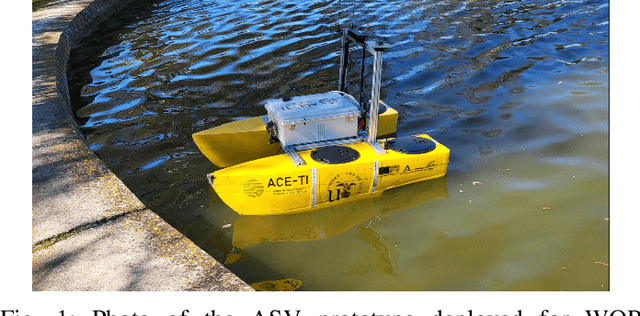

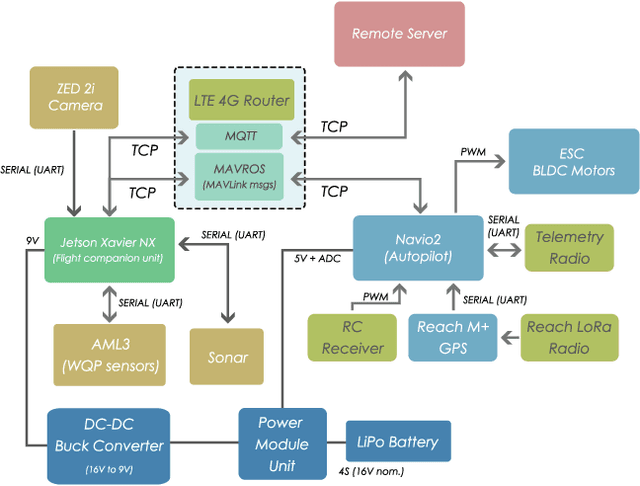
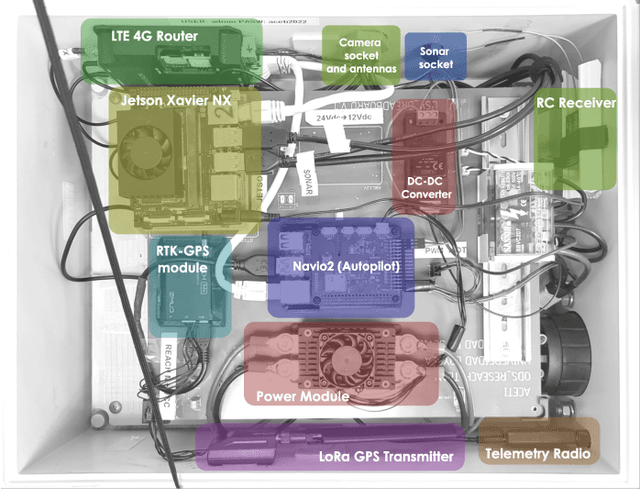
The use of Autonomous Surface Vehicles, equipped with water quality sensors and artificial vision systems, allows for a smart and adaptive deployment in water resources environmental monitoring. This paper presents a real implementation of a vehicle prototype that to address the use of Artificial Intelligence algorithms and enhanced sensing techniques for water quality monitoring. The vehicle is fully equipped with high-quality sensors to measure water quality parameters and water depth. Furthermore, by means of a stereo-camera, it also can detect and locate macro-plastics in real environments by means of deep visual models, such as YOLOv5. In this paper, experimental results, carried out in Lago Mayor (Sevilla), has been presented as proof of the capabilities of the proposed architecture. The overall system, and the early results obtained, are expected to provide a solid example of a real platform useful for the water resource monitoring task, and to serve as a real case scenario for deploying Artificial Intelligence algorithms, such as path planning, artificial vision, etc.