 Add to Chrome
 Add to Firefox
 Add to Edge
Learning Random Geometric Graphs Drawn in Probabilistic Metric Spaces
Aug 19, 2026
We present a new data-driven learning of a Random Geometric Graph (RGG) of a multivariate dataset, where the graph is drawn in a probabilistic metric space. This graph learning works for generic datasets, irrespective of the type of the observables; their probability distributions; or size of the data. We identify a metric of the space that the graph is drawn in, as a probability distribution of a random variable that we introduce, namely, a variable that represents the disparity between the connectedness of two vertices of the graph, and the correlation between the two random variables that are attached to the respective vertex. It is the closed-form {\it{cdf}} of this disparity variable that we advance as the distance function of the host space of the learnt RGG, such that the edge exists between any two nodes, if this inter-nodal distance falls short of a chosen cutoff probability. Drawing the RGG in this probabilistic space leads to the graph being an Soft RGG, such that any edge - if it exists - exists with an identified probability. We forward a simple Rejection Sampling-based technique for learning the probability of any edge. The expected degree distribution of a vertex of this RGG is identified as local, and dependent on the inter-observable correlation matrix. If said correlation matrix is not known, it can be learnt given the data, using its closed-form posterior probability density function, that we forward. We illustrate our graph learning method by learning multiple RGGs of highly multivariate real datasets.

Probabilistic learning to perform pre-onset individualised prediction of disease severity: application to Veno Occlusive Disease
Jun 02, 2026We advance a new probabilistic supervised learning approach that permits reliable, automated, and early individualised prediction of the severity with which a disease will develop in a prospective patient. The prediction capacity is illustrated via the pre-transplant prediction of the score of severity of Veno Occlusive Disease (or VOD) in the digital twin (DT) of the considered prospective patient, where this score parametrises the severity with which VOD will develop in this patient, after they undergo their Bone Marrow Transplant. The learning of the relationship between the pre-transplant variables, and a severity score variable is undertaken by modelling this relationship as a (random) function that is treated as a sample function of an adequately-chosen stochastic process. The parameters of this underlying process are learnt using a training dataset that is generated using the real-time evolution of retrospective patients in a cohort, with this training dataset subsequently augmented in size by a probabilistic inverse learning of the score of prospective patients. The augmented training set, then permits the learning of the function that capacitates - at the pre-transplant stage - automated prediction of the score of the severity of VOD that characterises the DT of a physical patient in their unique pre-transplant state. This score is subsequently fed back to the real prospective patient as the severity with which VOD will develop in them, after this patient undergoes their transplant. Such a score then permits the treating Haematologist-Oncologists to decide on the treatment regimen, which in this illustration reduces to deciding on treating the patient with Defibrotide. An AI facility is developed to undertake such automated prediction, with the physician inputting the data on the pre-transplant state that characterises the DT of the prospective patient under consideration.
Gaussian Process-based learning with new MCMC-based implementation of Wishart prior on correlation matrix
May 26, 2026In probabilstic supervised learning of an input-output relationship - as a sample function of a Gaussian Process (GP) - priors are typically specified for the hyperparameters of the kernel that parametrises the covariance function of the GP, where the induced covariance matrix of the (resulting multivariate Normal) likelihood, governs the learning and prediction. When the sought function is highly multivariate, multiple lengthscale parameters must be learnt simultaneously, making inference difficult. We develop a ``self-assembled'' Wishart prior for the covariance matrix, while undertaking Bayesian inference on the kernel hyperparameters using MCMC. The construction uses a look-back window over recent MCMC iterations to define a time-step dependent scale matrix, thereby introducing adaptiveness to the chain. Results suggest that direct prior specification on the covariance matrix can be useful for diagnosing weakly informative inputs within the GP-based learning paradigm. We support our prior development with two distinct empirical illustrations - one on synthetic data, and another on a real-world dataset.
Individualised recovery trajectories of patients with impeded mobility, using distance between probability distributions of learnt graphs
Oct 29, 2024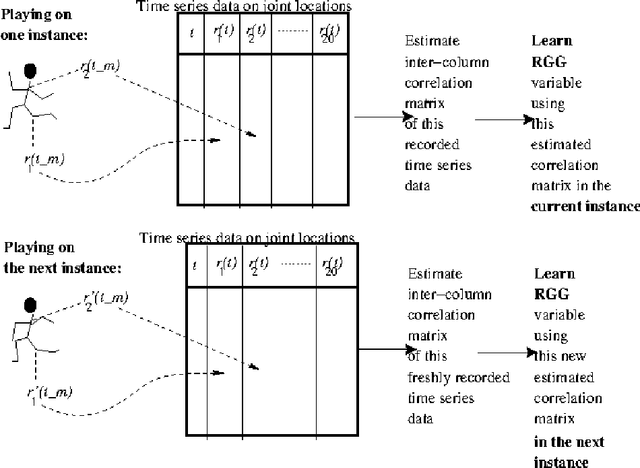


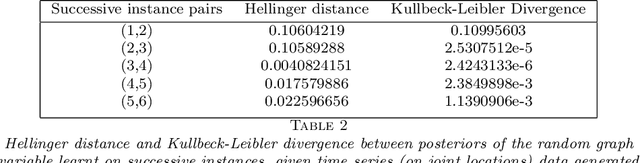
Patients who are undergoing physical rehabilitation, benefit from feedback that follows from reliable assessment of their cumulative performance attained at a given time. In this paper, we provide a method for the learning of the recovery trajectory of an individual patient, as they undertake exercises as part of their physical therapy towards recovery of their loss of movement ability, following a critical illness. The difference between the Movement Recovery Scores (MRSs) attained by a patient, when undertaking a given exercise routine on successive instances, is given by a statistical distance/divergence between the (posterior) probabilities of random graphs that are Bayesianly learnt using time series data on locations of 20 of the patient's joints, recorded on an e-platform as the patient exercises. This allows for the computation of the MRS on every occasion the patient undertakes this exercise, using which, the recovery trajectory is drawn. We learn each graph as a Random Geometric Graph drawn in a probabilistic metric space, and identify the closed-form marginal posterior of any edge of the graph, given the correlation structure of the multivariate time series data on joint locations. On the basis of our recovery learning, we offer recommendations on the optimal exercise routines for patients with given level of mobility impairment.
A New Reliable & Parsimonious Learning Strategy Comprising Two Layers of Gaussian Processes, to Address Inhomogeneous Empirical Correlation Structures
Apr 18, 2024We present a new strategy for learning the functional relation between a pair of variables, while addressing inhomogeneities in the correlation structure of the available data, by modelling the sought function as a sample function of a non-stationary Gaussian Process (GP), that nests within itself multiple other GPs, each of which we prove can be stationary, thereby establishing sufficiency of two GP layers. In fact, a non-stationary kernel is envisaged, with each hyperparameter set as dependent on the sample function drawn from the outer non-stationary GP, such that a new sample function is drawn at every pair of input values at which the kernel is computed. However, such a model cannot be implemented, and we substitute this by recalling that the average effect of drawing different sample functions from a given GP is equivalent to that of drawing a sample function from each of a set of GPs that are rendered different, as updated during the equilibrium stage of the undertaken inference (via MCMC). The kernel is fully non-parametric, and it suffices to learn one hyperparameter per layer of GP, for each dimension of the input variable. We illustrate this new learning strategy on a real dataset.