 Add to Chrome
 Add to Firefox
 Add to Edge
Online TT-ALS for Streaming Tensor Decomposition with Incremental Orthogonalization
Jun 30, 2026
Tensor Train (TT) decomposition is a powerful technique for analyzing high-dimensional data. Existing algorithms for computing TT decompositions can be categorized into two main types: conventional batch-based approaches and recursive online methods. In the context of streaming data, batch methods typically achieve higher reconstruction accuracy but often suffer from memory exhaustion, while online methods provide greater computational efficiency. In this work, we introduce Online TT-ALS (Alternating Least Squares), an algorithm that sequentially enforces orthogonality constraints. This approach allows for efficient and exact updates of the core tensor while maintaining high reconstruction accuracy. Theoretically, we prove that enforcing these orthogonal gauge constraints guarantees monotonic decrease of the local objective function and temporal smoothness. Computationally, our deterministic single-sweep update reduces the rank dependence from quadratic to linear, achieving an overall complexity of $\mathcal{O}(I^{n-1} r)$. Experimental results demonstrate that the proposed method outperforms existing online techniques not only in terms of mathematical approximation accuracy but also in human perception-based video quality metrics. Furthermore, compared to recent deep learning-based paradigms, our algebraic approach achieves speedups of several orders of magnitude. Consequently, our method exhibits high computational efficiency and is suitable for low-latency real-time processing applications.

Accelerating SAV-based optimization via randomized low-rank Hessian approximation
Jun 09, 2026We propose a new optimization method, the Nyström-enhanced relaxed scalar auxiliary variable method (N-RSAV), which incorporates curvature information into the RSAV framework to accelerate convergence while preserving an unconditional modified energy dissipation law. Existing RSAV-based methods rely solely on first-order information and often suffer from slow convergence, particularly for ill-conditioned problems such as those arising in physics-informed neural networks (PINNs). To address this limitation, we design the linear operator in the RSAV scheme using approximate Hessian information obtained from a randomized low-rank Nyström approximation. To preserve the dissipation structure, we enforce positive semidefiniteness through eigenvalue truncation. Furthermore, we introduce an adaptive strategy that reuses the approximate Hessian based on the deviation between the original and modified energies, significantly reducing computational cost. We also provide a convergence analysis of the RSAV scheme with a general positive semidefinite operator under the Polyak-Lojasiewicz (PL) condition and establish corresponding convergence guarantees for N-RSAV under the PL condition and an additional convexity assumption. Numerical experiments on ill-conditioned problems with effectively low-rank structure, including convex quadratic problems and training of PINNs, demonstrate that the proposed methods achieve substantially faster convergence than conventional RSAV-based approaches.
Structure-Preserving Physics-Informed Neural Networks With Energy or Lyapunov Structure
Jan 10, 2024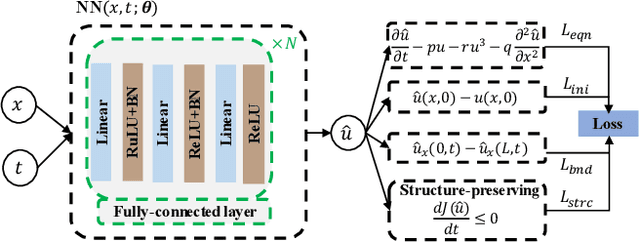
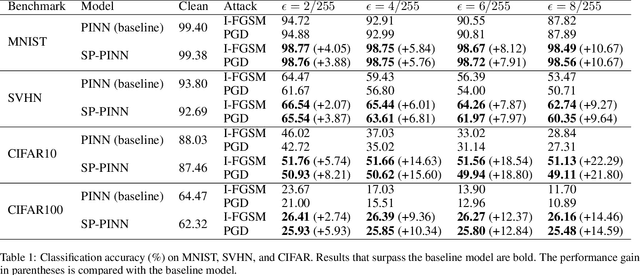
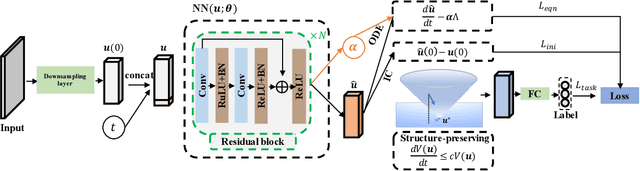
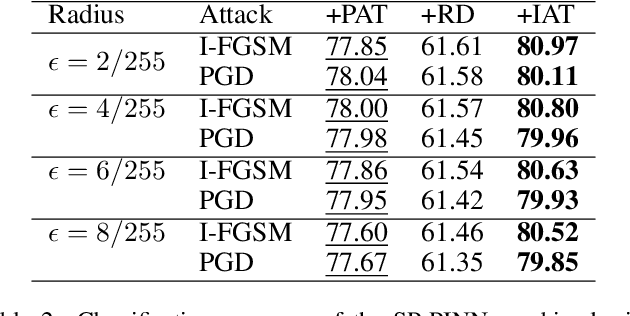
Recently, there has been growing interest in using physics-informed neural networks (PINNs) to solve differential equations. However, the preservation of structure, such as energy and stability, in a suitable manner has yet to be established. This limitation could be a potential reason why the learning process for PINNs is not always efficient and the numerical results may suggest nonphysical behavior. Besides, there is little research on their applications on downstream tasks. To address these issues, we propose structure-preserving PINNs to improve their performance and broaden their applications for downstream tasks. Firstly, by leveraging prior knowledge about the physical system, a structure-preserving loss function is designed to assist the PINN in learning the underlying structure. Secondly, a framework that utilizes structure-preserving PINN for robust image recognition is proposed. Here, preserving the Lyapunov structure of the underlying system ensures the stability of the system. Experimental results demonstrate that the proposed method improves the numerical accuracy of PINNs for partial differential equations. Furthermore, the robustness of the model against adversarial perturbations in image data is enhanced.
A modified model for topic detection from a corpus and a new metric evaluating the understandability of topics
Jun 08, 2023


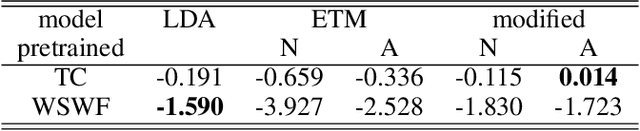
This paper presents a modified neural model for topic detection from a corpus and proposes a new metric to evaluate the detected topics. The new model builds upon the embedded topic model incorporating some modifications such as document clustering. Numerical experiments suggest that the new model performs favourably regardless of the document's length. The new metric, which can be computed more efficiently than widely-used metrics such as topic coherence, provides variable information regarding the understandability of the detected topics.
Composing a surrogate observation operator for sequential data assimilation
Jan 29, 2022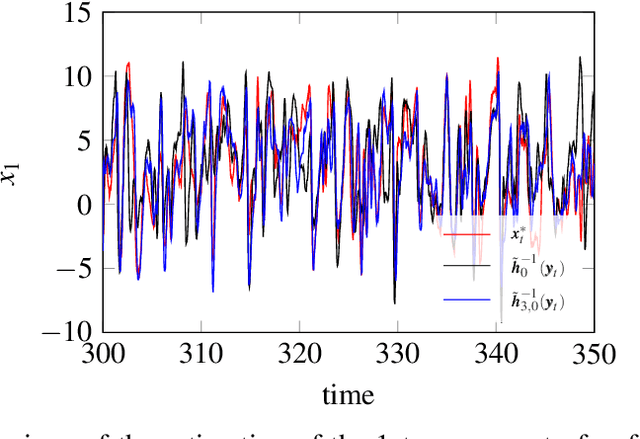
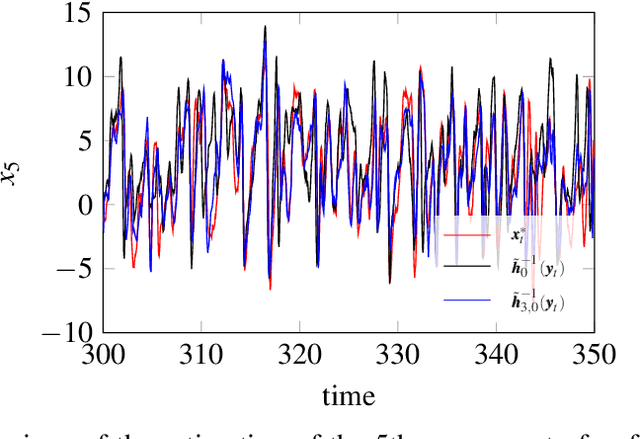
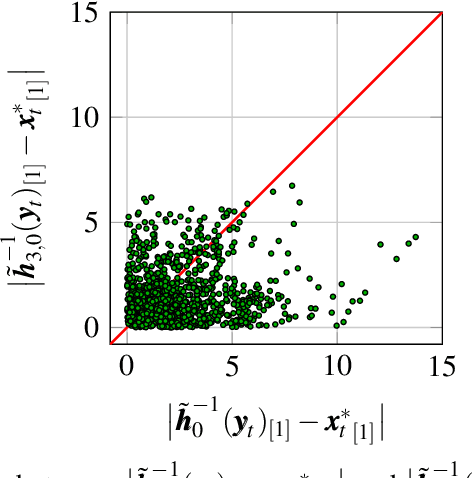
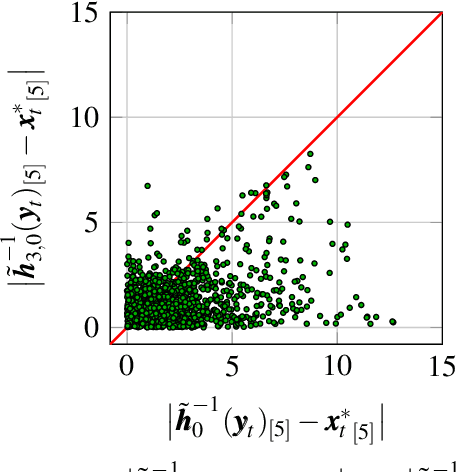
In data assimilation, state estimation is not straightforward when the observation operator is unknown. This study proposes a method for composing a surrogate operator for a true operator. The surrogate model is improved iteratively to decrease the difference between the observations and the results of the surrogate model, and a neural network is adopted in the process. A twin experiment suggests that the proposed method outperforms approaches that use a specific operator that is given tentatively throughout the data assimilation process.