 Add to Chrome
 Add to Firefox
 Add to Edge
Instruction-Following Evaluation of Large Vision-Language Models
Dec 29, 2025
Following the initial flourishing of large language models (LLMs), there has been a surge in proposed large vision-language models (LVLMs) that integrate LLMs with vision capabilities. However, it has been observed that LVLMs, after tuning to visual instruction using commonly used training datasets, often fail to exhibit the instruction-following ability that was present in the LLM before integration, leading to results in which they do not follow task instructions as expected. This study quantitatively demonstrates that LVLMs' instruction-following ability declines after fine-tuning and analyzes its underlying causes. In particular, we constructed new training datasets highlighting whether the output format is specified. Then, we investigated how explicitly indicating the output format during fine-tuning affects LVLMs' instruction-following ability. Our quantitative evaluation confirmed that LVLMs' instruction-following ability declines after fine-tuning with commonly used datasets. Furthermore, we found that LVLMs trained with datasets, including instructions on output format, tend to follow instructions more accurately than models that do not. These findings suggest that including samples with instructions on output format during (visual) instruction tuning may help mitigate the decline in instruction-following abilities.

Read or Ignore? A Unified Benchmark for Typographic-Attack Robustness and Text Recognition in Vision-Language Models
Dec 10, 2025Large vision-language models (LVLMs) are vulnerable to typographic attacks, where misleading text within an image overrides visual understanding. Existing evaluation protocols and defenses, largely focused on object recognition, implicitly encourage ignoring text to achieve robustness; however, real-world scenarios often require joint reasoning over both objects and text (e.g., recognizing pedestrians while reading traffic signs). To address this, we introduce a novel task, Read-or-Ignore VQA (RIO-VQA), which formalizes selective text use in visual question answering (VQA): models must decide, from context, when to read text and when to ignore it. For evaluation, we present the Read-or-Ignore Benchmark (RIO-Bench), a standardized dataset and protocol that, for each real image, provides same-scene counterfactuals (read / ignore) by varying only the textual content and question type. Using RIO-Bench, we show that strong LVLMs and existing defenses fail to balance typographic robustness and text-reading capability, highlighting the need for improved approaches. Finally, RIO-Bench enables a novel data-driven defense that learns adaptive selective text use, moving beyond prior non-adaptive, text-ignoring defenses. Overall, this work reveals a fundamental misalignment between the existing evaluation scope and real-world requirements, providing a principled path toward reliable LVLMs. Our Project Page is at https://turingmotors.github.io/rio-vqa/.
STRIDE-QA: Visual Question Answering Dataset for Spatiotemporal Reasoning in Urban Driving Scenes
Aug 14, 2025Vision-Language Models (VLMs) have been applied to autonomous driving to support decision-making in complex real-world scenarios. However, their training on static, web-sourced image-text pairs fundamentally limits the precise spatiotemporal reasoning required to understand and predict dynamic traffic scenes. We address this critical gap with STRIDE-QA, a large-scale visual question answering (VQA) dataset for physically grounded reasoning from an ego-centric perspective. Constructed from 100 hours of multi-sensor driving data in Tokyo, capturing diverse and challenging conditions, STRIDE-QA is the largest VQA dataset for spatiotemporal reasoning in urban driving, offering 16 million QA pairs over 285K frames. Grounded by dense, automatically generated annotations including 3D bounding boxes, segmentation masks, and multi-object tracks, the dataset uniquely supports both object-centric and ego-centric reasoning through three novel QA tasks that require spatial localization and temporal prediction. Our benchmarks demonstrate that existing VLMs struggle significantly, achieving near-zero scores on prediction consistency. In contrast, VLMs fine-tuned on STRIDE-QA exhibit dramatic performance gains, achieving 55% success in spatial localization and 28% consistency in future motion prediction, compared to near-zero scores from general-purpose VLMs. Therefore, STRIDE-QA establishes a comprehensive foundation for developing more reliable VLMs for safety-critical autonomous systems.
Detecting Response Generation Not Requiring Factual Judgment
Jun 14, 2024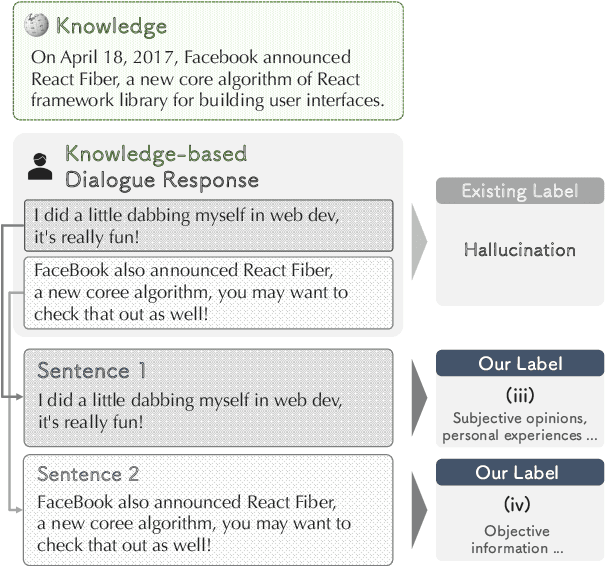
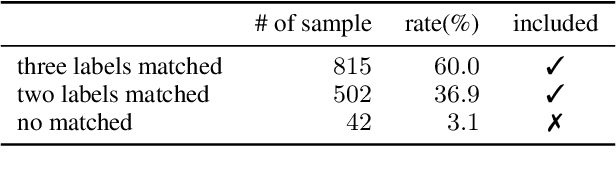
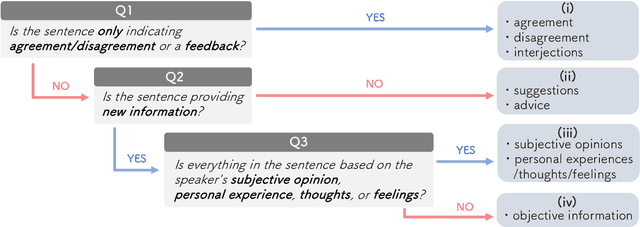
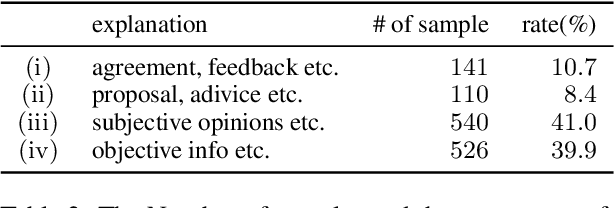
With the remarkable development of large language models (LLMs), ensuring the factuality of output has become a challenge. However, having all the contents of the response with given knowledge or facts is not necessarily a good thing in dialogues. This study aimed to achieve both attractiveness and factuality in a dialogue response for which a task was set to predict sentences that do not require factual correctness judgment such as agreeing, or personal opinions/feelings. We created a dataset, dialogue dataset annotated with fact-check-needed label (DDFC), for this task via crowdsourcing, and classification tasks were performed on several models using this dataset. The model with the highest classification accuracy could yield about 88% accurate classification results.