 Add to Chrome
 Add to Firefox
 Add to Edge
3Dify: a Framework for Procedural 3D-CG Generation Assisted by LLMs Using MCP and RAG
Oct 06, 2025
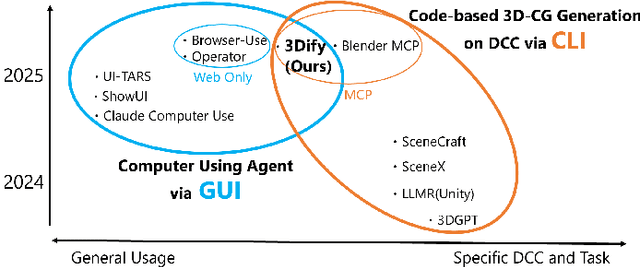
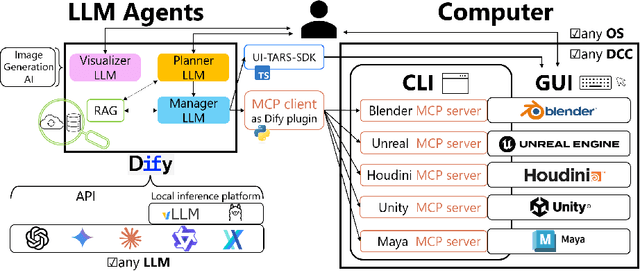
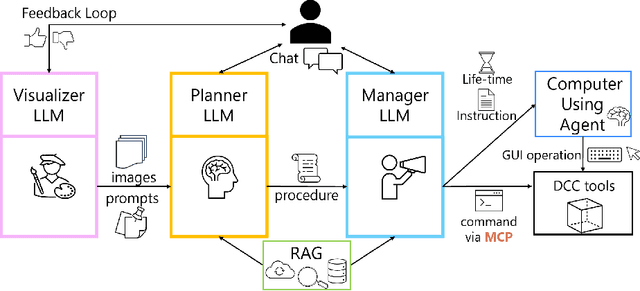
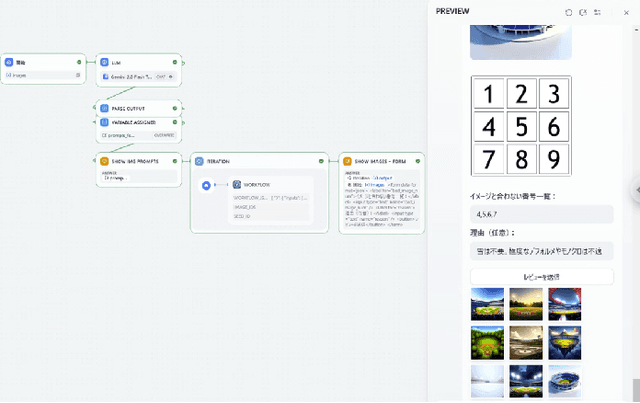
This paper proposes "3Dify," a procedural 3D computer graphics (3D-CG) generation framework utilizing Large Language Models (LLMs). The framework enables users to generate 3D-CG content solely through natural language instructions. 3Dify is built upon Dify, an open-source platform for AI application development, and incorporates several state-of-the-art LLM-related technologies such as the Model Context Protocol (MCP) and Retrieval-Augmented Generation (RAG). For 3D-CG generation support, 3Dify automates the operation of various Digital Content Creation (DCC) tools via MCP. When DCC tools do not support MCP-based interaction, the framework employs the Computer-Using Agent (CUA) method to automate Graphical User Interface (GUI) operations. Moreover, to enhance image generation quality, 3Dify allows users to provide feedback by selecting preferred images from multiple candidates. The LLM then learns variable patterns from these selections and applies them to subsequent generations. Furthermore, 3Dify supports the integration of locally deployed LLMs, enabling users to utilize custom-developed models and to reduce both time and monetary costs associated with external API calls by leveraging their own computational resources.

Towards Generalized Parameter Tuning in Coherent Ising Machines: A Portfolio-Based Approach
Jul 27, 2025Coherent Ising Machines (CIMs) have recently gained attention as a promising computing model for solving combinatorial optimization problems. In particular, the Chaotic Amplitude Control (CAC) algorithm has demonstrated high solution quality, but its performance is highly sensitive to a large number of hyperparameters, making efficient tuning essential. In this study, we present an algorithm portfolio approach for hyperparameter tuning in CIMs employing Chaotic Amplitude Control with momentum (CACm) algorithm. Our method incorporates multiple search strategies, enabling flexible and effective adaptation to the characteristics of the hyperparameter space. Specifically, we propose two representative tuning methods, Method A and Method B. Method A optimizes each hyperparameter sequentially with a fixed total number of trials, while Method B prioritizes hyperparameters based on initial evaluations before applying Method A in order. Performance evaluations were conducted on the Supercomputer "Flow" at Nagoya University, using planted Wishart instances and Time to Solution (TTS) as the evaluation metric. Compared to the baseline performance with best-known hyperparameters, Method A achieved up to 1.47x improvement, and Method B achieved up to 1.65x improvement. These results demonstrate the effectiveness of the algorithm portfolio approach in enhancing the tuning process for CIMs.