 Add to Chrome
 Add to Firefox
 Add to Edge
One-Dimensional Nonnegative Spline Smoothing via Convex Semi-Infinite Programming with a Cutting-Plane Method
May 05, 2026
Spline functions are smooth piecewise polynomials widely used for interpolation and smoothing, and nonnegative spline smoothing is also studied for nonnegative data. Previous research used sufficient conditions for the nonnegativity of spline functions because necessary and sufficient conditions for the nonnegativity are infinitely many linear inequalities, which are difficult to handle in optimization algorithms. This conventional method quickly computes a nonnegative spline function via quadratic programming (QP), but the optimal solution may be slightly degraded by using the sufficient condition. In this paper, we express 1D nonnegative spline smoothing as a convex semi-infinite programming (CSIP) problem that directly deals with infinite inequality constraints. As optimization algorithms for general SIP problems, local-reduction-based sequential quadratic programming (LRSQP) methods are used, but their convergence performance deteriorates for certain problems due to multiple approximations during updates. To quickly solve the CSIP problem, we propose a cutting-plane (CP) method. In the proposed method, after giving an initial solution by the standard spline smoothing, we find the minimizer of each polynomial piece by using the closed-form solution for a low-degree polynomial or a numerical solution for a high-degree polynomial. If the minimum value is negative, then such minimizer is added into the constraint of the problem to guarantee the nonnegativity. This constrained problem is quickly solved via QP, and we find the minimizer of each polynomial piece again. We repeat these procedures until there are no negative minimum values. The proposed method guarantees convergence to the original CSIP solution, and its effectiveness is demonstrated in numerical experiments by comparison to the conventional methods, QP under the sufficient condition and CSIP using the MATLAB LRSQP algorithm.

Convex Estimation of Sparse-Smooth Power Spectral Densities from Mixtures of Realizations with Application to Weather Radar
Sep 28, 2023In this paper, we propose a convex optimization-based estimation of sparse and smooth power spectral densities (PSDs) of complex-valued random processes from mixtures of realizations. While the PSDs are related to the magnitude of the frequency components of the realizations, it has been a major challenge to exploit the smoothness of the PSDs because penalizing the difference of the magnitude of the frequency components results in a nonconvex optimization problem that is difficult to solve. To address this challenge, we design the proposed model that jointly estimates the complex-valued frequency components and the nonnegative PSDs, which are respectively regularized to be sparse and sparse-smooth. By penalizing the difference of the nonnegative variable that estimates the PSDs, the proposed model can enhance the smoothness of the PSDs via convex optimization. Numerical experiments on the phased array weather radar, an advanced weather radar system, demonstrate that the proposed model achieves superior estimation accuracy to the existing sparse estimation models combined with or without post-smoothing.
Design of Tight Minimum-Sidelobe Windows by Riemannian Newton's Method
Nov 02, 2021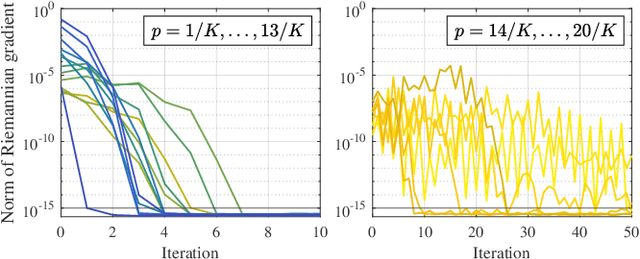
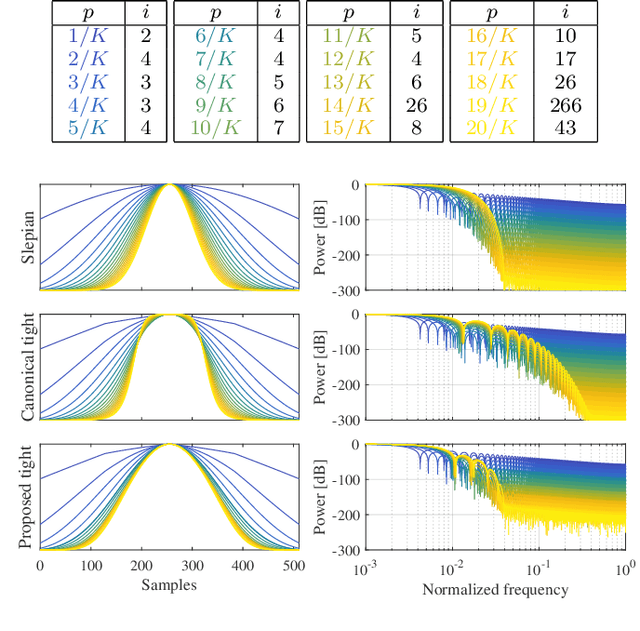
The short-time Fourier transform (STFT), or the discrete Gabor transform (DGT), has been extensively used in signal analysis and processing. Their properties are characterized by a window function, and hence window design is a significant topic up to date. For signal processing, designing a pair of analysis and synthesis windows is important because results of processing in the time-frequency domain are affected by both of them. A tight window is a special window that can perfectly reconstruct a signal by using it for both analysis and synthesis. It is known to make time-frequency-domain processing robust to error, and therefore designing a better tight window is desired. In this paper, we propose a method of designing tight windows that minimize the sidelobe energy. It is formulated as an optimization problem on an oblique manifold, and a Riemannian Newton algorithm on this manifold is derived to efficiently obtain a solution.