 Add to Chrome
 Add to Firefox
 Add to Edge
An Axiomatic Approach to General Intelligence: SANC(E3) -- Self-organizing Active Network of Concepts with Energy E3
Jan 13, 2026
General intelligence must reorganize experience into internal structures that enable prediction and action under finite resources. Existing systems implicitly presuppose fixed primitive units -- tokens, subwords, pixels, or predefined sensor channels -- thereby bypassing the question of how representational units themselves emerge and stabilize. This paper proposes SANC(E3), an axiomatic framework in which representational units are not given a priori but instead arise as stable outcomes of competitive selection, reconstruction, and compression under finite activation capacity, governed by the explicit minimization of an energy functional E3. SANC(E3) draws a principled distinction between system tokens -- structural anchors such as {here, now, I} and sensory sources -- and tokens that emerge through self-organization during co-occurring events. Five core axioms formalize finite capacity, association from co-occurrence, similarity-based competition, confidence-based stabilization, and the reconstruction-compression-update trade-off. A key feature is a pseudo-memory-mapped I/O mechanism, through which internally replayed Gestalts are processed via the same axiomatic pathway as external sensory input. As a result, perception, imagination, prediction, planning, and action are unified within a single representational and energetic process. From the axioms, twelve propositions are derived, showing that category formation, hierarchical organization, unsupervised learning, and high-level cognitive activities can all be understood as instances of Gestalt completion under E3 minimization.

Folded context condensation in Path Integral formalism for infinite context transformers
May 07, 2024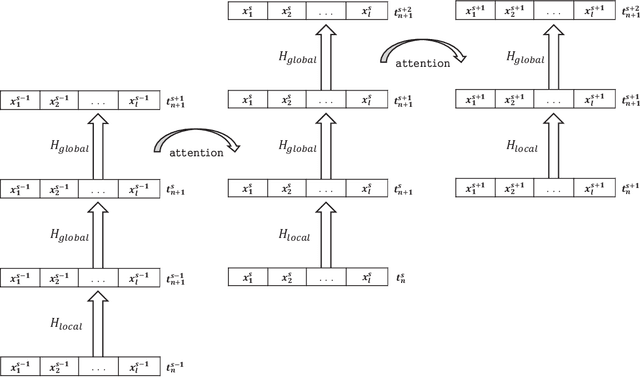
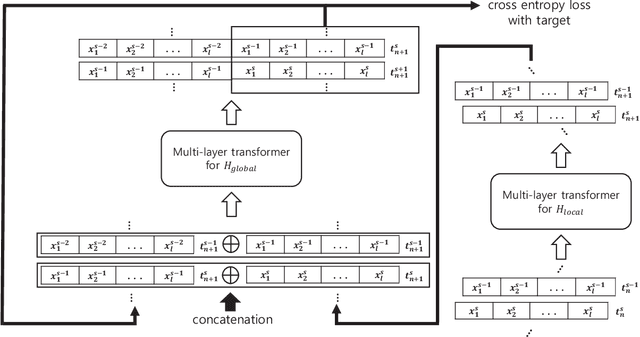
This short note is written for rapid communication of long context training and to share the idea of how to train it with low memory usage. In the note, we generalize the attention algorithm and neural network of Generative Pre-Trained Transformers and reinterpret it in Path integral formalism. First, the role of the transformer is understood as the time evolution of the token state and second, it is suggested that the all key-token states in the same time as the query-token can attend to the attention with the query token states. As a result of the repetitive time evolution, it is discussed that the token states in the past sequence meats the token states in the present sequence so that the attention between separated sequences becomes possible for maintaining infinite contextual information just by using low memory for limited size of sequence. For the experiment, the $12$ input token window size was taken and one GPU with $24$GB memory was used for the pre-training. It was confirmed that more than $150$ length context is preserved. The sampling result of the training, the code and the other details will be included in the revised version of this note later.