 Add to Chrome
 Add to Firefox
 Add to Edge
K-EXAONE 2.0 Technical Report
Aug 05, 2026
This technical report presents K-EXAONE 2.0, an open-weight multilingual foundation model developed by LG AI Research as a step in our effort toward global frontier-scale foundation models. Rather than training from scratch, we upcycle K-EXAONE and expand its architecture, yielding a Mixture-of-Experts (MoE) model with 750B total parameters and approximately 37B activated per token---more than three times the capacity of its predecessor. K-EXAONE 2.0 supports context lengths of up to 256K tokens and expands multilingual coverage from six to ten languages. Its training pipeline combines continual pre-training, difficulty-focused mid-training, and post-training to strengthen reasoning, agentic coding, multilingual capability, and safety grounded in Korean sociocultural contexts. Across nine evaluation categories selected to reflect the conditions of practical use, K-EXAONE 2.0 improves over K-EXAONE and remains competitive with open-weight models, showing its largest gains in agentic coding and long-context understanding and its clearest strengths in long-context retrieval and safety. Released under the Apache 2.0 license, K-EXAONE 2.0 enables the wider AI ecosystem to evaluate, deploy, adapt, and build upon it, while marking the beginning---rather than the endpoint---of our challenge toward the global frontier.

EXAONE 4.5 Technical Report
Apr 09, 2026This technical report introduces EXAONE 4.5, the first open-weight vision language model released by LG AI Research. EXAONE 4.5 is architected by integrating a dedicated visual encoder into the existing EXAONE 4.0 framework, enabling native multimodal pretraining over both visual and textual modalities. The model is trained on large-scale data with careful curation, particularly emphasizing document-centric corpora that align with LG's strategic application domains. This targeted data design enables substantial performance gains in document understanding and related tasks, while also delivering broad improvements across general language capabilities. EXAONE 4.5 extends context length up to 256K tokens, facilitating long-context reasoning and enterprise-scale use cases. Comparative evaluations demonstrate that EXAONE 4.5 achieves competitive performance in general benchmarks while outperforming state-of-the-art models of similar scale in document understanding and Korean contextual reasoning. As part of LG's ongoing effort toward practical industrial deployment, EXAONE 4.5 is designed to be continuously extended with additional domains and application scenarios to advance AI for a better life.
An Automatic ICD Coding Network Using Partition-Based Label Attention
Nov 15, 2022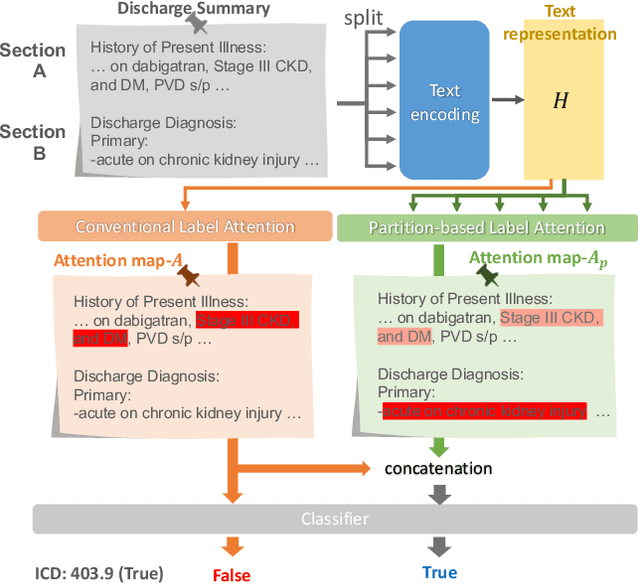
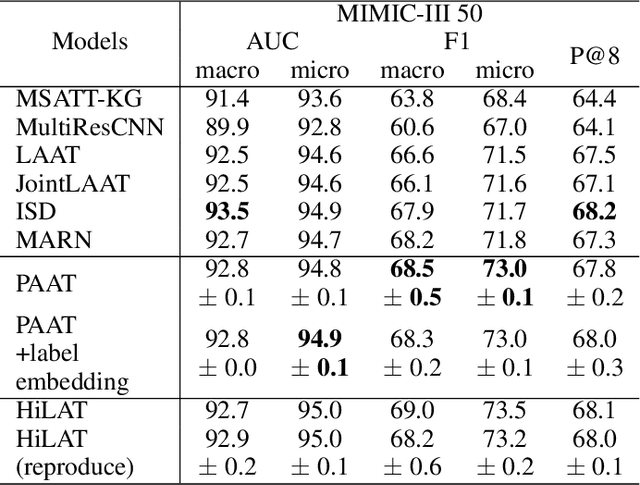
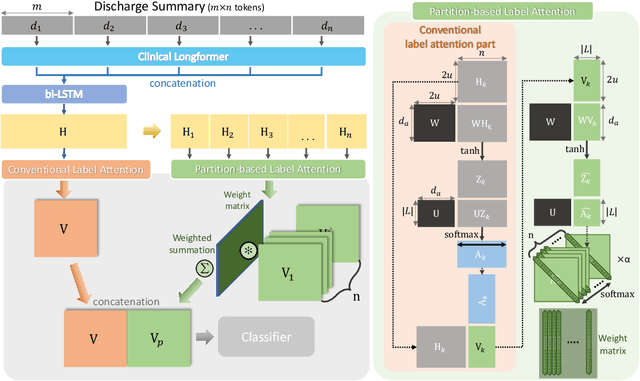
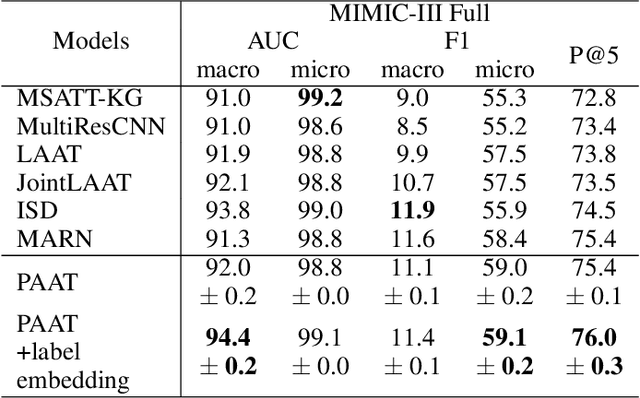
International Classification of Diseases (ICD) is a global medical classification system which provides unique codes for diagnoses and procedures appropriate to a patient's clinical record. However, manual coding by human coders is expensive and error-prone. Automatic ICD coding has the potential to solve this problem. With the advancement of deep learning technologies, many deep learning-based methods for automatic ICD coding are being developed. In particular, a label attention mechanism is effective for multi-label classification, i.e., the ICD coding. It effectively obtains the label-specific representations from the input clinical records. However, because the existing label attention mechanism finds key tokens in the entire text at once, the important information dispersed in each paragraph may be omitted from the attention map. To overcome this, we propose a novel neural network architecture composed of two parts of encoders and two kinds of label attention layers. The input text is segmentally encoded in the former encoder and integrated by the follower. Then, the conventional and partition-based label attention mechanisms extract important global and local feature representations. Our classifier effectively integrates them to enhance the ICD coding performance. We verified the proposed method using the MIMIC-III, a benchmark dataset of the ICD coding. Our results show that our network improves the ICD coding performance based on the partition-based mechanism.