 Add to Chrome
 Add to Firefox
 Add to Edge
SESSE: Sketch, Expand, Sort, Summarize, Evaluate -- LLM-as-Judge Evaluation via Structured Decomposition
Aug 18, 2026
LLM-as-judge evaluation reduces response quality assessment to a single holistic A/B preference choice, providing no mechanism to isolate which quality dimensions drove the preference or distinguish model errors from genuine label ambiguity. We propose SESSE (Sketch, Expand, Sort, Summarize, Evaluate), a training-free framework that decomposes holistic judgment into structured sub-questions mined directly from the judge's own error cases; requiring no oracle responses, task-specific rubrics, or fine-tuning. On RewardBench (n=1,000), SESSE achieves near-parity with the chain-of-thought baseline and is competitive with RISE-Judge-32B (92.7%), a fine-tuned specialist, while remaining fully training-free. Per-criterion vote evidence provides an interpretable audit trail for diagnosing label ambiguity and judge failure modes unavailable from a single holistic output token.

Improving group robustness under noisy labels using predictive uncertainty
Dec 14, 2022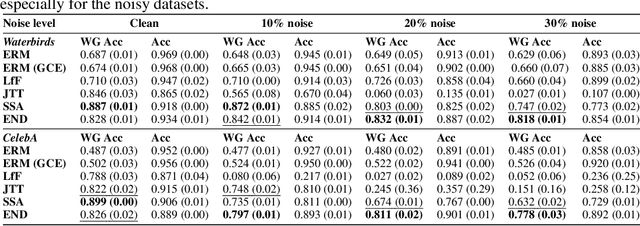

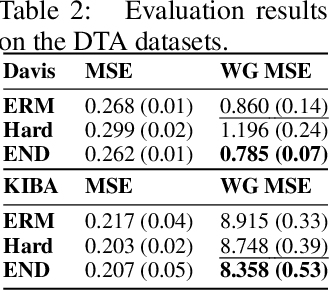
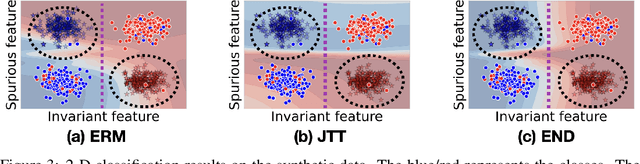
The standard empirical risk minimization (ERM) can underperform on certain minority groups (i.e., waterbirds in lands or landbirds in water) due to the spurious correlation between the input and its label. Several studies have improved the worst-group accuracy by focusing on the high-loss samples. The hypothesis behind this is that such high-loss samples are \textit{spurious-cue-free} (SCF) samples. However, these approaches can be problematic since the high-loss samples may also be samples with noisy labels in the real-world scenarios. To resolve this issue, we utilize the predictive uncertainty of a model to improve the worst-group accuracy under noisy labels. To motivate this, we theoretically show that the high-uncertainty samples are the SCF samples in the binary classification problem. This theoretical result implies that the predictive uncertainty is an adequate indicator to identify SCF samples in a noisy label setting. Motivated from this, we propose a novel ENtropy based Debiasing (END) framework that prevents models from learning the spurious cues while being robust to the noisy labels. In the END framework, we first train the \textit{identification model} to obtain the SCF samples from a training set using its predictive uncertainty. Then, another model is trained on the dataset augmented with an oversampled SCF set. The experimental results show that our END framework outperforms other strong baselines on several real-world benchmarks that consider both the noisy labels and the spurious-cues.