 Add to Chrome
 Add to Firefox
 Add to Edge
Fuzzy Adaptive Resonance Theory, Diffusion Maps and their applications to Clustering and Biclustering
Oct 06, 2015

In this paper, we describe an algorithm FARDiff (Fuzzy Adaptive Resonance Dif- fusion) which combines Diffusion Maps and Fuzzy Adaptive Resonance Theory to do clustering on high dimensional data. We describe some applications of this method and some problems for future research.
* Accepted in Math.Model.Nat.Phenom

Back-propagation of accuracy
Nov 15, 2004In this paper we solve the problem: how to determine maximal allowable errors, possible for signals and parameters of each element of a network proceeding from the condition that the vector of output signals of the network should be calculated with given accuracy? "Back-propagation of accuracy" is developed to solve this problem. The calculation of allowable errors for each element of network by back-propagation of accuracy is surprisingly similar to a back-propagation of error, because it is the backward signals motion, but at the same time it is very different because the new rules of signals transformation in the passing back through the elements are different. The method allows us to formulate the requirements to the accuracy of calculations and to the realization of technical devices, if the requirements to the accuracy of output signals of the network are known.
Neural network modeling of data with gaps: method of principal curves, Carleman's formula, and other
May 21, 2003
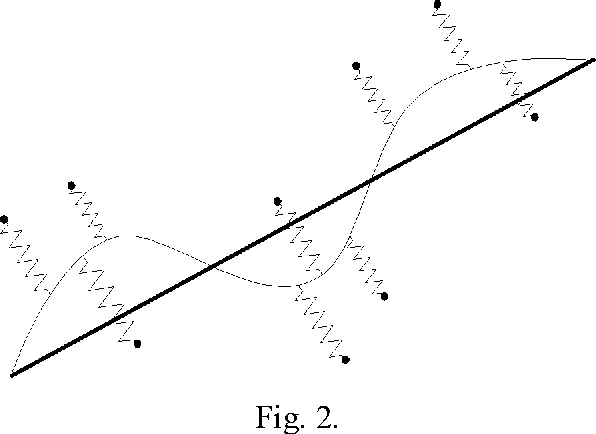


A method of modeling data with gaps by a sequence of curves has been developed. The new method is a generalization of iterative construction of singular expansion of matrices with gaps. Under discussion are three versions of the method featuring clear physical interpretation: linear - modeling the data by a sequence of linear manifolds of small dimension; quasilinear - constructing "principal curves: (or "principal surfaces"), univalently projected on the linear principal components; essentially non-linear - based on constructing "principal curves": (principal strings and beams) employing the variation principle; the iteration implementation of this method is close to Kohonen self-organizing maps. The derived dependencies are extrapolated by Carleman's formulas. The method is interpreted as a construction of neural network conveyor designed to solve the following problems: to fill gaps in data; to repair data - to correct initial data values in such a way as to make the constructed models work best; to construct a calculator to fill gaps in the data line fed to the input.