 Add to Chrome
 Add to Firefox
 Add to Edge
Energy Prediction on Sloping Ground for Quadruped Robots
Mar 12, 2026
Energy management is a fundamental challenge for legged robots in outdoor environments. Endurance directly constrains mission success, while efficient resource use reduces ecological impact. This paper investigates how terrain slope and heading orientation influence the energetic cost of quadruped locomotion. We introduce a simple energy model that relies solely on standard onboard sensors, avoids specialized instrumentation, and remains applicable in previously unexplored environments. The model is identified from field runs on a commercial quadruped and expressed as a compact function of slope angle and heading. Field validation on natural terrain shows near-linear trends of force-equivalent cost with slope angle, consistently higher lateral costs, and additive behavior across trajectory segments, supporting path-level energy prediction for planning-oriented evaluation.

Toward a Better Understanding of Robot Energy Consumption in Agroecological Applications
Oct 10, 2024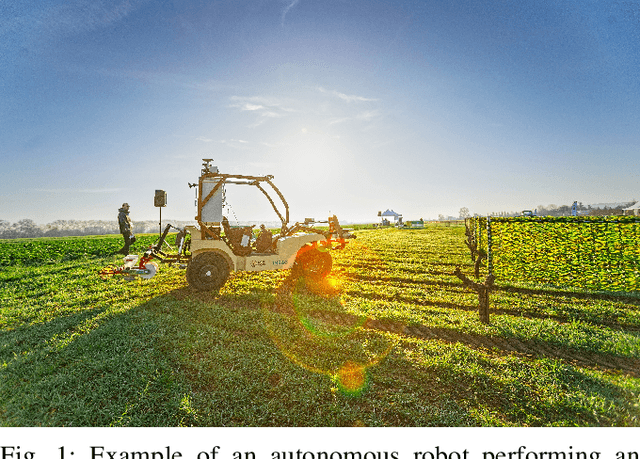


In this paper, we present a comprehensive analysis and discussion of energy consumption in agricultural robots. Robots are emerging as a promising solution to address food production and agroecological challenges, offering potential reductions in chemical use and the ability to perform strenuous tasks beyond human capabilities. The automation of agricultural tasks introduces a previously unattainable level of complexity, enabling robots to optimize trajectories, control laws, and overall task planning. Consequently, automation can lead to higher levels of energy optimization in agricultural tasks. However, the energy consumption of robotic platforms is not fully understood, and a deeper analysis of contributing factors is essential to optimize energy use. We analyze the energy data of an automated agricultural tractor performing tasks throughout the year, revealing nontrivial correlations between the robot's velocity, the type of task performed, and energy consumption. This suggests a tradeoff between task efficiency, time to completion, and energy expenditure that can be harnessed to improve the energy efficiency of robotic agricultural operations.