 Add to Chrome
 Add to Firefox
 Add to Edge
Towards Symmetry-sensitive Pose Estimation: A Rotation Representation for Symmetric Object Classes
Apr 20, 2026
Symmetric objects are common in daily life and industry, yet their inherent orientation ambiguities that impede the training of deep learning networks for pose estimation are rarely discussed in the literature. To cope with these ambiguities, existing solutions typically require the design of specific loss functions and network architectures or resort to symmetry-invariant evaluation metrics. In contrast, we focus on the numeric representation of the rotation itself, modifying trigonometric identities with the degrees of symmetry derived from the objects' shapes. We use our representation, SARR, to obtain canonic (symmetry-resolved) poses for the symmetric objects in two popular 6D pose estimation datasets, T-LESS and ITODD, where SARR is unique and continuous w.r.t. the visual appearance. This allows us to use a standard CNN for 3D orientation estimation whose performance is evaluated with the symmetry-sensitive cosine distance $\text{AR}_{\text{C}}$. Our networks outperform the state of the art using $\text{AR}_{\text{C}}$ and achieve satisfactory performance when using conventional symmetry-invariant measures. Our method does not require any 3D models but only depth, or, as part of an additional experiment, texture-less RGB/grayscale images as input. We also show that networks trained on SARR outperform the same networks trained on rotation matrices, Euler angles, quaternions, standard trigonometrics or the recently popular 6d representation -- even in inference scenarios where no prior knowledge of the objects' symmetry properties is available. Code and a visualization toolkit are available at https://github.com/akriegler/SARR .
* Published Open-Access in IJCV, see https://link.springer.com/article/10.1007/s11263-026-02770-x . 28 pages, 6 figures, 9 tables, 1 algorithm

ADAPT: An Autonomous Forklift for Construction Site Operation
Mar 18, 2025
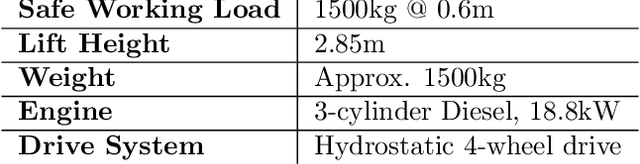
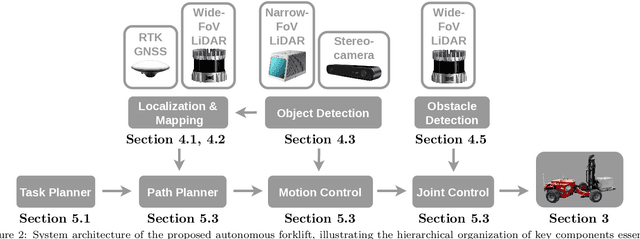
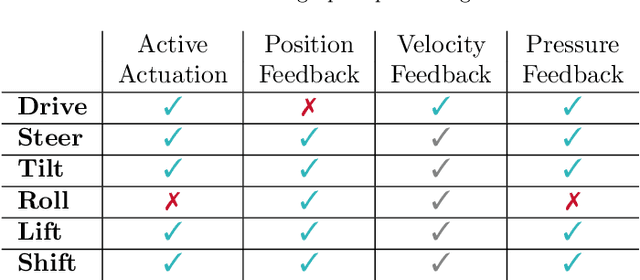
Efficient material logistics play a critical role in controlling costs and schedules in the construction industry. However, manual material handling remains prone to inefficiencies, delays, and safety risks. Autonomous forklifts offer a promising solution to streamline on-site logistics, reducing reliance on human operators and mitigating labor shortages. This paper presents the development and evaluation of the Autonomous Dynamic All-terrain Pallet Transporter (ADAPT), a fully autonomous off-road forklift designed for construction environments. Unlike structured warehouse settings, construction sites pose significant challenges, including dynamic obstacles, unstructured terrain, and varying weather conditions. To address these challenges, our system integrates AI-driven perception techniques with traditional approaches for decision making, planning, and control, enabling reliable operation in complex environments. We validate the system through extensive real-world testing, comparing its long-term performance against an experienced human operator across various weather conditions. We also provide a comprehensive analysis of challenges and key lessons learned, contributing to the advancement of autonomous heavy machinery. Our findings demonstrate that autonomous outdoor forklifts can operate near human-level performance, offering a viable path toward safer and more efficient construction logistics.
TalkWithMachines: Enhancing Human-Robot Interaction for Interpretable Industrial Robotics Through Large/Vision Language Models
Dec 19, 2024

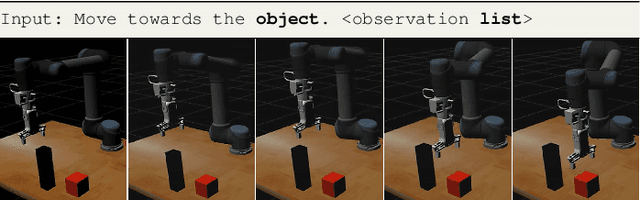
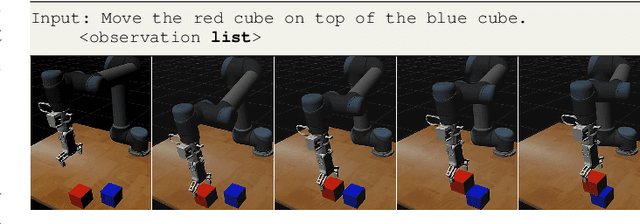
TalkWithMachines aims to enhance human-robot interaction by contributing to interpretable industrial robotic systems, especially for safety-critical applications. The presented paper investigates recent advancements in Large Language Models (LLMs) and Vision Language Models (VLMs), in combination with robotic perception and control. This integration allows robots to understand and execute commands given in natural language and to perceive their environment through visual and/or descriptive inputs. Moreover, translating the LLM's internal states and reasoning into text that humans can easily understand ensures that operators gain a clearer insight into the robot's current state and intentions, which is essential for effective and safe operation. Our paper outlines four LLM-assisted simulated robotic control workflows, which explore (i) low-level control, (ii) the generation of language-based feedback that describes the robot's internal states, (iii) the use of visual information as additional input, and (iv) the use of robot structure information for generating task plans and feedback, taking the robot's physical capabilities and limitations into account. The proposed concepts are presented in a set of experiments, along with a brief discussion. Project description, videos, and supplementary materials will be available on the project website: https://talk-machines.github.io.
RGB-D Railway Platform Monitoring and Scene Understanding for Enhanced Passenger Safety
Feb 23, 2021


Automated monitoring and analysis of passenger movement in safety-critical parts of transport infrastructures represent a relevant visual surveillance task. Recent breakthroughs in visual representation learning and spatial sensing opened up new possibilities for detecting and tracking humans and objects within a 3D spatial context. This paper proposes a flexible analysis scheme and a thorough evaluation of various processing pipelines to detect and track humans on a ground plane, calibrated automatically via stereo depth and pedestrian detection. We consider multiple combinations within a set of RGB- and depth-based detection and tracking modalities. We exploit the modular concepts of Meshroom [2] and demonstrate its use as a generic vision processing pipeline and scalable evaluation framework. Furthermore, we introduce a novel open RGB-D railway platform dataset with annotations to support research activities in automated RGB-D surveillance. We present quantitative results for multiple object detection and tracking for various algorithmic combinations on our dataset. Results indicate that the combined use of depth-based spatial information and learned representations yields substantially enhanced detection and tracking accuracies. As demonstrated, these enhancements are especially pronounced in adverse situations when occlusions and objects not captured by learned representations are present.
* The final authenticated version is available online at https://doi.org/10.1007/978-3-030-68787-8_47