 Add to Chrome
 Add to Firefox
 Add to Edge
Real-time body pose non-verbal communication with a consistency-based reliability measure
Jun 08, 2026
Body movement communicates intent at distances and in conditions where neither the face, nor speech can be captured. We study the recognition of communicative intent from 2D body pose alone. We argue that body motion is a reliable signal especially in scenarios that require real time low-cost on-device person-to-robot communication in long distance environments, such as rescue missions. However, existing resources do not isolate this signal. Affective corpora combine body, face, voice and text, while skeleton action-recognition benchmarks label the action performed rather than the message conveyed. We release a dataset of real frames of full-body pose covering ten communicative intents and we compare it against other real (IPC) and synthetic (MotionLCM, VEO3.1, Kimodo) ones that span a range of difficulty. We target systems that can run on a robot's limited onboard hardware. We benchmark multiple models, from skeleton graph classifiers to joint motion-forecasting networks, and report performance metrics together with frame rate on an embedded GPU (NVIDIA Orin~Nano), since speed matters as much as accuracy in our scenario. Finally, we show that a model's own autoregressive self-consistency works as an unsupervised reliability signal. We give a short proof that bounds the probability that a self-consistent prediction is correct, show that this probability grows with the number of consistent steps, and identify the conditions under which a confident prediction can still be false, benchmarked against industry-standard metrics.

Non-verbal Real-time Human-AI Interaction in Constrained Robotic Environments
Mar 02, 2026We study the ongoing debate regarding the statistical fidelity of AI-generated data compared to human-generated data in the context of non-verbal communication using full body motion. Concretely, we ask if contemporary generative models move beyond surface mimicry to participate in the silent, but expressive dialogue of body language. We tackle this question by introducing the first framework that generates a natural non-verbal interaction between Human and AI in real-time from 2D body keypoints. Our experiments utilize four lightweight architectures which run at up to 100 FPS on an NVIDIA Orin Nano, effectively closing the perception-action loop needed for natural Human-AI interaction. We trained on 437 human video clips and demonstrated that pretraining on synthetically-generated sequences reduces motion errors significantly, without sacrificing speed. Yet, a measurable reality gap persists. When the best model is evaluated on keypoints extracted from cutting-edge text-to-video systems, such as SORA and VEO, we observe that performance drops on SORA-generated clips. However, it degrades far less on VEO, suggesting that temporal coherence, not image fidelity, drives real-world performance. Our results demonstrate that statistically distinguishable differences persist between Human and AI motion.
Maia: A Real-time Non-Verbal Chat for Human-AI Interaction
Feb 09, 2024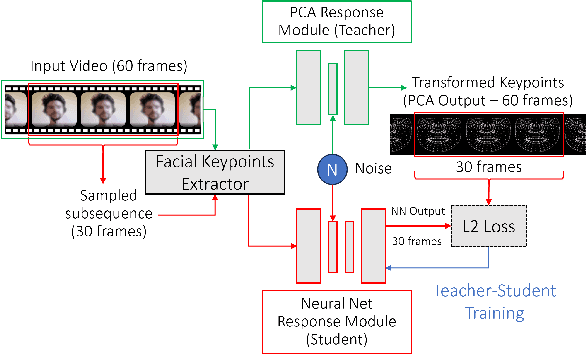
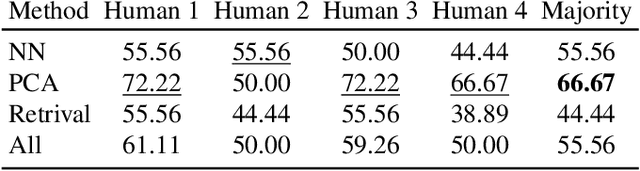
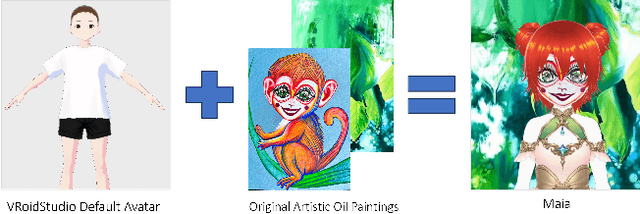

Face-to-face communication modeling in computer vision is an area of research focusing on developing algorithms that can recognize and analyze non-verbal cues and behaviors during face-to-face interactions. We propose an alternative to text chats for Human-AI interaction, based on non-verbal visual communication only, using facial expressions and head movements that mirror, but also improvise over the human user, to efficiently engage with the users, and capture their attention in a low-cost and real-time fashion. Our goal is to track and analyze facial expressions, and other non-verbal cues in real-time, and use this information to build models that can predict and understand human behavior. We offer three different complementary approaches, based on retrieval, statistical, and deep learning techniques. We provide human as well as automatic evaluations and discuss the advantages and disadvantages of each direction.