 Add to Chrome
 Add to Firefox
 Add to Edge
Vision-Language Model Reasoning for Contextual Semantic Mapping in Intralogistics
Jun 23, 2026
Autonomous mobile robots operating in intralogistics environments rely on geometric maps for localization and navigation, but lack semantic understanding of objects and their contextual properties. We present a contextual semantic mapping pipeline that combines SLAM-based geometric mapping, SAM-based instance segmentation, instance clustering, and VLM multi-view reasoning to produce a contextual semantic map representation encoding geometric structure, object class, and object movability. By aggregating observations across multiple viewpoints and querying a VLM in a zero-shot, open-vocabulary setting, the pipeline infers contextual object properties--here demonstrated through movability--without requiring task-specific training or predefined object categories. We evaluate three VLMs under two prompting strategies and conduct a component-wise analysis of the pipeline. The proposed pipeline achieves 98.93 % mIoU for semantic classification and 89.17 % mAcc for object movability estimation. Component analysis identifies VLM reasoning as the primary bottleneck for contextual understanding and instance clustering as the main limitation for panoptic performance. The resulting semantic map supports context-aware filtering and robust navigation in dynamic intralogistics environments.

Automated Generation of Continuous-Space Roadmaps for Routing Mobile Robot Fleets
Nov 10, 2025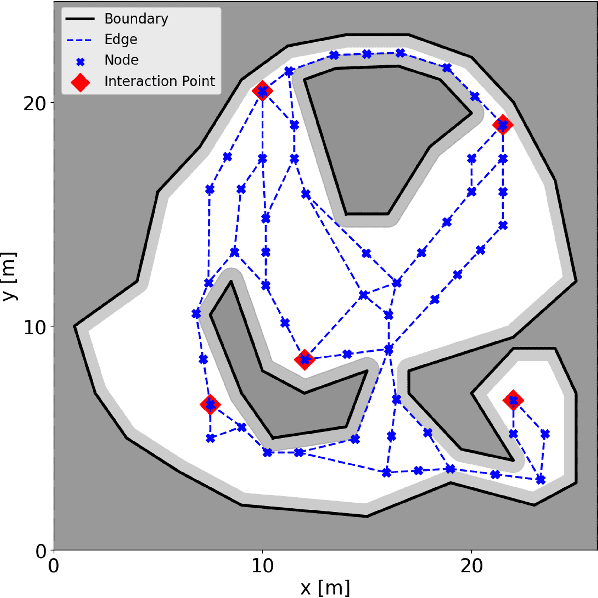
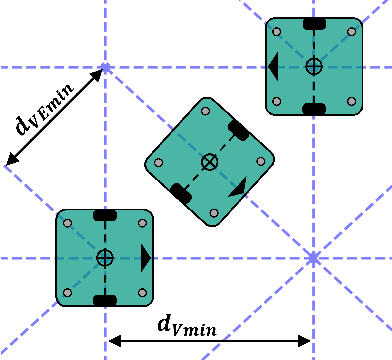
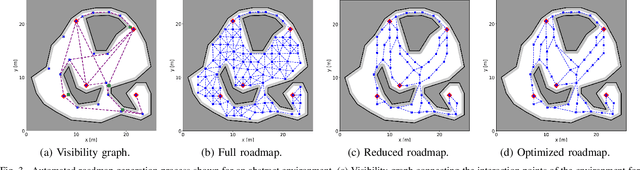
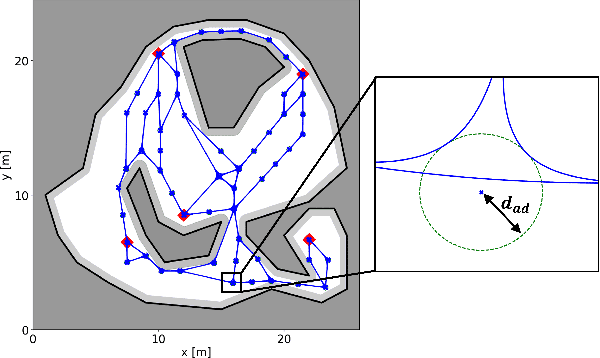
Efficient routing of mobile robot fleets is crucial in intralogistics, where delays and deadlocks can substantially reduce system throughput. Roadmap design, specifying feasible transport routes, directly affects fleet coordination and computational performance. Existing approaches are either grid-based, compromising geometric precision, or continuous-space approaches that disregard practical constraints. This paper presents an automated roadmap generation approach that bridges this gap by operating in continuous-space, integrating station-to-station transport demand and enforcing minimum distance constraints for nodes and edges. By combining free space discretization, transport demand-driven $K$-shortest-path optimization, and path smoothing, the approach produces roadmaps tailored to intralogistics applications. Evaluation across multiple intralogistics use cases demonstrates that the proposed approach consistently outperforms established baselines (4-connected grid, 8-connected grid, and random sampling), achieving lower structural complexity, higher redundancy, and near-optimal path lengths, enabling efficient and robust routing of mobile robot fleets.