 Add to Chrome
 Add to Firefox
 Add to Edge
Collective Ranking of Environmental Signals through Gaussian Belief Propagation in a Patrolling Robot Swarm
Aug 18, 2026
Multi-robot patrolling requires a team to visit all areas of an environment at regular intervals, typically minimising idleness. A practical extension, motivated by security and environmental monitoring, is to additionally form a collective ranking of all patrol locations by some measured signal, a generalisation of the best-of-n problem to the many-option, continuous-valued regime. We observe that the patrol graph admits a natural dual interpretation: it is simultaneously the topology that dictates agent movement and a factor graph over which spatial beliefs can be propagated. Exploiting this equivalence, we apply Gaussian Belief Propagation (GBP), a graph-based algorithm, to collective ranking using unary measurement factors at visited nodes and pairwise smoothness factors along patrol edges. We compare GBP against simple and visit-count-weighted averaging across a range of sensor-noise conditions in simulation, and validate the approach on four Leo Rovers tracking a propagating radio signal in an office lobby. GBP outperforms both baselines on ranking accuracy, mean squared error, and time to consensus. We find that as noise increases and the task becomes harder, GBP degrades gracefully in simulation while both averaging methods degrade substantially. Hardware trials reproduce the same performance ordering on a real propagating radio signal, supporting the practical relevance of the simulated results.

Heterogeneity in Multi-Robot Environmental Monitoring for Resolving Time-Conflicting Tasks
Dec 09, 2025Multi-robot systems performing continuous tasks face a performance trade-off when interrupted by urgent, time-critical sub-tasks. We investigate this trade-off in a scenario where a team must balance area patrolling with locating an anomalous radio signal. To address this trade-off, we evaluate both behavioral heterogeneity through agent role specialization ("patrollers" and "searchers") and sensing heterogeneity (i.e., only the searchers can sense the radio signal). Through simulation, we identify the Pareto-optimal trade-offs under varying team compositions, with behaviorally heterogeneous teams demonstrating the most balanced trade-offs in the majority of cases. When sensing capability is restricted, heterogeneous teams with half of the sensing-capable agents perform comparably to homogeneous teams, providing cost-saving rationale for restricting sensor payload deployment. Our findings demonstrate that pre-deployment role and sensing specialization are powerful design considerations for multi-robot systems facing time-conflicting tasks, where varying the degree of behavioral heterogeneity can tune system performance toward either task.
Shaping Multi-Robot Patrol Performance with Heterogeneity in Individual Learning Behavior
Mar 02, 2024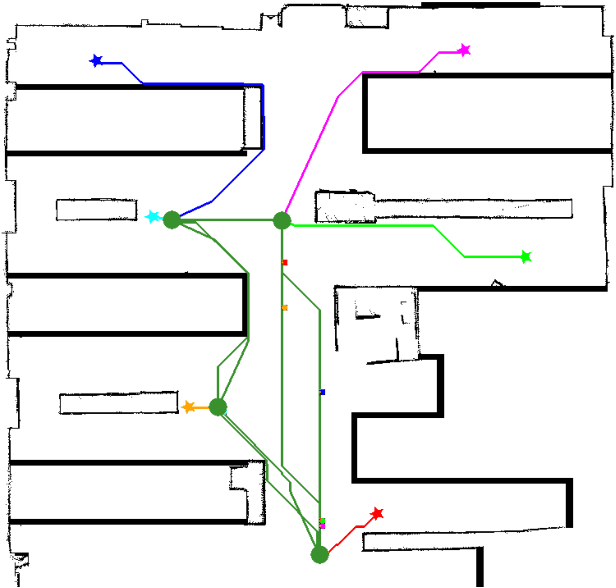
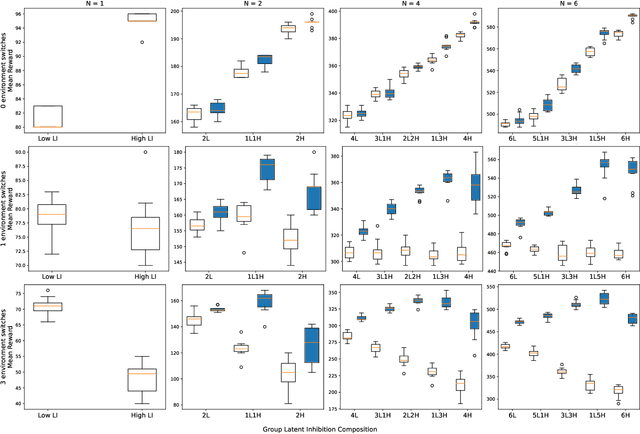
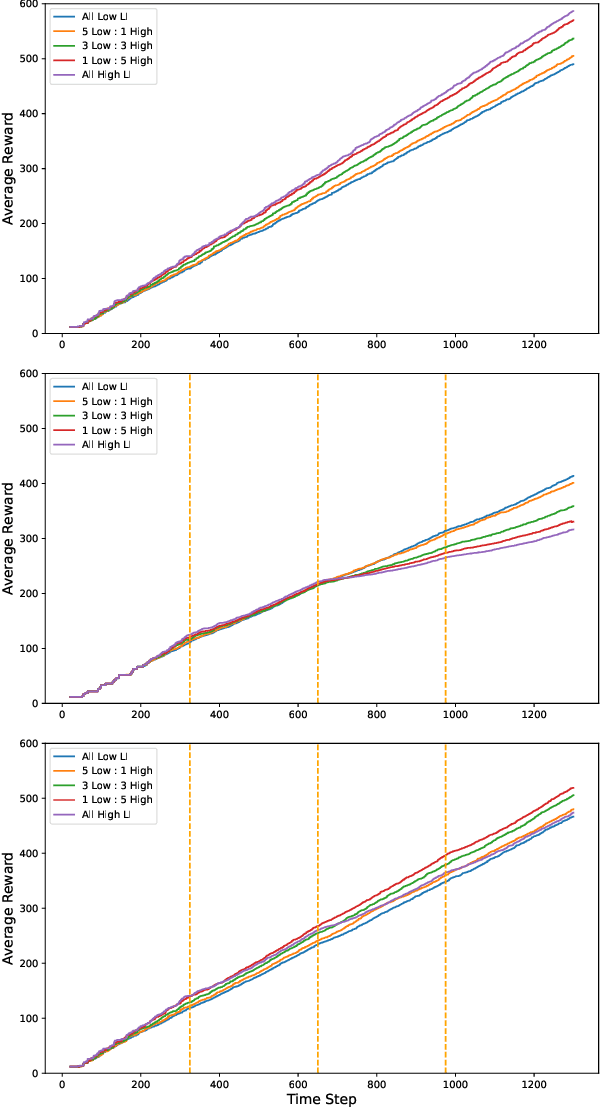
Individual differences in learning behavior within social groups, whether in humans, other animals, or among robots, can have significant effects on collective task performance. This is because it can affect individuals' response to the environment and their interactions with each other. In recent years there has been rising interest in the question of how individual differences, whether in learning or other traits, affect collective outcomes: studied, for example, in social insect foraging behavior. Multi-robot, 'swarm' systems have a heritage of bioinspiration from such examples, and here we consider whether heterogeneity in a learning behavior called latent inhibition (LI) may be useful for a team of patrolling robots tasked with environmental monitoring and anomaly detection. Individuals with high LI can be seen as better at learning to be inattentive to irrelevant or unrewarding stimuli, while low LI individuals might be seen as 'distractible' and yet, more positively, more exploratory. We introduce a simple model of the effects of LI as the probability of re-searching a location for a reward (anomalous reading) where it has previously been found to be unrewarding (irrelevant). In simulated patrols, we find that a negatively skewed distribution of mostly high LI robots, and just a single low LI robot, is collectively most effective at monitoring dynamic environments. These results are an example of 'functional heterogeneity' in 'swarm engineering' and could inform predictions for ecological distributions of learning traits within social groups.