 Add to Chrome
 Add to Firefox
 Add to Edge
Monitoring Deployed AI Systems in Health Care
Dec 09, 2025
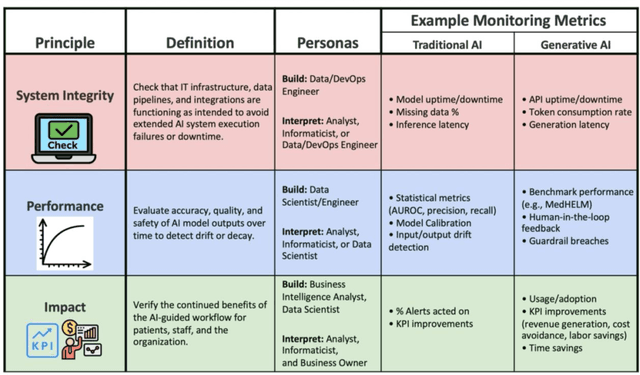
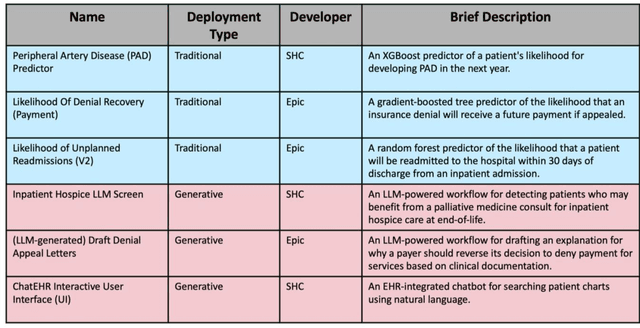
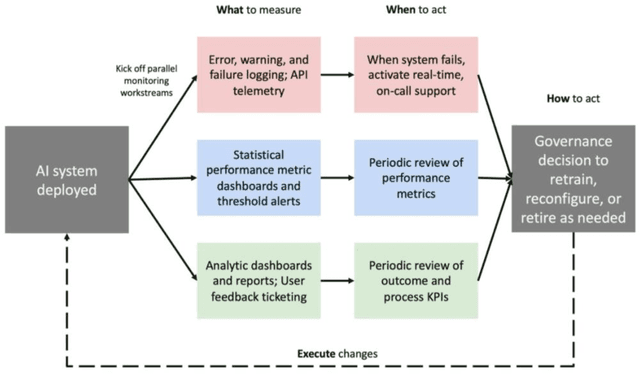
Post-deployment monitoring of artificial intelligence (AI) systems in health care is essential to ensure their safety, quality, and sustained benefit-and to support governance decisions about which systems to update, modify, or decommission. Motivated by these needs, we developed a framework for monitoring deployed AI systems grounded in the mandate to take specific actions when they fail to behave as intended. This framework, which is now actively used at Stanford Health Care, is organized around three complementary principles: system integrity, performance, and impact. System integrity monitoring focuses on maximizing system uptime, detecting runtime errors, and identifying when changes to the surrounding IT ecosystem have unintended effects. Performance monitoring focuses on maintaining accurate system behavior in the face of changing health care practices (and thus input data) over time. Impact monitoring assesses whether a deployed system continues to have value in the form of benefit to clinicians and patients. Drawing on examples of deployed AI systems at our academic medical center, we provide practical guidance for creating monitoring plans based on these principles that specify which metrics to measure, when those metrics should be reviewed, who is responsible for acting when metrics change, and what concrete follow-up actions should be taken-for both traditional and generative AI. We also discuss challenges to implementing this framework, including the effort and cost of monitoring for health systems with limited resources and the difficulty of incorporating data-driven monitoring practices into complex organizations where conflicting priorities and definitions of success often coexist. This framework offers a practical template and starting point for health systems seeking to ensure that AI deployments remain safe and effective over time.

CORONA-Fields: Leveraging Foundation Models for Classification of Solar Wind Phenomena
Nov 13, 2025Space weather at Earth, driven by the solar activity, poses growing risks to satellites around our planet as well as to critical ground-based technological infrastructure. Major space weather contributors are the solar wind and coronal mass ejections whose variable density, speed, temperature, and magnetic field make the automated classification of those structures challenging. In this work, we adapt a foundation model for solar physics, originally trained on Solar Dynamics Observatory imagery, to create embeddings suitable for solar wind structure analysis. These embeddings are concatenated with the spacecraft position and solar magnetic connectivity encoded using Fourier features which generates a neural field-based model. The full deep learning architecture is fine-tuned bridging the gap between remote sensing and in situ observations. Labels are derived from Parker Solar Probe measurements, forming a downstream classification task that maps plasma properties to solar wind structures. Although overall classification performance is modest, likely due to coarse labeling, class imbalance, and limited transferability of the pretrained model, this study demonstrates the feasibility of leveraging foundation model embeddings for in situ solar wind tasks. As a first proof-of-concept, it lays the groundwork for future improvements toward more reliable space weather predictions. The code and configuration files used in this study are publicly available to support reproducibility.