 Add to Chrome
 Add to Firefox
 Add to Edge
When Does Trimming Help Conformal Prediction? A Retained-Law Diagnostic under Calibration Contamination
May 07, 2026
Trimming suspicious calibration points is a common response to contamination in conformal prediction. Its effect on clean-target coverage, however, is governed by the retained law induced by trimming, not by the contamination level alone. We analyse fixed-threshold trimming as conditioning rather than purification. It replaces the contaminated calibration law with a retained law, reducing clean-target coverage to a one-dimensional score-CDF transfer problem with an exact finite-sample identity. A componentwise bound on the transfer gap gives a population-level diagnostic. This separates a clean-side covariance cost from a retained-contamination cost, governed by the dirty-to-clean retention ratio. Trimming helps when the anomaly score separates retention probabilities while remaining score-neutral on the clean population. Otherwise, it cannot substantially reduce contamination through the retained mixture coefficient. We also give finite-sample certificate templates that provide numerical guarantees under independent audit.

Reinforcement Learning for Adaptive MCMC
May 22, 2024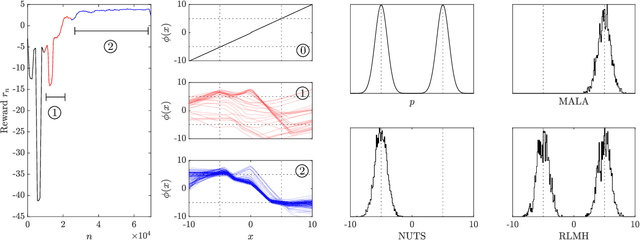
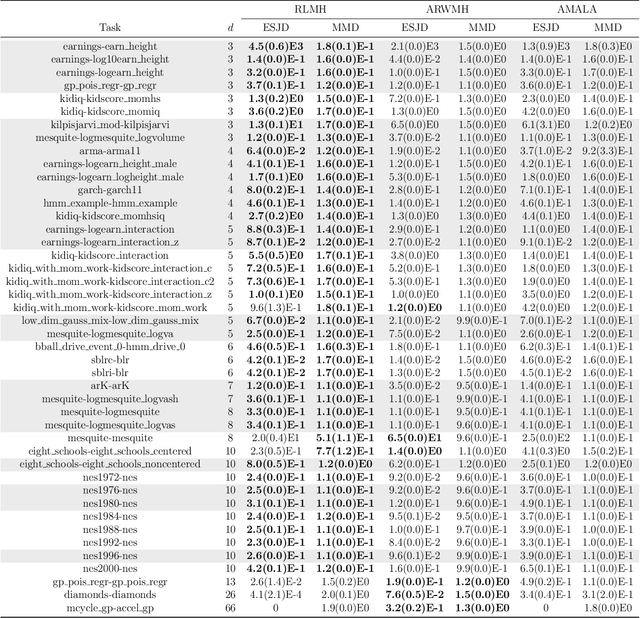
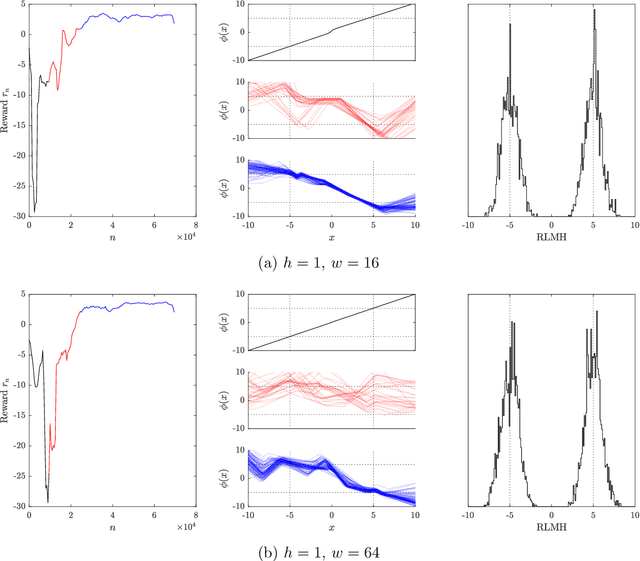

An informal observation, made by several authors, is that the adaptive design of a Markov transition kernel has the flavour of a reinforcement learning task. Yet, to-date it has remained unclear how to actually exploit modern reinforcement learning technologies for adaptive MCMC. The aim of this paper is to set out a general framework, called Reinforcement Learning Metropolis--Hastings, that is theoretically supported and empirically validated. Our principal focus is on learning fast-mixing Metropolis--Hastings transition kernels, which we cast as deterministic policies and optimise via a policy gradient. Control of the learning rate provably ensures conditions for ergodicity are satisfied. The methodology is used to construct a gradient-free sampler that out-performs a popular gradient-free adaptive Metropolis--Hastings algorithm on $\approx 90 \%$ of tasks in the PosteriorDB benchmark.