 Add to Chrome
 Add to Firefox
 Add to Edge
Preference Learning from Physics-Based Feedback: Tuning Language Models to Design BCC/B2 Superalloys
Nov 15, 2025
We apply preference learning to the task of language model-guided design of novel structural alloys. In contrast to prior work that focuses on generating stable inorganic crystals, our approach targets the synthesizeability of a specific structural class: BCC/B2 superalloys, an underexplored family of materials with potential applications in extreme environments. Using three open-weight models (LLaMA-3.1, Gemma-2, and OLMo-2), we demonstrate that language models can be optimized for multiple design objectives using a single, unified reward signal through Direct Preference Optimization (DPO). Unlike prior approaches that rely on heuristic or human-in-the-loop feedback (costly), our reward signal is derived from thermodynamic phase calculations, offering a scientifically grounded criterion for model tuning. To our knowledge, this is the first demonstration of preference-tuning a language model using physics-grounded feedback for structural alloy design. The resulting framework is general and extensible, providing a path forward for intelligent design-space exploration across a range of physical science domains.

Toward Reliable Ad-hoc Scientific Information Extraction: A Case Study on Two Materials Datasets
Jun 08, 2024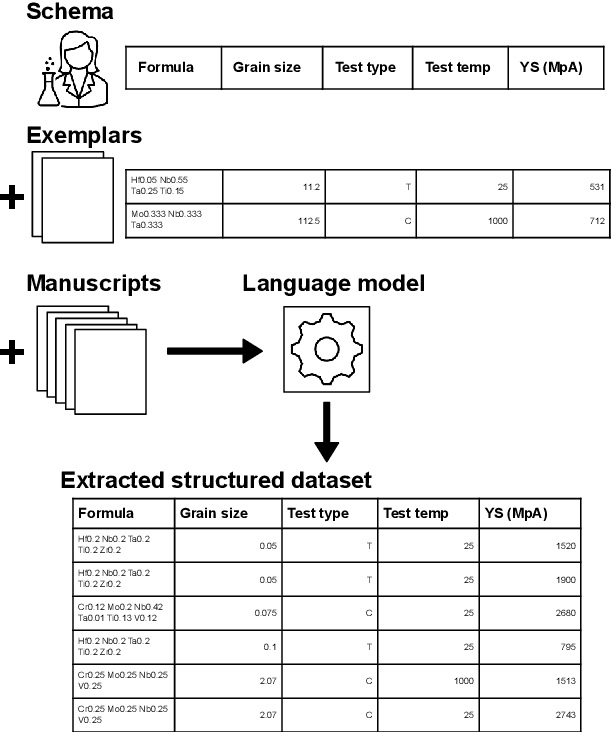
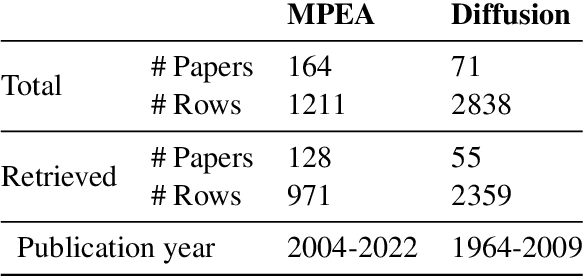
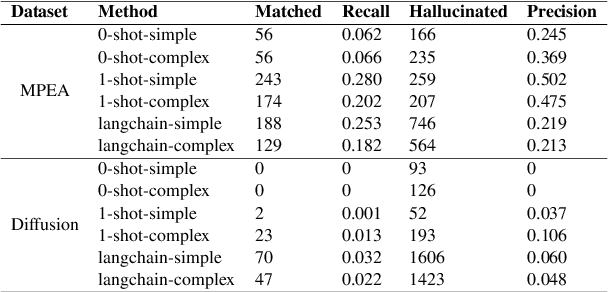
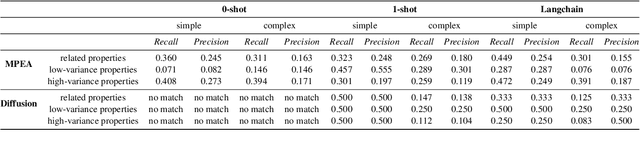
We explore the ability of GPT-4 to perform ad-hoc schema based information extraction from scientific literature. We assess specifically whether it can, with a basic prompting approach, replicate two existing material science datasets, given the manuscripts from which they were originally manually extracted. We employ materials scientists to perform a detailed manual error analysis to assess where the model struggles to faithfully extract the desired information, and draw on their insights to suggest research directions to address this broadly important task.