 Add to Chrome
 Add to Firefox
 Add to Edge
Across the Levels of Analysis: Explaining Predictive Processing in Humans Requires More Than Machine-Estimated Probabilities
Apr 10, 2026
Under the lens of Marr's levels of analysis, we critique and extend two claims about language models (LMs) and language processing: first, that predicting upcoming linguistic information based on context is central to language processing, and second, that many advances in psycholinguistics would be impossible without large language models (LLMs). We further outline future directions that combine the strengths of LLMs with psycholinguistic models.

Assessing Composition in Sentence Vector Representations
Sep 11, 2018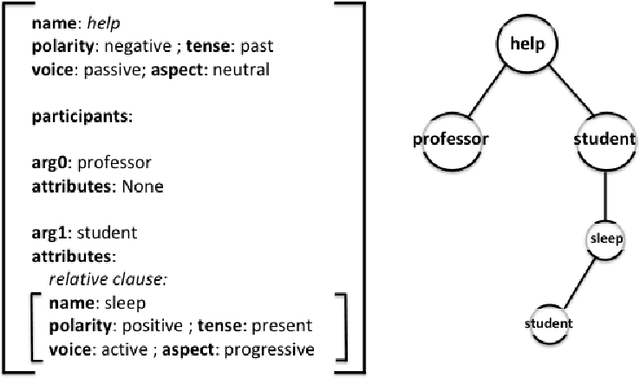
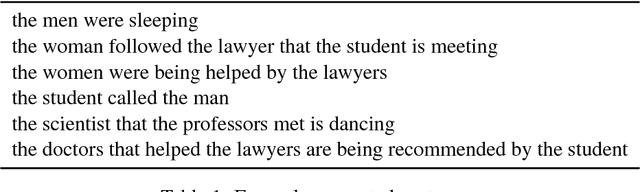
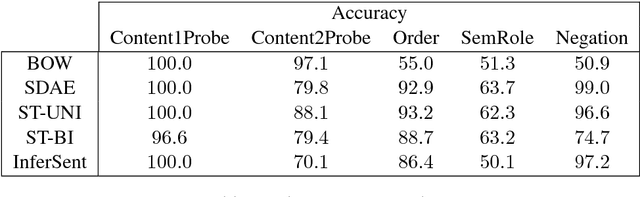
An important component of achieving language understanding is mastering the composition of sentence meaning, but an immediate challenge to solving this problem is the opacity of sentence vector representations produced by current neural sentence composition models. We present a method to address this challenge, developing tasks that directly target compositional meaning information in sentence vector representations with a high degree of precision and control. To enable the creation of these controlled tasks, we introduce a specialized sentence generation system that produces large, annotated sentence sets meeting specified syntactic, semantic and lexical constraints. We describe the details of the method and generation system, and then present results of experiments applying our method to probe for compositional information in embeddings from a number of existing sentence composition models. We find that the method is able to extract useful information about the differing capacities of these models, and we discuss the implications of our results with respect to these systems' capturing of sentence information. We make available for public use the datasets used for these experiments, as well as the generation system.
* COLING 2018