 Add to Chrome
 Add to Firefox
 Add to Edge
Hypercomplex Widely Linear Processing: Fundamentals for Quaternion Machine Learning
Mar 12, 2026
Numerous attempts have been made to replicate the success of complex-valued algebra in engineering and science to other hypercomplex domains such as quaternions, tessarines, biquaternions, and octonions. Perhaps, none have matched the success of quaternions. The most useful feature of quaternions lies in their ability to model three-dimensional rotations which, in turn, have found various industrial applications such as in aeronautics and computergraphics. Recently, we have witnessed a renaissance of quaternions due to the rise of machine learning. To equip the reader to contribute to this emerging research area, this chapter lays down the foundation for: - augmented statistics for modelling quaternion-valued random processes, - widely linear models to exploit such advanced statistics, - quaternion calculus and algebra for algorithmic derivations, - mean square estimation for practical considerations. For ease of exposure, several examples are offered to facilitate the learning, understanding, and(hopefully) the adoption of this multidimensional domain.

A Quantum of Learning: Using Quaternion Algebra to Model Learning on Quantum Devices
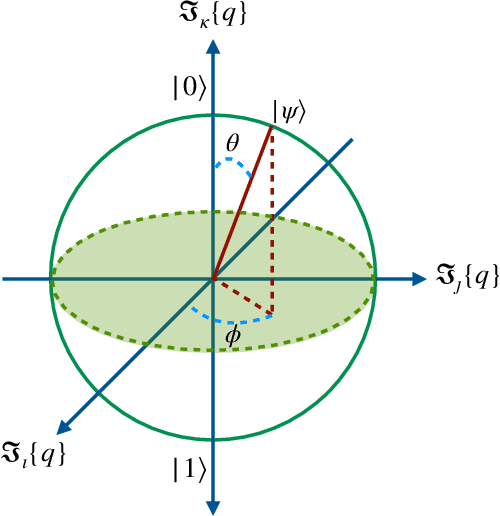
Apr 17, 2025This article considers the problem of designing adaption and optimisation techniques for training quantum learning machines. To this end, the division algebra of quaternions is used to derive an effective model for representing computation and measurement operations on qubits. In turn, the derived model, serves as the foundation for formulating an adaptive learning problem on principal quantum learning units, thereby establishing quantum information processing units akin to that of neurons in classical approaches. Then, leveraging the modern HR-calculus, a comprehensive training framework for learning on quantum machines is developed. The quaternion-valued model accommodates mathematical tractability and establishment of performance criteria, such as convergence conditions.
The HR-Calculus: Enabling Information Processing with Quaternion Algebra
Nov 28, 2023


From their inception, quaternions and their division algebra have proven to be advantageous in modelling rotation/orientation in three-dimensional spaces and have seen use from the initial formulation of electromagnetic filed theory through to forming the basis of quantum filed theory. Despite their impressive versatility in modelling real-world phenomena, adaptive information processing techniques specifically designed for quaternion-valued signals have only recently come to the attention of the machine learning, signal processing, and control communities. The most important development in this direction is introduction of the HR-calculus, which provides the required mathematical foundation for deriving adaptive information processing techniques directly in the quaternion domain. In this article, the foundations of the HR-calculus are revised and the required tools for deriving adaptive learning techniques suitable for dealing with quaternion-valued signals, such as the gradient operator, chain and product derivative rules, and Taylor series expansion are presented. This serves to establish the most important applications of adaptive information processing in the quaternion domain for both single-node and multi-node formulations. The article is supported by Supplementary Material, which will be referred to as SM.