 Add to Chrome
 Add to Firefox
 Add to Edge
Rank-Aware Link Adaptation for XR Tethering Groups with Realistic Tethering Link: A Multi-Offset OLLA Framework
Apr 22, 2026
We investigate higher-rank transmissions for multi-connected Extended Reality (XR) devices enabled through tethering group (TGr), in which a nearby tethering User Equipment (UE) cooperates with an XR UE via a short-range tethering link (TL). In contrast to prior studies that are limited to rank-1 transmission and ideal tethering assumptions, we analyze TGr performance under higher-rank point-to-multipoint (PTM) transmission and realistic TL delays. Conventional single Outer Loop Link Adaptation (OLLA) offset results in inaccurate throughput prediction across ranks, leading to suboptimal rank selection. To address this limitation, we propose a multi-offset Outer Loop Link Adaptation (MO-OLLA) framework that introduces rank-dependent signal-to-interference-plus-noise ratio (SINR) correction to improve Link Adaptation (LA) accuracy. Furthermore, a Wireless Fidelity (WiFi) based delay model is incorporated to characterize the impact of practical TL constraints including limited bandwidth and achievable throughput on XR capacity and cellular resource utilization, providing the first such analysis for higher-rank multi-connected XR device. System-level simulations demonstrate that MO-OLLA provides up to 20% performance improvement over conventional OLLA for multi-connected XR UEs. Moreover, TGrs effectively exploit higher-rank transmission, achieving XR capacity gains of 180-200% over single-link XR UEs under ideal TL conditions. Critically, the gains of the TGr remain at 165-180% under realistic high-throughput TLs relative to single-link XR UEs, confirming the practical viability of TGr based cooperation for XR capacity enhancements within existing cellular resources.

XR Capacity Enhancement through Multi-Connected XR Tethering Groups
Dec 13, 2025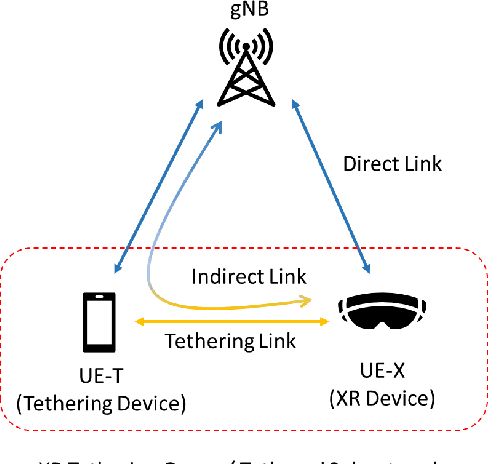
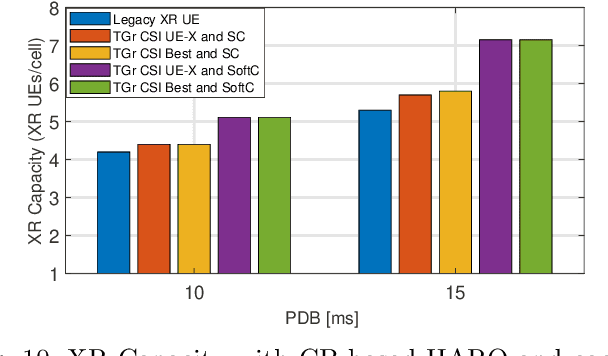
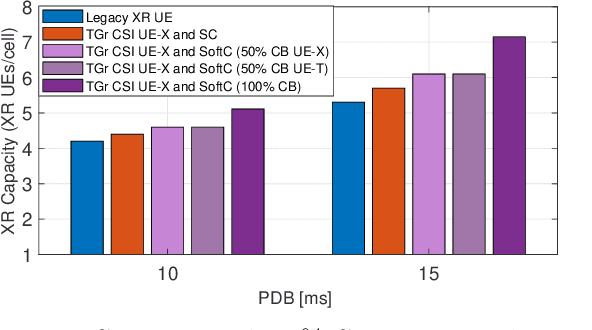
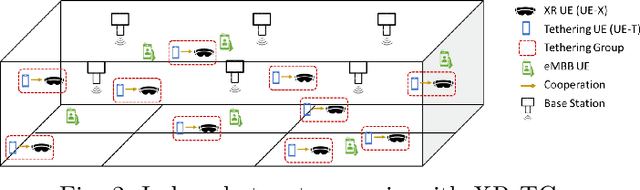
Extended Reality (XR) applications have limited capacity in 5th generation-advanced (5G-A) cellular networks due to high throughput requirements coupled with strict latency and high reliability constraints. To enhance XR capacity in the downlink (DL), this paper investigates multi-connected XR tethering groups (TGrs), comprising an XR device and a cooperating 5G-A device. This paper presents investigations for two types of cooperation within XR TGr, i.e., selection combining (SC) and soft combining and their impact on the XR capacity of the network. These investigations consider joint hybrid automatic repeat request (HARQ) feedback processing algorithm and also propose enhanced joint Outer Loop Link Adaptation (OLLA) algorithm to leverage the benefits of multi-connectivity. These enhancements aim to improve the spectral efficiency of the network by limiting HARQ retransmissions and enabling the use of higher modulation and coding scheme (MCS) indices for given signal-to-interference-plus-noise ratio (SINR), all while maintaining or operating below than the target block error rate (BLER). Dynamic system-level simulation demonstrate that XR TGrs with soft combining achieve performance improvements of 23 - 42% in XR capacity with only XR users and 38-173% in the coexistence scenarios consisting of XR users and enhanced mobile broadband (eMBB) user. Furthermore, the enhanced joint OLLA algorithm enables similar performance gains even when only one device per XR TGr provides channel state information (CSI) reports, compared to scenarios where both devices report CSI. Notably, XR TGrs with soft combining also enhance eMBB throughput in coexistence scenarios.