 Add to Chrome
 Add to Firefox
 Add to Edge
SVH-BD : Synthetic Vegetation Hyperspectral Benchmark Dataset for Emulation of Remote Sensing Images
Mar 30, 2026
This dataset provides a large collection of 10,915 synthetic hyperspectral image cubes paired with pixel-level vegetation trait maps, designed to support research in radiative transfer emulation, vegetation trait retrieval, and uncertainty quantification. Each hyperspectral cube contains 211 bands spanning 400--2500 nm at 10 nm resolution and a fixed spatial layout of 64 \times 64 pixels, offering continuous simulated surface reflectance spectra suitable for emulator development and machine-learning tasks requiring high spectral detail. Vegetation traits were derived by inverting Sentinel-2 Level-2A surface reflectance using a PROSAIL-based lookup-table approach, followed by forward PROSAIL simulations to generate hyperspectral reflectance under physically consistent canopy and illumination conditions. The dataset covers four ecologically diverse regions -- East Africa, Northern France, Eastern India, and Southern Spain -- and includes 5th and 95th percentile uncertainty maps as well as Sentinel-2 scene classification layers. This resource enables benchmarking of inversion methods, development of fast radiative transfer emulators, and studies of spectral--biophysical relationships under controlled yet realistic environmental variability.

A Latent Representation Learning Framework for Hyperspectral Image Emulation in Remote Sensing
Mar 23, 2026Synthetic hyperspectral image (HSI) generation is essential for large-scale simulation, algorithm development, and mission design, yet traditional radiative transfer models remain computationally expensive and often limited to spectrum-level outputs. In this work, we propose a latent representation-based framework for hyperspectral emulation that learns a latent generative representation of hyperspectral data. The proposed approach supports both spectrum-level and spatial-spectral emulation and can be trained either in a direct one-step formulation or in a two-step strategy that couples variational autoencoder (VAE) pretraining with parameter-to-latent interpolation. Experiments on PROSAIL-simulated vegetation data and Sentinel-3 OLCI imagery demonstrate that the method outperforms classical regression-based emulators in reconstruction accuracy, spectral fidelity, and robustness to real-world spatial variability. We further show that emulated HSIs preserve performance in downstream biophysical parameter retrieval, highlighting the practical relevance of emulated data for remote sensing applications.
Hyperspectral and multispectral image fusion under spectrally varying spatial blurs -- Application to high dimensional infrared astronomical imaging
Dec 26, 2019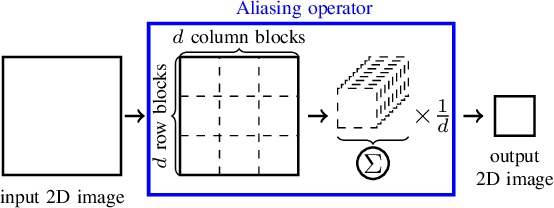
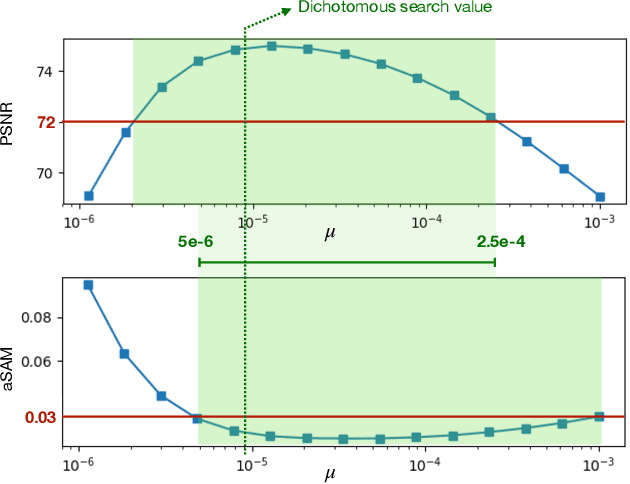
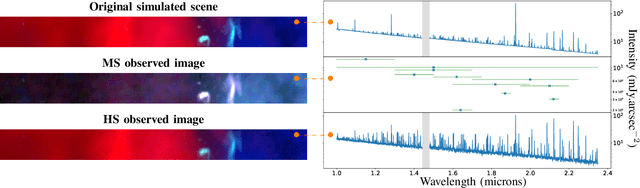
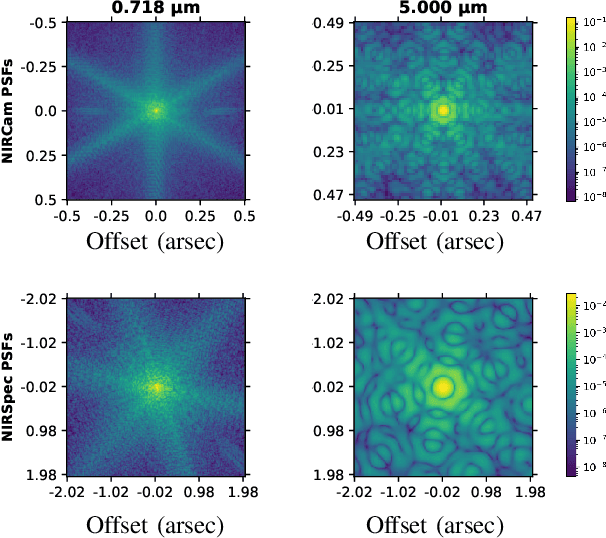
Hyperspectral imaging has become a significant source of valuable data for astronomers over the past decades. Current instrumental and observing time constraints allow direct acquisition of multispectral images, with high spatial but low spectral resolution, and hyperspectral images, with low spatial but high spectral resolution. To enhance scientific interpretation of the data, we propose a data fusion method which combines the benefits of each image to recover a high spatio-spectral resolution datacube. The proposed inverse problem accounts for the specificities of astronomical instruments, such as spectrally variant blurs. We provide a fast implementation by solving the problem in the frequency domain and in a low-dimensional subspace to efficiently handle the convolution operators as well as the high dimensionality of the data. We conduct experiments on a realistic synthetic dataset of simulated observation of the upcoming James Webb Space Telescope, and we show that our fusion algorithm outperforms state-of-the-art methods commonly used in remote sensing for Earth observation.