 Add to Chrome
 Add to Firefox
 Add to Edge
The Deleuzian Representation Hypothesis
Dec 17, 2025
We propose an alternative to sparse autoencoders (SAEs) as a simple and effective unsupervised method for extracting interpretable concepts from neural networks. The core idea is to cluster differences in activations, which we formally justify within a discriminant analysis framework. To enhance the diversity of extracted concepts, we refine the approach by weighting the clustering using the skewness of activations. The method aligns with Deleuze's modern view of concepts as differences. We evaluate the approach across five models and three modalities (vision, language, and audio), measuring concept quality, diversity, and consistency. Our results show that the proposed method achieves concept quality surpassing prior unsupervised SAE variants while approaching supervised baselines, and that the extracted concepts enable steering of a model's inner representations, demonstrating their causal influence on downstream behavior.

Automatic Die Studies for Ancient Numismatics
Jul 30, 2024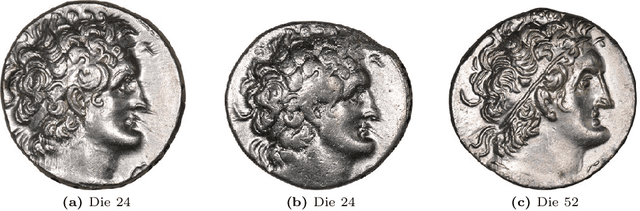
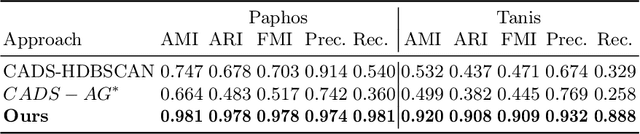

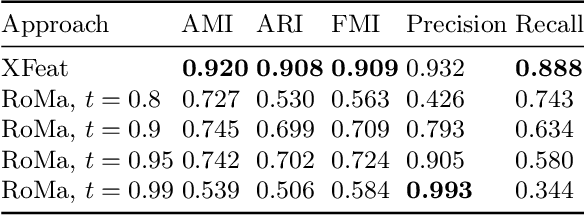
Die studies are fundamental to quantifying ancient monetary production, providing insights into the relationship between coinage, politics, and history. The process requires tedious manual work, which limits the size of the corpora that can be studied. Few works have attempted to automate this task, and none have been properly released and evaluated from a computer vision perspective. We propose a fully automatic approach that introduces several innovations compared to previous methods. We rely on fast and robust local descriptors matching that is set automatically. Second, the core of our proposal is a clustering-based approach that uses an intrinsic metric (that does not need the ground truth labels) to determine its critical hyper-parameters. We validate the approach on two corpora of Greek coins, propose an automatic implementation and evaluation of previous baselines, and show that our approach significantly outperforms them.