 Add to Chrome
 Add to Firefox
 Add to Edge
Benchmarking Patent Embeddings: A Multi-Task Evaluation of 22 Models Across Retrieval, Classification, and Clustering
May 26, 2026
Two questions regarding practitioners' use of patent embeddings arise: (i) Does one fine-tuning recipe suffice for all downstream applications? (ii) Is fine-tuning on one patent landscape sufficient for downstream application on other landscapes? By evaluating 22 pre-trained embedding models (ranging from 22M to 12B parameters) on three tasks -- information retrieval, classification, and clustering -- on 113,148 WIPO patents for assistive technology (46,069 citation queries) and on an external DAPFAM dataset, we find that two results cast doubt on the prevailing wisdom. (i) The optimal fine-tuning recipe depends on the downstream task: cross-sectional alignment (recipe R3) provides the largest improvements to retrieval performance (+7.1% nDCG@10), whereas a combined signal recipe (recipe R4) is better suited to classification (+7.1 F1) and clustering (+10.9 V-measure); a matched data control confirms that differences in training dataset size are not a contributing factor. (ii) Single-landscape fine-tuning hampers cross-landscape information retrieval: fine-tuning on one landscape significantly degrades cross-domain retrieval for 5 of 8 model-recipe combinations on the DAPFAM corpus, with the stronger zero-shot models suffering most. While within-family scaling is consistent (Qwen3 0.6B->4B->8B; Llama-Nemotron 1B->8B), cross-family scaling is erratic; the 12B KaLM-Gemma3 is ranked 8th on TAC retrieval performance, following prefix modification. Title+Abstract+Claims is the ubiquitous best text view, and all models suffer from a 55-65% gap between IN and OUT-of-domain performance which cannot be mitigated by hybrid BM25-dense fusion. Code and evaluation framework are publicly available.

When Does Synthetic Patent Data Help? Volume-Fidelity Trade-offs in Low-Resource Multi-Label Classification
May 26, 2026The issues that must be considered regarding the utilization of synthetic data generated through LLMs for multilabel patent classification include (i) when the use of such data may help and (ii) why. Indeed, the former part appropriately adjusts for the possibility of improving results by an increase in sample size. The current experiment involves six open-source LLMs (from 3.8B to 12B parameters) for four real-data regimes in classification of 64 WIPO labels of assistive technologies. Both full-synthesis generation, conditioned on the label set, and paraphrasing methods are applied, with each used in combination with three classifier categories. It is shown that the claimed improvements in micro F1 for BERT-for-Patents from 0.120 to 0.702 mainly reflect a volume effect; indeed, replication with replacement in 165 examples produces 0.678. Thus, the improvement over the control is +0.024, while compared to the best baseline (focal loss reweighting) is +0.219. The second crucial point to consider here is that of evolving fidelity scores as the data generation regime varies. For low real-data regimes, the volume effect dominates and the correlation coefficient between maximum mean discrepancy (MMD) and classification performance equals r = +0.95. As more real data is used, the correlation becomes inverted and reaches r = -0.73 at the 1:10 regime (Fisher z = +6.47, p < 0.001, 95% CI on Delta r [ +0.96, +1.00 ]). In terms of a fixed budget allocation, combining real data (about 20-30%) with synthetic (70-80%) outperforms both purely synthetic and purely real strategies. Moreover, a corpus that allows for improvement in classification performance up to +0.58 in raw micro F1 may adversely affect a Jaccard-overlap retrieval proxy. Prompt-family variations for other genres may provide some explanation of the phenomenon, but using the standard-patent filter still decreases nDCG@10 by 26%.
Fine-Tuning Causal LLMs for Text Classification: Embedding-Based vs. Instruction-Based Approaches
Dec 14, 2025We explore efficient strategies to fine-tune decoder-only Large Language Models (LLMs) for downstream text classification under resource constraints. Two approaches are investigated: (1) attaching a classification head to a pre-trained causal LLM and fine-tuning on the task (using the LLM's final token embedding as a sequence representation), and (2) instruction-tuning the LLM in a prompt->response format for classification. To enable single-GPU fine-tuning of models up to 8B parameters, we combine 4-bit model quantization with Low-Rank Adaptation (LoRA) for parameter-efficient training. Experiments on two datasets - a proprietary single-label dataset and the public WIPO-Alpha patent dataset (extreme multi-label classification) - show that the embedding-based method significantly outperforms the instruction-tuned method in F1-score, and is very competitive with - even surpassing - fine-tuned domain-specific models (e.g. BERT) on the same tasks. These results demonstrate that directly leveraging the internal representations of causal LLMs, along with efficient fine-tuning techniques, yields impressive classification performance under limited computational resources. We discuss the advantages of each approach while outlining practical guidelines and future directions for optimizing LLM fine-tuning in classification scenarios.
Patent Language Model Pretraining with ModernBERT
Sep 18, 2025Transformer-based language models such as BERT have become foundational in NLP, yet their performance degrades in specialized domains like patents, which contain long, technical, and legally structured text. Prior approaches to patent NLP have primarily relied on fine-tuning general-purpose models or domain-adapted variants pretrained with limited data. In this work, we pretrain 3 domain-specific masked language models for patents, using the ModernBERT architecture and a curated corpus of over 60 million patent records. Our approach incorporates architectural optimizations, including FlashAttention, rotary embeddings, and GLU feed-forward layers. We evaluate our models on four downstream patent classification tasks. Our model, ModernBERT-base-PT, consistently outperforms the general-purpose ModernBERT baseline on three out of four datasets and achieves competitive performance with a baseline PatentBERT. Additional experiments with ModernBERT-base-VX and Mosaic-BERT-large demonstrate that scaling the model size and customizing the tokenizer further enhance performance on selected tasks. Notably, all ModernBERT variants retain substantially faster inference over - 3x that of PatentBERT - underscoring their suitability for time-sensitive applications. These results underscore the benefits of domain-specific pretraining and architectural improvements for patent-focused NLP tasks.
End-to-End Document Classification and Key Information Extraction using Assignment Optimization
Jun 01, 2023We propose end-to-end document classification and key information extraction (KIE) for automating document processing in forms. Through accurate document classification we harness known information from templates to enhance KIE from forms. We use text and layout encoding with a cosine similarity measure to classify visually-similar documents. We then demonstrate a novel application of mixed integer programming by using assignment optimization to extract key information from documents. Our approach is validated on an in-house dataset of noisy scanned forms. The best performing document classification approach achieved 0.97 f1 score. A mean f1 score of 0.94 for the KIE task suggests there is significant potential in applying optimization techniques. Abation results show that the method relies on document preprocessing techniques to mitigate Type II errors and achieve optimal performance.
Unimodal and Multimodal Representation Training for Relation Extraction
Nov 11, 2022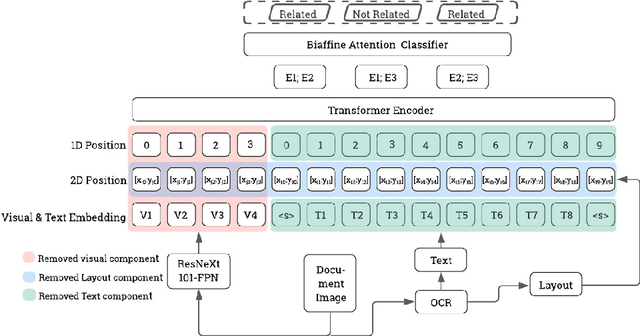
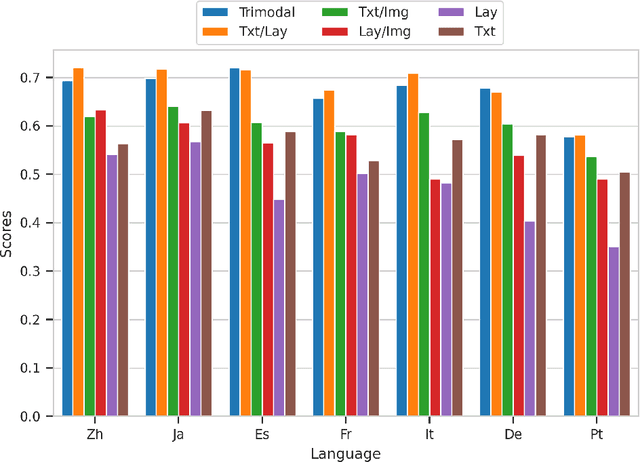
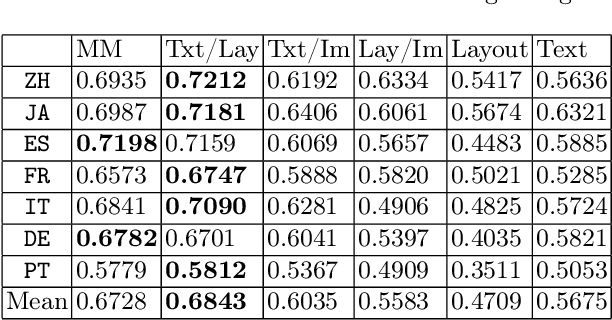
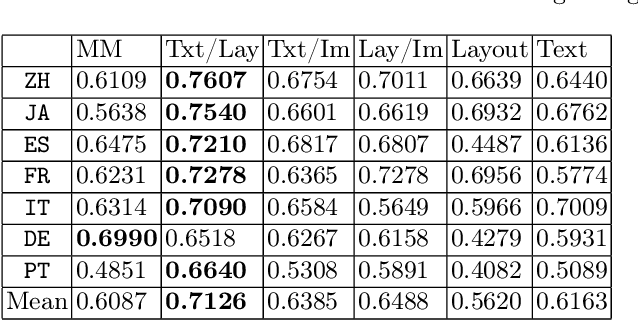
Multimodal integration of text, layout and visual information has achieved SOTA results in visually rich document understanding (VrDU) tasks, including relation extraction (RE). However, despite its importance, evaluation of the relative predictive capacity of these modalities is less prevalent. Here, we demonstrate the value of shared representations for RE tasks by conducting experiments in which each data type is iteratively excluded during training. In addition, text and layout data are evaluated in isolation. While a bimodal text and layout approach performs best (F1=0.684), we show that text is the most important single predictor of entity relations. Additionally, layout geometry is highly predictive and may even be a feasible unimodal approach. Despite being less effective, we highlight circumstances where visual information can bolster performance. In total, our results demonstrate the efficacy of training joint representations for RE.