 Add to Chrome
 Add to Firefox
 Add to Edge
Embark Now: User Demand Oriented Framework for Multi-day Urban Travel Itinerary Planning
Jul 12, 2026
In large urban areas, planning multi-day travel itineraries is challenging due to the abundance of Points of Interest (POIs), diverse user preferences, and constraints such as opening hours. Effective solutions must dynamically accommodate diverse traveler requirements while optimizing for satisfaction and feasibility within limited computation time. This paper addresses these challenges through introducing an innovative framework that integrates Large Language Models (LLMs) to dynamically capture user requirements with precision and flexibility, and an enhanced Greedy Randomized Adaptive Search Procedure (GRASP) algorithm as a well-suited preference-aware planner to generate feasible multi-day itineraries. The effectiveness of our integrated approach is demonstrated through extensive experiments on two real-world urban datasets from Beijing and Tianjin. Our framework significantly outperforms state-of-the-art (SOTA) methods, improving the average total itinerary score by at least 4.52% and 11.09% across 5,040 user cases with diverse preferences in the two datasets. Furthermore, through end-to-end algorithmic enhancements, it achieves notable average improvements of 17.95% and 26.07% in the computed metrics, while also delivering substantial gains in time efficiency -- realizing average performance increases of 4.64% and 25.55% within shorter computation times compared to suboptimal methods that require multiple iterations. These outcomes underscore our method's superiority in delivering both enhanced itinerary quality and computational efficiency over existing methodologies.

Topic-to-essay generation with knowledge-based content selection
Feb 26, 2024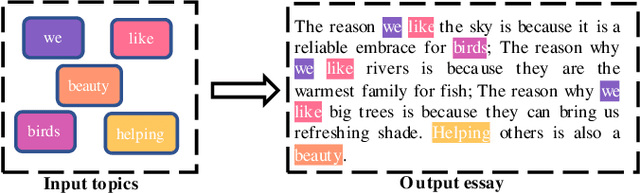
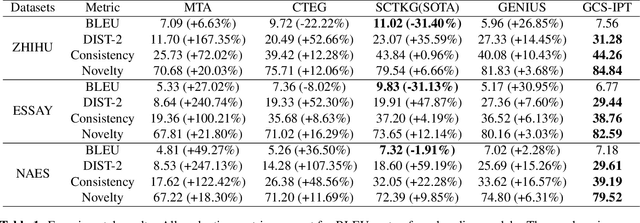
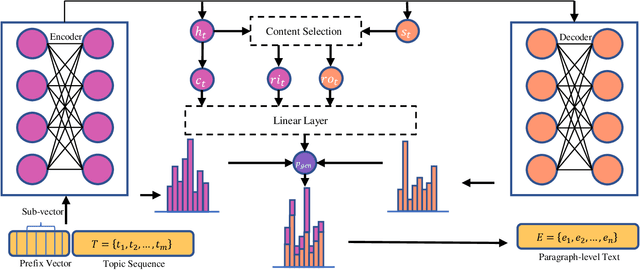
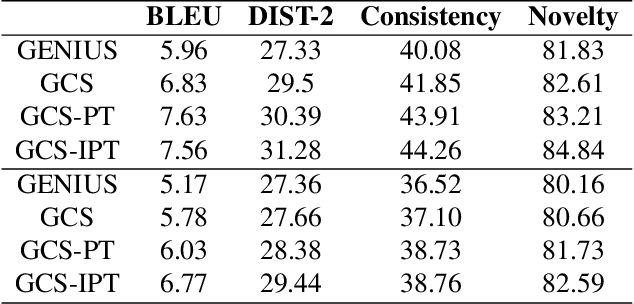
The topic-to-essay generation task is a challenging natural language generation task that aims to generate paragraph-level text with high semantic coherence based on a given set of topic words. Previous work has focused on the introduction of external knowledge, ignoring the insufficient generated text diversity. In order to improve the generation diversity, we propose a novel copy mechanism model with a content selection module that integrates rich semantic knowledge from the language model into the decoder. Furthermore, we introduce the improved prefix tuning method to train the model, enabling it to adapt to varying input complexities. In addition, we have contributed a new Chinese dataset for TEG tasks. Experimental results demonstrate that the proposed model can improve the generated text diversity by 35\% to 59\% compared to the state-of-the-art method, while maintaining a high level of topic consistency.