 Add to Chrome
 Add to Firefox
 Add to Edge
Prognostics of Multisensor Systems with Unknown and Unlabeled Failure Modes via Bayesian Nonparametric Process Mixtures
Feb 22, 2026
Modern manufacturing systems often experience multiple and unpredictable failure behaviors, yet most existing prognostic models assume a fixed, known set of failure modes with labeled historical data. This assumption limits the use of digital twins for predictive maintenance, especially in high-mix or adaptive production environments, where new failure modes may emerge, and the failure mode labels may be unavailable. To address these challenges, we propose a novel Bayesian nonparametric framework that unifies a Dirichlet process mixture module for unsupervised failure mode discovery with a neural network-based prognostic module. The key innovation lies in an iterative feedback mechanism to jointly learn two modules. These modules iteratively update one another to dynamically infer, expand, or merge failure modes as new data arrive while providing high prognostic accuracy. Experiments on both simulation and aircraft engine datasets show that the proposed approach performs competitively with or significantly better than existing approaches. It also exhibits robust online adaptation capabilities, making it well-suited for digital-twin-based system health management in complex manufacturing environments.

Deep Learning Models for River Classification at Sub-Meter Resolutions from Multispectral and Panchromatic Commercial Satellite Imagery
Dec 27, 2022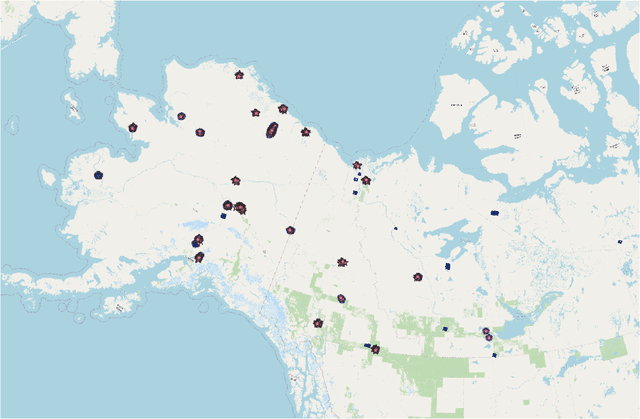
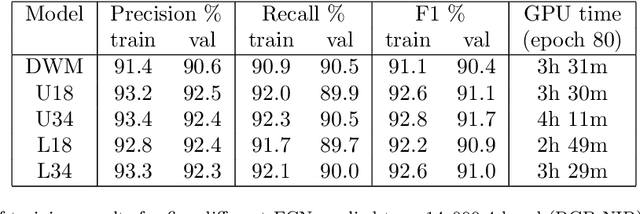
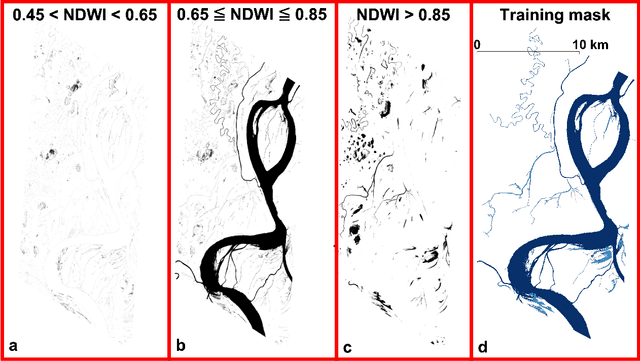
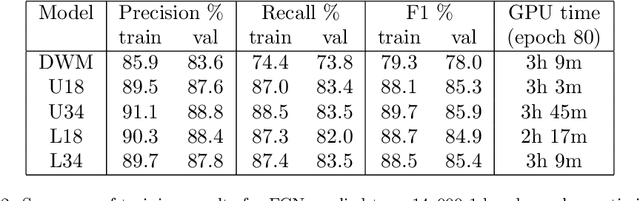
Remote sensing of the Earth's surface water is critical in a wide range of environmental studies, from evaluating the societal impacts of seasonal droughts and floods to the large-scale implications of climate change. Consequently, a large literature exists on the classification of water from satellite imagery. Yet, previous methods have been limited by 1) the spatial resolution of public satellite imagery, 2) classification schemes that operate at the pixel level, and 3) the need for multiple spectral bands. We advance the state-of-the-art by 1) using commercial imagery with panchromatic and multispectral resolutions of 30 cm and 1.2 m, respectively, 2) developing multiple fully convolutional neural networks (FCN) that can learn the morphological features of water bodies in addition to their spectral properties, and 3) FCN that can classify water even from panchromatic imagery. This study focuses on rivers in the Arctic, using images from the Quickbird, WorldView, and GeoEye satellites. Because no training data are available at such high resolutions, we construct those manually. First, we use the RGB, and NIR bands of the 8-band multispectral sensors. Those trained models all achieve excellent precision and recall over 90% on validation data, aided by on-the-fly preprocessing of the training data specific to satellite imagery. In a novel approach, we then use results from the multispectral model to generate training data for FCN that only require panchromatic imagery, of which considerably more is available. Despite the smaller feature space, these models still achieve a precision and recall of over 85%. We provide our open-source codes and trained model parameters to the remote sensing community, which paves the way to a wide range of environmental hydrology applications at vastly superior accuracies and 2 orders of magnitude higher spatial resolution than previously possible.
* 21 pages, 10 figures, 3 tables