 Add to Chrome
 Add to Firefox
 Add to Edge
JOMP: Jointly-Optimized Mixed-Precision Quantization Across Neural Video Coding Frameworks and Buffering Strategies
Jun 11, 2026
Variational autoencoder-based neural video coding has demonstrated impressive rate-distortion performance. However, its adoption in real-world applications remains hindered by challenges, such as prohibitively high computational complexity and limited cross-platform interoperability. These issues are often overlooked, as most neural video codecs rely on floating-point arithmetic to fully explore their rate-distortion potential. Practical deployment, however, requires integer-based implementations. Converting floating-point implementations into integer-based networks is non-trivial, since it involves quantizing inter-dependent coding components, whose sensitivity to precision may vary across codec designs. This paper introduces a Jointly-Optimized Mixed-Precision (JOMP) framework, in which both quantization parameters and bit widths are treated as learnable variables during training. This enables different codec modules to operate at varying precision levels, thereby jointly optimizing the rate-distortion-complexity trade-off. To the best of our knowledge, JOMP is the first mixed-precision quantization framework for neural video codecs. Its effectiveness is validated through a systematic investigation of quantization across different coding frameworks and temporal buffering strategies. Our study marks the first attempt to a unified understanding of the combined effects of modern coding frameworks and temporal buffering strategies, with the aim of informing future development of neural video codecs from a practicality perspective. In addition, we develop a complete integerization pipeline to achieve deterministic decoding. Overall, when applied to our best-performing model, JOMP enables end-to-end mixed-precision learning for integer neural video codecs, achieving rate-distortion performance comparable to that of the state-of-the-art DCVC-FM while reducing bit operations by 87.6%.

DeNVeR: Deformable Neural Vessel Representations for Unsupervised Video Vessel Segmentation
Jun 03, 2024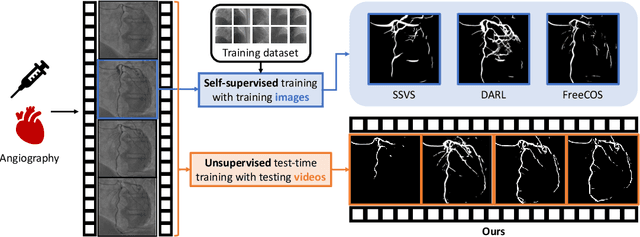


This paper presents Deformable Neural Vessel Representations (DeNVeR), an unsupervised approach for vessel segmentation in X-ray videos without annotated ground truth. DeNVeR uses optical flow and layer separation, enhancing segmentation accuracy and adaptability through test-time training. A key component of our research is the introduction of the XACV dataset, the first X-ray angiography coronary video dataset with high-quality, manually labeled segmentation ground truth. Our evaluation demonstrates that DeNVeR outperforms current state-of-the-art methods in vessel segmentation. This paper marks an advance in medical imaging, providing a robust, data-efficient tool for disease diagnosis and treatment planning and setting a new standard for future research in video vessel segmentation. See our project page for video results at https://kirito878.github.io/DeNVeR/.