 Add to Chrome
 Add to Firefox
 Add to Edge
Evidential Perfusion Physics-Informed Neural Networks with Residual Uncertainty Quantification
Mar 10, 2026
Physics-informed neural networks (PINNs) have shown promise in addressing the ill-posed deconvolution problem in computed tomography perfusion (CTP) imaging for acute ischemic stroke assessment. However, existing PINN-based approaches remain deterministic and do not quantify uncertainty associated with violations of physics constraints, limiting reliability assessment. We propose Evidential Perfusion Physics-Informed Neural Networks (EPPINN), a framework that integrates evidential deep learning with physics-informed modeling to enable uncertainty-aware perfusion parameter estimation. EPPINN models arterial input, tissue concentration, and perfusion parameters using coordinate-based networks, and places a Normal--Inverse--Gamma distribution over the physics residual to characterize voxel-wise aleatoric and epistemic uncertainty in physics consistency without requiring Bayesian sampling or ensemble inference. The framework further incorporates physiologically constrained parameterization and stabilization strategies to promote robust per-case optimization. We evaluate EPPINN on digital phantom data, the ISLES 2018 benchmark, and a clinical cohort. On the evaluated datasets, EPPINN achieves lower normalized mean absolute error than classical deconvolution and PINN baselines, particularly under sparse temporal sampling and low signal-to-noise conditions, while providing conservative uncertainty estimates with high empirical coverage. On clinical data, EPPINN attains the highest voxel-level and case-level infarct-core detection sensitivity. These results suggest that evidential physics-informed learning can improve both accuracy and reliability of CTP analysis for time-critical stroke assessment.

Improving Factuality of 3D Brain MRI Report Generation with Paired Image-domain Retrieval and Text-domain Augmentation
Nov 23, 2024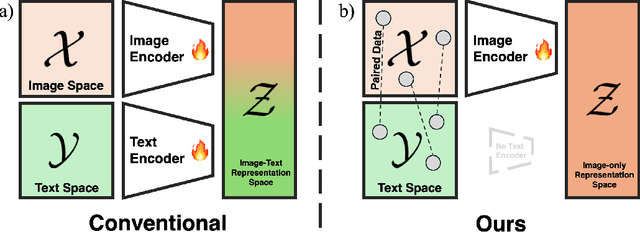

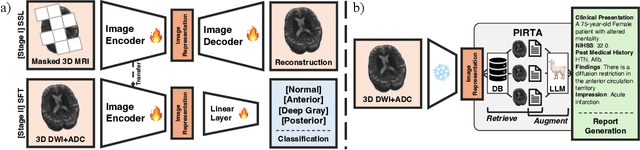
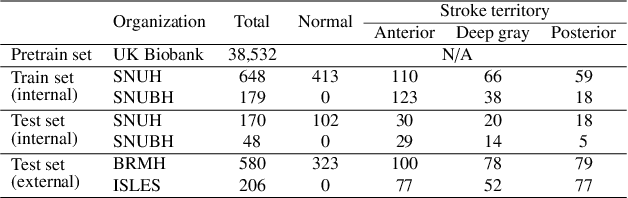
Acute ischemic stroke (AIS) requires time-critical management, with hours of delayed intervention leading to an irreversible disability of the patient. Since diffusion weighted imaging (DWI) using the magnetic resonance image (MRI) plays a crucial role in the detection of AIS, automated prediction of AIS from DWI has been a research topic of clinical importance. While text radiology reports contain the most relevant clinical information from the image findings, the difficulty of mapping across different modalities has limited the factuality of conventional direct DWI-to-report generation methods. Here, we propose paired image-domain retrieval and text-domain augmentation (PIRTA), a cross-modal retrieval-augmented generation (RAG) framework for providing clinician-interpretative AIS radiology reports with improved factuality. PIRTA mitigates the need for learning cross-modal mapping, which poses difficulty in image-to-text generation, by casting the cross-modal mapping problem as an in-domain retrieval of similar DWI images that have paired ground-truth text radiology reports. By exploiting the retrieved radiology reports to augment the report generation process of the query image, we show by experiments with extensive in-house and public datasets that PIRTA can accurately retrieve relevant reports from 3D DWI images. This approach enables the generation of radiology reports with significantly higher accuracy compared to direct image-to-text generation using state-of-the-art multimodal language models.