 Add to Chrome
 Add to Firefox
 Add to Edge
Deep material network for homogenization of piezoelectric composites
Jun 21, 2026
Piezoelectric composites are widely used in sensors, actuators, transducers, and energy-harvesting devices because their effective electromechanical performance can be tailored by combining constituent phases and microstructural architecture. However, conventional computational homogenization based on direct numerical simulation (DNS) is computationally expensive, particularly for multiscale simulations and material design tasks that require repeated homogenization analyses. To address this limitation, this work proposes a piezoelectric deep material network (PDMN) to efficiently homogenize two-phase piezoelectric composites. The proposed framework embeds the governing electromechanical homogenization relations directly into the network architecture, yielding a physics-informed, semi-analytical surrogate that explicitly captures the two-way coupling between the mechanical and electrical fields across constituent phases. The network is trained offline on linear electroelastic datasets and, through a fully coupled Newton--Raphson solution with a consistent electromechanical tangent, subsequently used for efficient online prediction under broader constitutive settings, including nonlinear electroelasticity and history-dependent responses. The framework is validated on two-phase composites of polyvinylidene fluoride (PVDF) and lithium niobate (LiNbO$_3$) with reversed phase arrangements under nonlinear electroelastic loading, and on a viscoelastic--piezoelectric composite exhibiting coupled stress relaxation. Numerical examples show that the proposed PDMN achieves high predictive accuracy while reducing the computational cost by more than three orders of magnitude compared with DNS. The proposed framework, therefore, provides an efficient and reliable surrogate for the multiscale analysis and design of piezoelectric composites.

Orientation-aware interaction-based deep material network in polycrystalline materials modeling
Feb 04, 2025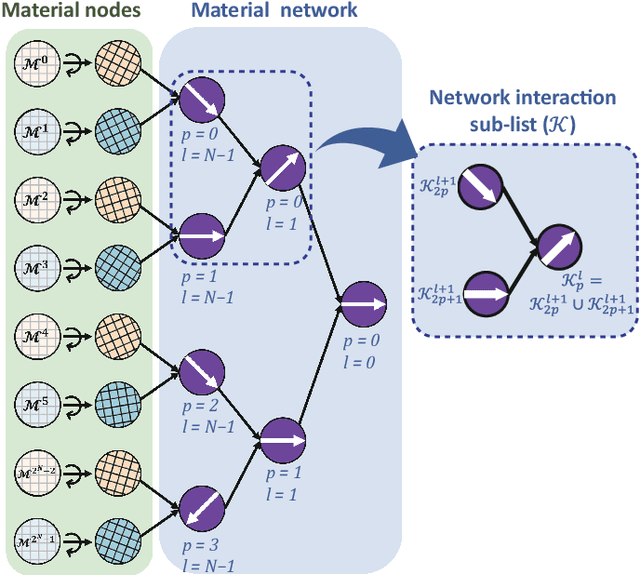
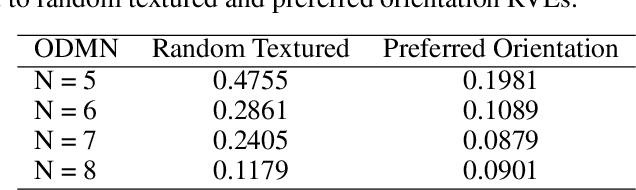
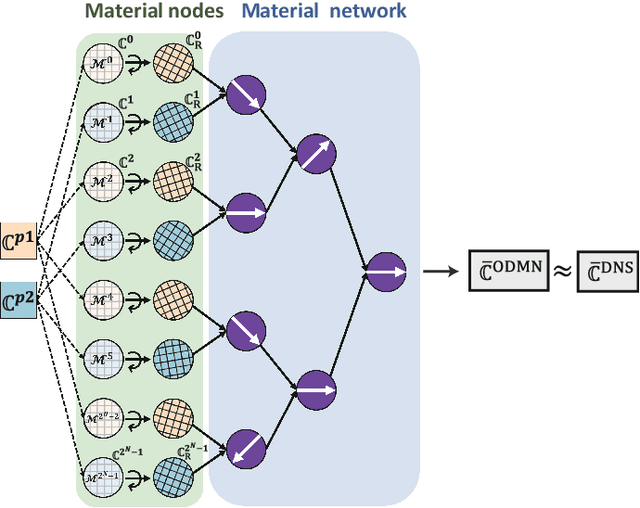
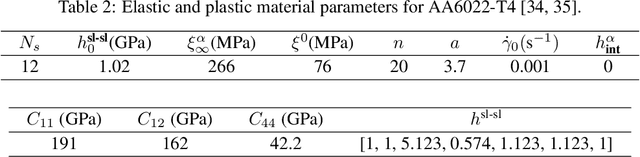
Multiscale simulations are indispensable for connecting microstructural features to the macroscopic behavior of polycrystalline materials, but their high computational demands limit their practicality. Deep material networks (DMNs) have been proposed as efficient surrogate models, yet they fall short of capturing texture evolution. To address this limitation, we propose the orientation-aware interaction-based deep material network (ODMN), which incorporates an orientation-aware mechanism and an interaction mechanism grounded in the Hill-Mandel principle. The orientation-aware mechanism learns the crystallographic textures, while the interaction mechanism captures stress-equilibrium directions among representative volume element (RVE) subregions, offering insight into internal microstructural mechanics. Notably, ODMN requires only linear elastic data for training yet generalizes effectively to complex nonlinear and anisotropic responses. Our results show that ODMN accurately predicts both mechanical responses and texture evolution under complex plastic deformation, thus expanding the applicability of DMNs to polycrystalline materials. By balancing computational efficiency with predictive fidelity, ODMN provides a robust framework for multiscale simulations of polycrystalline materials.