 Add to Chrome
 Add to Firefox
 Add to Edge
Probing Non-Equilibrium Grain Boundary Dynamics with XPCS and Domain-Adaptive Machine Learning
May 12, 2026
Grain-boundary (GB) dynamics control the stability, mechanical, and functional response of nanocrystalline materials, but direct experimental access to their slow non-equilibrium motion has been limited. Here we establish X-ray photon correlation spectroscopy (XPCS), combined with domain-adaptive machine learning, as a quantitative probe of GB dynamics. Temperature- and grain-size-dependent two-time XPCS measurements in nanocrystalline silicon reveal pronounced departures from time-translation invariance, showing that GB relaxation can remain far from equilibrium over experimental timescales. However, direct extraction of quantitative physical information from these high-dimensional, noisy fluctuation maps faces a significant challenge. To overcome this barrier, we develop a semi-supervised learning framework that transfers physical parameter labels from continuum simulations to unlabeled experimental XPCS maps through domain-adaptive representation alignment. This AI-augmented approach enables the extraction of key kinetic parameters, including bulk diffusivity, GB stiffness, and effective GB concentration, directly from experimental XPCS measurements. Our results show how machine learning can transform indirect fluctuation signals into quantitative materials dynamics, providing a general route to study non-equilibrium defect motion in solids.

AI-driven materials design: a mini-review
Feb 05, 2025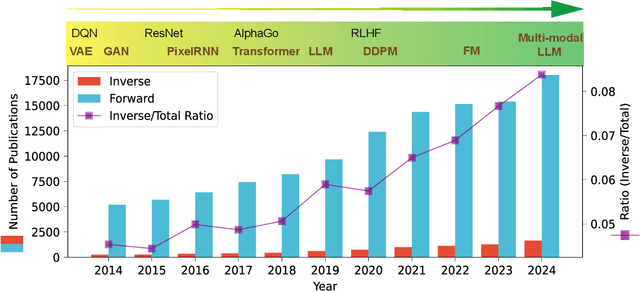
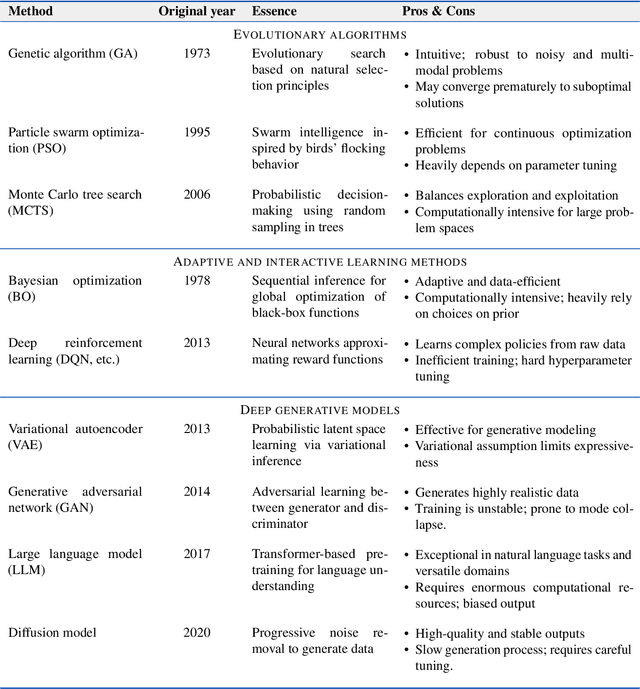
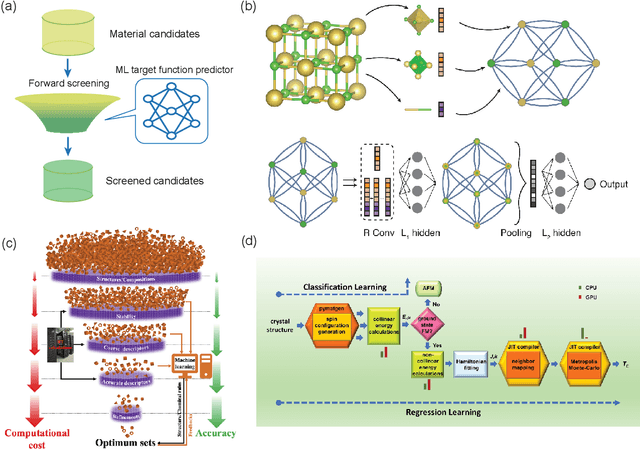
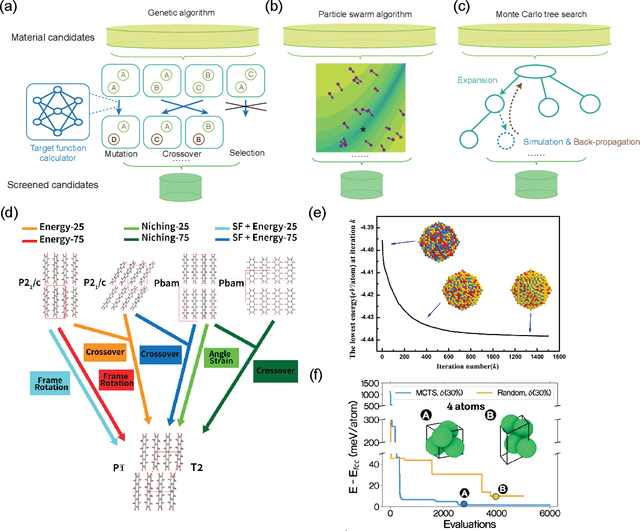
Materials design is an important component of modern science and technology, yet traditional approaches rely heavily on trial-and-error and can be inefficient. Computational techniques, enhanced by modern artificial intelligence (AI), have greatly accelerated the design of new materials. Among these approaches, inverse design has shown great promise in designing materials that meet specific property requirements. In this mini-review, we summarize key computational advancements for materials design over the past few decades. We follow the evolution of relevant materials design techniques, from high-throughput forward machine learning (ML) methods and evolutionary algorithms, to advanced AI strategies like reinforcement learning (RL) and deep generative models. We highlight the paradigm shift from conventional screening approaches to inverse generation driven by deep generative models. Finally, we discuss current challenges and future perspectives of materials inverse design. This review may serve as a brief guide to the approaches, progress, and outlook of designing future functional materials with technological relevance.