 Add to Chrome
 Add to Firefox
 Add to Edge
Super-resolution of turbulent reacting flows on complex meshes using graph neural networks
Mar 01, 2026
State-of-the-art deep learning models have been extensively utilized to reconstruct small-scale structures from coarse-grained data in turbulent flows. However, their application has predominantly been restricted to structured uniform meshes, limiting their applicability to data associated with complex geometries that are typically simulated on structured non-uniform or unstructured meshes. Machine learning (ML) models based on graph neural networks (GNNs), known for their ability to process unstructured data, offer a promising alternative. In this study, we leverage the inherent flexibility of GNNs featuring message passing layers to develop a methodology for reconstructing unresolved small-scale structures from low-resolution data on complex meshes. The accuracy of the proposed approach is demonstrated using two cases: a reacting channel flow on a structured non-uniform mesh, and a reacting hydrogen fueled internal combustion (IC) engine featuring an unstructured mesh. Evaluation of results based on visual agreement, statistical metrics, and cumulative error reduction indicates the effectiveness of the method in accurately reconstructing fine-scale features. Overall, this study provides a pathway for integrating data-driven small-scale reconstruction and subgrid-scale modeling to enhance the accuracy of coarse-grained simulations on complex meshes.

Flow reconstruction in time-varying geometries using graph neural networks
Nov 13, 2024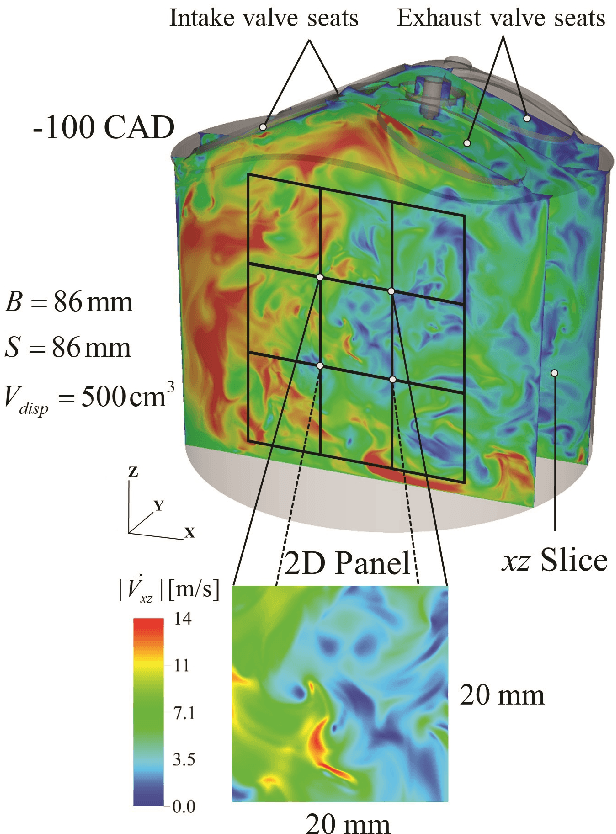
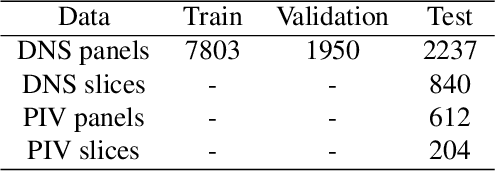
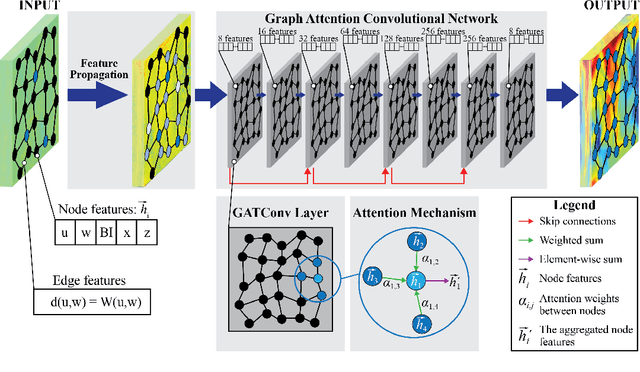
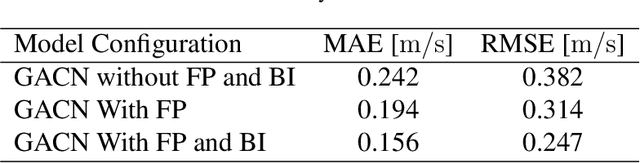
The paper presents a Graph Attention Convolutional Network (GACN) for flow reconstruction from very sparse data in time-varying geometries. The model incorporates a feature propagation algorithm as a preprocessing step to handle extremely sparse inputs, leveraging information from neighboring nodes to initialize missing features. In addition, a binary indicator is introduced as a validity mask to distinguish between the original and propagated data points, enabling more effective learning from sparse inputs. Trained on a unique data set of Direct Numerical Simulations (DNS) of a motored engine at a technically relevant operating condition, the GACN shows robust performance across different resolutions and domain sizes and can effectively handle unstructured data and variable input sizes. The model is tested on previously unseen DNS data as well as on an experimental data set from Particle Image Velocimetry (PIV) measurements that were not considered during training. A comparative analysis shows that the GACN consistently outperforms both a conventional Convolutional Neural Network (CNN) and cubic interpolation methods on the DNS and PIV test sets by achieving lower reconstruction errors and better capturing fine-scale turbulent structures. In particular, the GACN effectively reconstructs flow fields from domains up to 14 times larger than those observed during training, with the performance advantage increasing for larger domains.