 Add to Chrome
 Add to Firefox
 Add to Edge
Tracing the Heart: An Evidence-Linked Pipeline for Heart-Failure Feature Engineering
Aug 06, 2026
Electronic health record (EHR) feature engineering is a major bottleneck in clinical research and AI, accounting for 39-45% of data scientists' workload. This is especially pronounced in heart failure, which affects an estimated 6.7 million U.S. adults and requires integrating fragmented EHR data with disease-specific, guideline-based clinical reasoning. Existing rule-based and large language model (LLM)-based approaches offer only partial automation with limited maintainability and evidence traceability. We developed the Nimblemind Multi-Agent System (nMAS), an evidence-linked, rubric-grounded pipeline for automated heart-failure feature engineering, and evaluated it on 500 dummy patient records from nine EHR source tables. nMAS generated 132 structured and 70 rubric-scored aggregated features, verified for structural integrity, rubric compliance, and provenance, and audited by a restricted LLM. Adding the aggregated features improved held-out AUROC from 0.895 to 0.963 for HFrEF and 0.870 to 0.910 for HFpEF phenotyping, and an independent LLM-based rubric assessment of evidence support and methodological soundness scored the features at 81.5% of maximum points. These results demonstrate the feasibility of automated, auditable feature engineering for complex cardiovascular EHR data, though evaluation was limited to a single-institution cohort and external validation is needed.

How the fly holds a single goal: normalization, not selection, in Drosophila FC2
Jul 21, 2026A walking fly steers toward a goal direction, held as a bump of activity across the FC2 neurons of the fan-shaped body. These neurons also inhibit one another over distance, more strongly the farther apart they are, a feedback proposed to keep the fly on a single goal. We asked, from the connectome, what circuit produces this inhibition, and whether it lets FC2 actively choose one goal among competitors (a winner-take-all) or simply keeps a goal set elsewhere as one clean bump. Tracing the wiring in a single FlyWire brain, we find the inhibition is almost entirely global: four FB5A cells inhibit every FC2 neuron roughly equally, with a smaller, distance-dependent contribution from hDelta interneurons and a negligible direct component. A ring-attractor winner-take-all (the kind the compass uses) requires local recurrent excitation that the FC2 wiring lacks, so this geometry cannot build one; and across a range of dynamical models, including a spiking network, no version of the circuit locks onto a winner at the connectome-scaled reference coupling. FC2 therefore normalizes an externally set goal rather than selecting it, with FB5A likely acting as the global normalizer, much as the APL neuron does in the mushroom body. We are explicit about two open points: a different mechanism, mutual inhibition between two competing goals (which hDelta supplies), could in principle select at very strong coupling, and we bound rather than exclude it; and FB5A's inhibitory identity is a low-confidence prediction of the connectome's transmitter classifier, not yet measured, and likely not GABAergic. We then ask where the goal is actually set: the connectome nominates an upstream hDelta network and rules out the leading proposed alternative, whose neurons supply under 0.2% of FC2's input. Finally, we propose a direct experiment, silencing FB5A while imaging FC2, that would test the account.
EXAONE 4.5 Technical Report
Apr 09, 2026This technical report introduces EXAONE 4.5, the first open-weight vision language model released by LG AI Research. EXAONE 4.5 is architected by integrating a dedicated visual encoder into the existing EXAONE 4.0 framework, enabling native multimodal pretraining over both visual and textual modalities. The model is trained on large-scale data with careful curation, particularly emphasizing document-centric corpora that align with LG's strategic application domains. This targeted data design enables substantial performance gains in document understanding and related tasks, while also delivering broad improvements across general language capabilities. EXAONE 4.5 extends context length up to 256K tokens, facilitating long-context reasoning and enterprise-scale use cases. Comparative evaluations demonstrate that EXAONE 4.5 achieves competitive performance in general benchmarks while outperforming state-of-the-art models of similar scale in document understanding and Korean contextual reasoning. As part of LG's ongoing effort toward practical industrial deployment, EXAONE 4.5 is designed to be continuously extended with additional domains and application scenarios to advance AI for a better life.
Comparison of automated crater catalogs for Mars from Benedix et al. (2020) and Lee and Hogan (2021)
Aug 28, 2023Crater mapping using neural networks and other automated methods has increased recently with automated Crater Detection Algorithms (CDAs) applied to planetary bodies throughout the solar system. A recent publication by Benedix et al. (2020) showed high performance at small scales compared to similar automated CDAs but with a net positive diameter bias in many crater candidates. I compare the publicly available catalogs from Benedix et al. (2020) and Lee & Hogan (2021) and show that the reported performance is sensitive to the metrics used to test the catalogs. I show how the more permissive comparison methods indicate a higher CDA performance by allowing worse candidate craters to match ground-truth craters. I show that the Benedix et al. (2020) catalog has a substantial performance loss with increasing latitude and identify an image projection issue that might cause this loss. Finally, I suggest future applications of neural networks in generating large scientific datasets be validated using secondary networks with independent data sources or training methods.
Automated crater detection with human level performance
Oct 23, 2020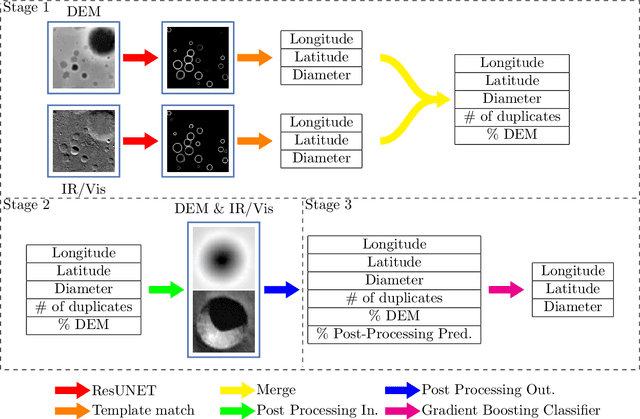
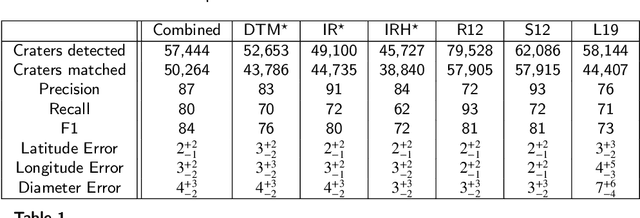


Crater cataloging is an important yet time-consuming part of geological mapping. We present an automated Crater Detection Algorithm (CDA) that is competitive with expert-human researchers and hundreds of times faster. The CDA uses multiple neural networks to process digital terrain model and thermal infra-red imagery to identify and locate craters across the surface of Mars. We use additional post-processing filters to refine and remove potential false crater detections, improving our precision and recall by 10% compared to Lee (2019). We now find 80% of known craters above 3km in diameter, and identify 7,000 potentially new craters (13% of the identified craters). The median differences between our catalog and other independent catalogs is 2-4% in location and diameter, in-line with other inter-catalog comparisons. The CDA has been used to process global terrain maps and infra-red imagery for Mars, and the software and generated global catalog are available at https://doi.org/10.5683/SP2/CFUNII.
Explorations in engagement for humans and robots
Jul 21, 2005
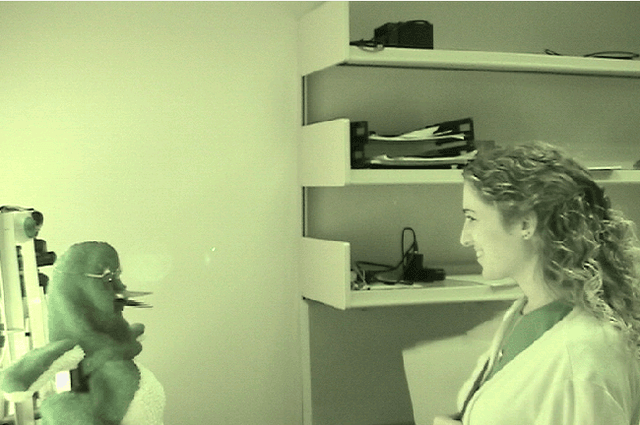


This paper explores the concept of engagement, the process by which individuals in an interaction start, maintain and end their perceived connection to one another. The paper reports on one aspect of engagement among human interactors--the effect of tracking faces during an interaction. It also describes the architecture of a robot that can participate in conversational, collaborative interactions with engagement gestures. Finally, the paper reports on findings of experiments with human participants who interacted with a robot when it either performed or did not perform engagement gestures. Results of the human-robot studies indicate that people become engaged with robots: they direct their attention to the robot more often in interactions where engagement gestures are present, and they find interactions more appropriate when engagement gestures are present than when they are not.
* 31 pages, 5 figures, 3 tables