 Add to Chrome
 Add to Firefox
 Add to Edge
Identifiability Limits of Physics-Informed Inference for Spatial Stochastic Dynamics from Static Snapshots
Jul 02, 2026
Despite increasing scale and resolution, many biological measurements remain destructive, revealing only spatial information rather than the dynamics it encodes. By combining flexible representations with mechanistic constraints, physics-informed machine learning offers a promising route to inferring these dynamics from static snapshots. Motivated by subcellular imaging of gene expression, we ask when a static spatial pattern of molecules can identify spatially varying diffusivity, creation, destruction, and boundary exchange, and how different inference schemes perform on the task. A structural identifiability analysis shows that distributed sources are non-identifiable, whereas a point source such as a transcription site can restore identifiability. These limits are further shaped by seemingly innocuous modeling choices: the boundary conditions, the spatial regularity of the underlying dynamics, and even the stochastic calculus convention. We then adapt several physics-informed schemes, differing in how they represent the solution and enforce the governing equations, and demonstrate effective inference from a single snapshot. Physics-informed approaches can thus recover spatial heterogeneities of biological dynamics from static data, but their use should be accompanied and guided by careful identifiability analysis for meaningful interpretation of the results.

Dynamical mixture modeling with fast, automatic determination of Markov chains
Jun 07, 2024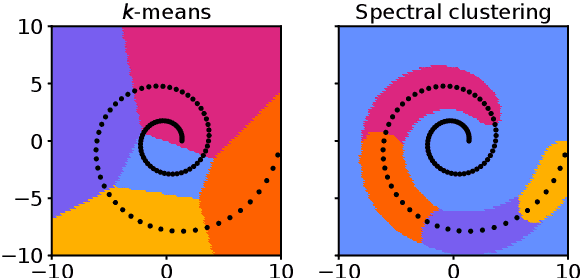
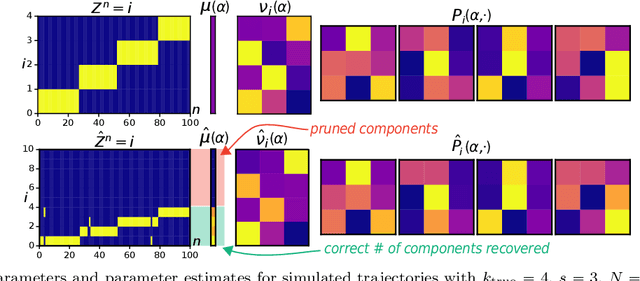
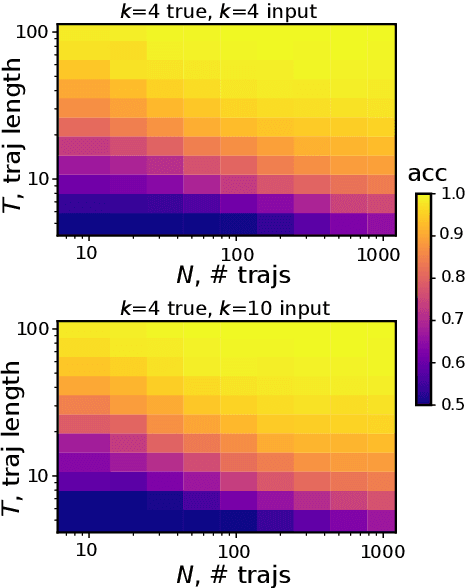
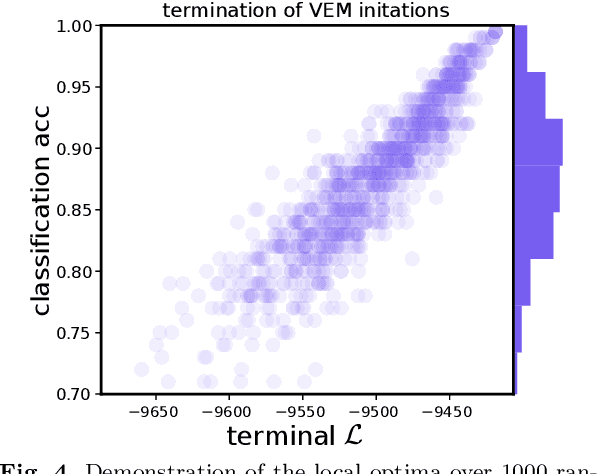
Markov state modeling has gained popularity in various scientific fields due to its ability to reduce complex time series data into transitions between a few states. Yet, current frameworks are limited by assuming a single Markov chain describes the data, and they suffer an inability to discern heterogeneities. As a solution, this paper proposes a variational expectation-maximization algorithm that identifies a mixture of Markov chains in a time-series data set. The method is agnostic to the definition of the Markov states, whether data-driven (e.g. by spectral clustering) or based on domain knowledge. Variational EM efficiently and organically identifies the number of Markov chains and dynamics of each chain without expensive model comparisons or posterior sampling. The approach is supported by a theoretical analysis and numerical experiments, including simulated and observational data sets based on ${\tt Last.fm}$ music listening, ultramarathon running, and gene expression. The results show the new algorithm is competitive with contemporary mixture modeling approaches and powerful in identifying meaningful heterogeneities in time series data.