 Add to Chrome
 Add to Firefox
 Add to Edge
Adapting Vision Transformers to Ultra-High Resolution Semantic Segmentation with Relay Tokens
Jan 09, 2026
Current approaches for segmenting ultra high resolution images either slide a window, thereby discarding global context, or downsample and lose fine detail. We propose a simple yet effective method that brings explicit multi scale reasoning to vision transformers, simultaneously preserving local details and global awareness. Concretely, we process each image in parallel at a local scale (high resolution, small crops) and a global scale (low resolution, large crops), and aggregate and propagate features between the two branches with a small set of learnable relay tokens. The design plugs directly into standard transformer backbones (eg ViT and Swin) and adds fewer than 2 % parameters. Extensive experiments on three ultra high resolution segmentation benchmarks, Archaeoscape, URUR, and Gleason, and on the conventional Cityscapes dataset show consistent gains, with up to 15 % relative mIoU improvement. Code and pretrained models are available at https://archaeoscape.ai/work/relay-tokens/ .

Archaeoscape: Bringing Aerial Laser Scanning Archaeology to the Deep Learning Era
Dec 06, 2024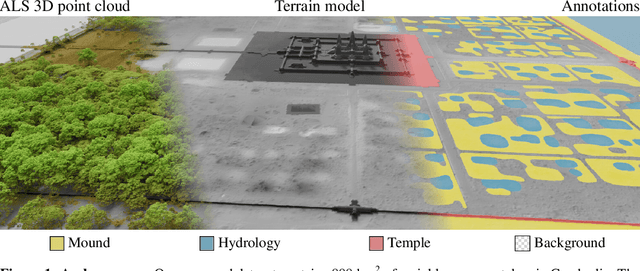
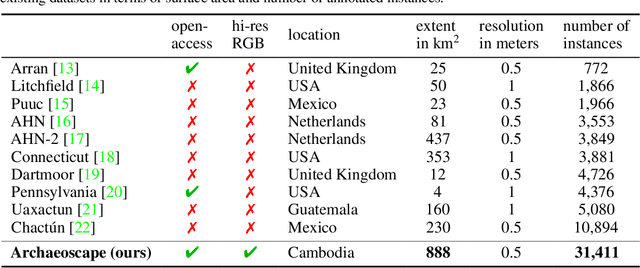
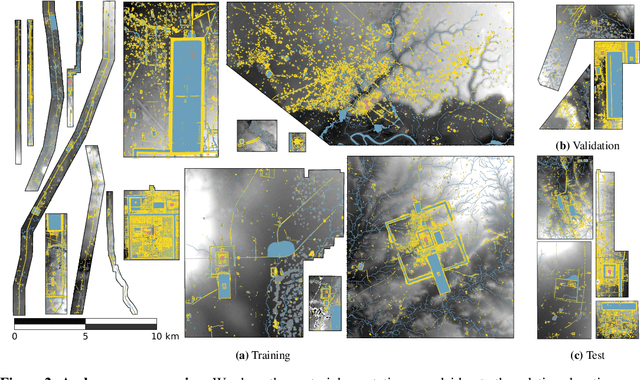
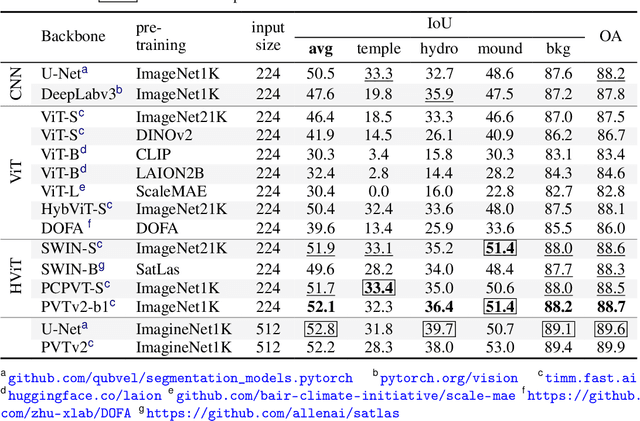
Airborne Laser Scanning (ALS) technology has transformed modern archaeology by unveiling hidden landscapes beneath dense vegetation. However, the lack of expert-annotated, open-access resources has hindered the analysis of ALS data using advanced deep learning techniques. We address this limitation with Archaeoscape (available at https://archaeoscape.ai), a novel large-scale archaeological ALS dataset spanning 888 km$^2$ in Cambodia with 31,141 annotated archaeological features from the Angkorian period. Archaeoscape is over four times larger than comparable datasets, and the first ALS archaeology resource with open-access data, annotations, and models. We benchmark several recent segmentation models to demonstrate the benefits of modern vision techniques for this problem and highlight the unique challenges of discovering subtle human-made structures under dense jungle canopies. By making Archaeoscape available in open access, we hope to bridge the gap between traditional archaeology and modern computer vision methods.