 Add to Chrome
 Add to Firefox
 Add to Edge
Characterizing AlphaEarth Embedding Geometry for Agentic Environmental Reasoning
Apr 20, 2026
Earth observation foundation models encode land surface information into dense embedding vectors, yet the geometric structure of these representations and its implications for downstream reasoning remain underexplored. We characterize the manifold geometry of Google AlphaEarth's 64-dimensional embeddings across 12.1 million Continental United States samples (2017--2023) and develop an agentic system that leverages this geometric understanding for environmental reasoning. The manifold is non-Euclidean: effective dimensionality is 13.3 (participation ratio) from 64 raw dimensions, with local intrinsic dimensionality of approximately 10. Tangent spaces rotate substantially, with 84\% of locations exceeding 60\textdegree{} and local-global alignment (mean$|\cosθ| = 0.17$) approaching the random baseline of 0.125. Supervised linear probes indicate that concept directions rotate across the manifold, and compositional vector arithmetic using both PCA-derived and probe-derived directions yields poor precision. Retrieval instead produces physically coherent results, with local geometry predicting retrieval coherence ($R^2 = 0.32$). Building on this characterization, we introduce an agentic system with nine specialized tools that decomposes environmental queries into reasoning chains over a FAISS-indexed embedding database. A five-condition ablation (120 queries, three complexity tiers) shows that embedding retrieval dominates response quality ($μ= 3.79 \pm 0.90$ vs.\ $3.03 \pm 0.77$ parametric-only; scale 1--5), with peak performance on multi-step comparisons ($μ= 4.28 \pm 0.43$). A cross-model benchmark show that geometric tools reduce Sonnet 4.5's score by 0.12 points but improve Opus 4.6's by 0.07, with Opus achieving higher geometric grounding (3.38 vs.\ 2.64), suggesting that the value of geometric characterization scales with the reasoning capability of the consuming model.

Towards an Open Global Air Quality Monitoring Platform to Assess Children's Exposure to Air Pollutants in the Light of COVID-19 Lockdowns
Mar 17, 2021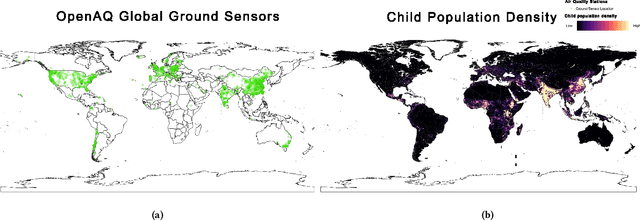
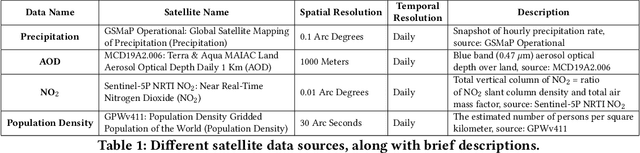
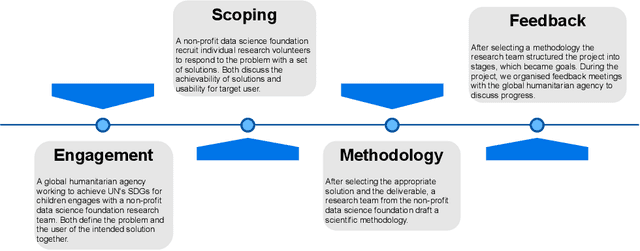
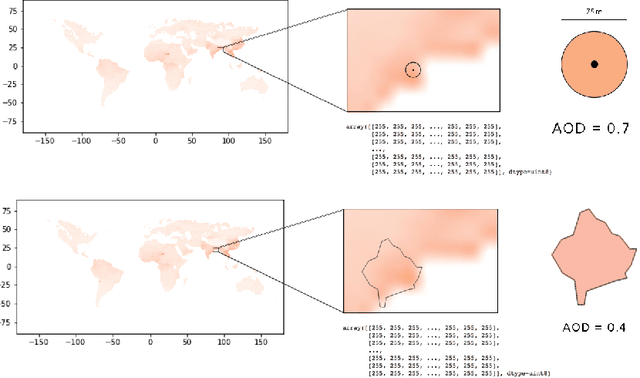
This ongoing work attempts to understand and address the requirements of UNICEF, a leading organization working in children's welfare, where they aim to tackle the problem of air quality for children at a global level. We are motivated by the lack of a proper model to account for heavily fluctuating air quality levels across the world in the wake of the COVID-19 pandemic, leading to uncertainty among public health professionals on the exact levels of children's exposure to air pollutants. We create an initial model as per the agency's requirement to generate insights through a combination of virtual meetups and online presentations. Our research team comprised of UNICEF's researchers and a group of volunteer data scientists. The presentations were delivered to a number of scientists and domain experts from UNICEF and community champions working with open data. We highlight their feedback and possible avenues to develop this research further.