 Add to Chrome
 Add to Firefox
 Add to Edge
ROS 2-Based LiDAR Perception Framework for Mobile Robots in Dynamic Production Environments, Utilizing Synthetic Data Generation, Transformation-Equivariant 3D Detection and Multi-Object Tracking
Apr 02, 2026
Adaptive robots in dynamic production environments require robust perception capabilities, including 6D pose estimation and multi-object tracking. To address limitations in real-world data dependency, noise robustness, and spatiotemporal consistency, a LiDAR framework based on the Robot Operating System integrating a synthetic-data-trained Transformation-Equivariant 3D Detection with multi-object-tracking leveraging center poses is proposed. Validated across 72 scenarios with motion capture technology, overall results yield an Intersection over Union of 62.6% for standalone pose estimation, rising to 83.12% with multi-object-tracking integration. Our LiDAR-based framework achieves 91.12% of Higher Order Tracking Accuracy, advancing robustness and versatility of LiDAR-based perception systems for industrial mobile manipulators.

Analysis of Truncated Singular Value Decomposition for Koopman Operator-Based Lane Change Model
Sep 27, 2024Understanding and modeling complex dynamic systems is crucial for enhancing vehicle performance and safety, especially in the context of autonomous driving. Recently, popular methods such as Koopman operators and their approximators, known as Extended Dynamic Mode Decomposition (EDMD), have emerged for their effectiveness in transforming strongly nonlinear system behavior into linear representations. This allows them to be integrated with conventional linear controllers. To achieve this, Singular Value Decomposition (SVD), specifically truncated SVD, is employed to approximate Koopman operators from extensive datasets efficiently. This study evaluates different basis functions used in EDMD and ranks for truncated SVD for representing lane change behavior models, aiming to balance computational efficiency with information loss. The findings, however, suggest that the technique of truncated SVD does not necessarily achieve substantial reductions in computational training time and results in significant information loss.
Unscented Transform-based Pure Pursuit Path-Tracking Algorithm under Uncertainty
Sep 27, 2024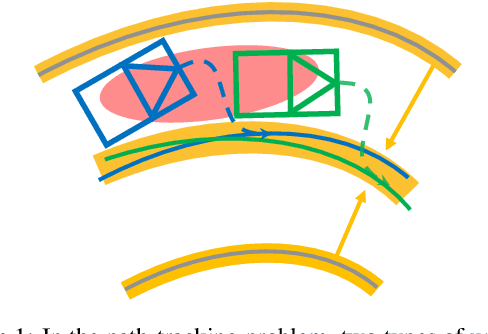

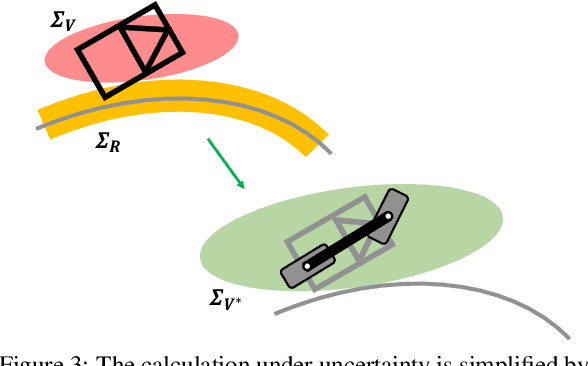

Automated driving has become more and more popular due to its potential to eliminate road accidents by taking over driving tasks from humans. One of the remaining challenges is to follow a planned path autonomously, especially when uncertainties in self-localizing or understanding the surroundings can influence the decisions made by autonomous vehicles, such as calculating how much they need to steer to minimize tracking errors. In this paper, a modified geometric pure pursuit path-tracking algorithm is proposed, taking into consideration such uncertainties using the unscented transform. The algorithm is tested through simulations for typical road geometries, such as straight and circular lines.