 Add to Chrome
 Add to Firefox
 Add to Edge
R2RAG-Flood: A reasoning-reinforced training-free retrieval augmentation generation framework for flood damage nowcasting
Feb 10, 2026
R2RAG-Flood is a reasoning-reinforced, training-free retrieval-augmented generation framework for post-storm property damage nowcasting. Building on an existing supervised tabular predictor, the framework constructs a reasoning-centric knowledge base composed of labeled tabular records, where each sample includes structured predictors, a compact natural language text-mode summary, and a model-generated reasoning trajectory. During inference, R2RAG-Flood issues context-augmented prompts that retrieve and condition on relevant reasoning trajectories from nearby geospatial neighbors and canonical class prototypes, enabling the large language model backbone to emulate and adapt prior reasoning rather than learn new task-specific parameters. Predictions follow a two-stage procedure that first determines property damage occurrence and then refines severity within a three-level Property Damage Extent categorization, with a conditional downgrade step to correct over-predicted severity. In a case study of Harris County, Texas at the 12-digit Hydrologic Unit Code scale, the supervised tabular baseline trained directly on structured predictors achieves 0.714 overall accuracy and 0.859 damage class accuracy for medium and high damage classes. Across seven large language model backbones, R2RAG-Flood attains 0.613 to 0.668 overall accuracy and 0.757 to 0.896 damage class accuracy, approaching the supervised baseline while additionally producing a structured rationale for each prediction. Using a severity-per-cost efficiency metric derived from API pricing and GPU instance costs, lightweight R2RAG-Flood variants demonstrate substantially higher efficiency than both the supervised tabular baseline and larger language models, while requiring no task-specific training or fine-tuning.

FloodDamageCast: Building Flood Damage Nowcasting with Machine Learning and Data Augmentation
May 23, 2024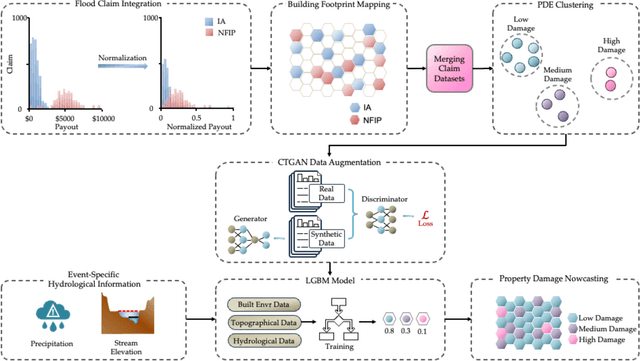
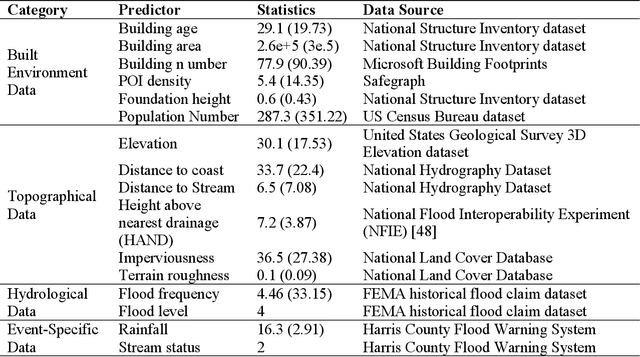
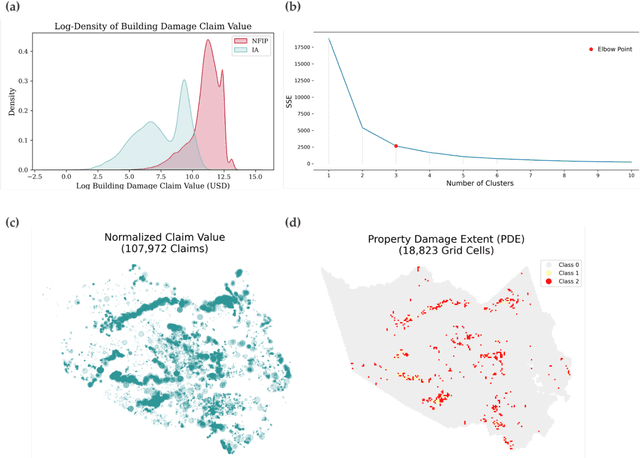

Near-real time estimation of damage to buildings and infrastructure, referred to as damage nowcasting in this study, is crucial for empowering emergency responders to make informed decisions regarding evacuation orders and infrastructure repair priorities during disaster response and recovery. Here, we introduce FloodDamageCast, a machine learning framework tailored for property flood damage nowcasting. The framework leverages heterogeneous data to predict residential flood damage at a resolution of 500 meters by 500 meters within Harris County, Texas, during the 2017 Hurricane Harvey. To deal with data imbalance, FloodDamageCast incorporates a generative adversarial networks-based data augmentation coupled with an efficient machine learning model. The results demonstrate the model's ability to identify high-damage spatial areas that would be overlooked by baseline models. Insights gleaned from flood damage nowcasting can assist emergency responders to more efficiently identify repair needs, allocate resources, and streamline on-the-ground inspections, thereby saving both time and effort.